
The pH scale is your key to understanding how acidic...
 Science5 προβολές·Ενημερώθηκε Jun 16, 2026·5 σελίδες
The Ultimate Guide to the pH Scale
1 / 5
1
of 5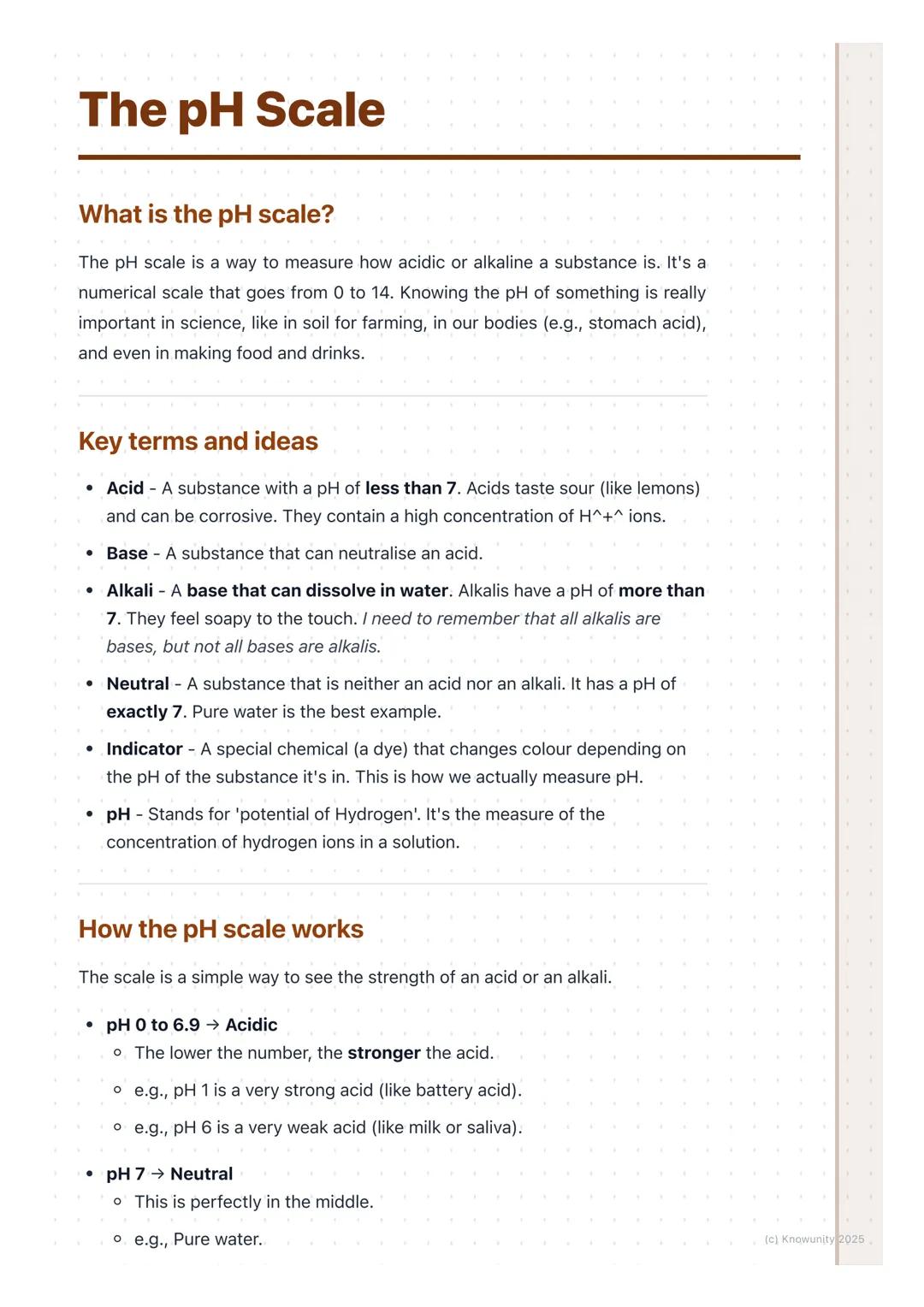
Understanding the pH Scale Basics
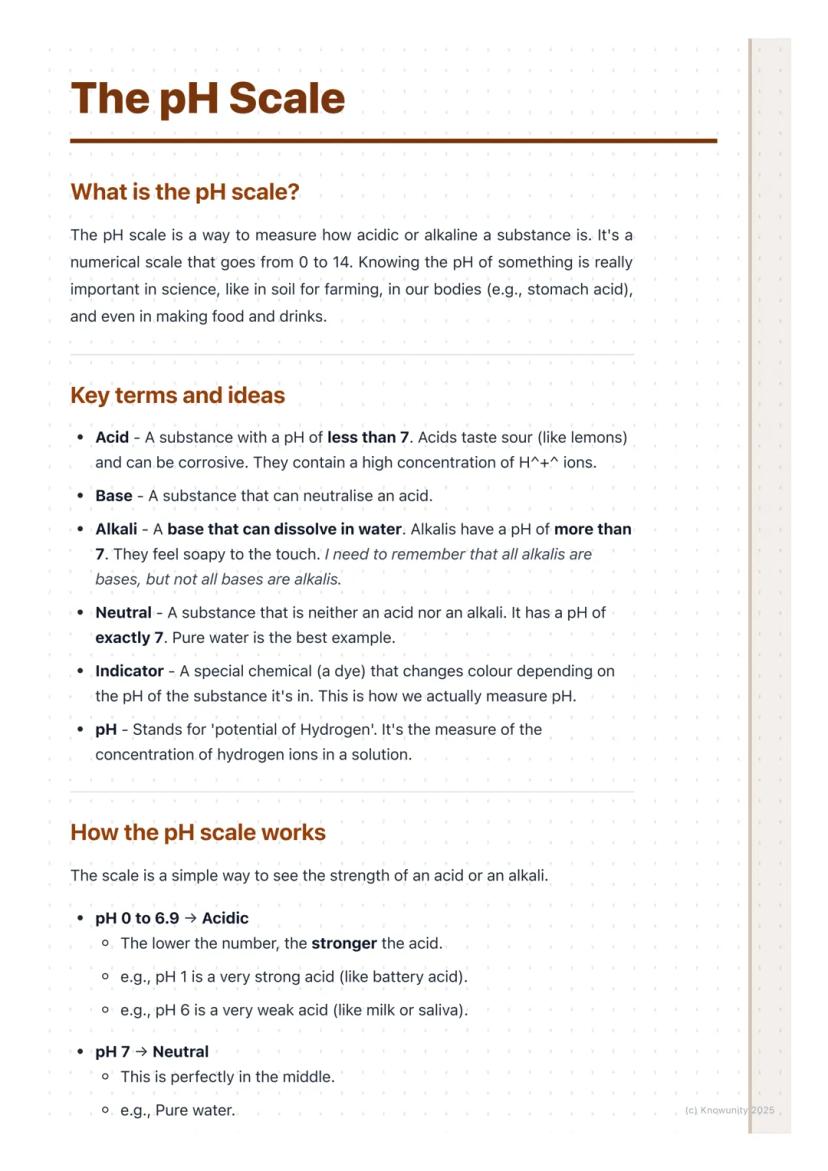
Ever wondered why lemons taste so sour or why soap feels slippery? It's all about pH - which stands for 'potential of Hydrogen' and measures how acidic or alkaline something is.
The pH scale runs from 0 to 14, and it's dead simple once you know the rules. Acids have a pH less than 7 and taste sour (think vinegar or citrus fruits), whilst alkalis have a pH greater than 7 and feel soapy to touch. Right in the middle at pH 7 is neutral - like pure water.
Here's what makes this tricky: the scale is logarithmic. This means each whole number represents a 10-times change in strength. So battery acid at pH 1 isn't just a bit stronger than lemon juice at pH 2 - it's actually 10 times stronger!
Key Insight: All alkalis are bases, but not all bases are alkalis. Alkalis are simply bases that can dissolve in water.
2
of 5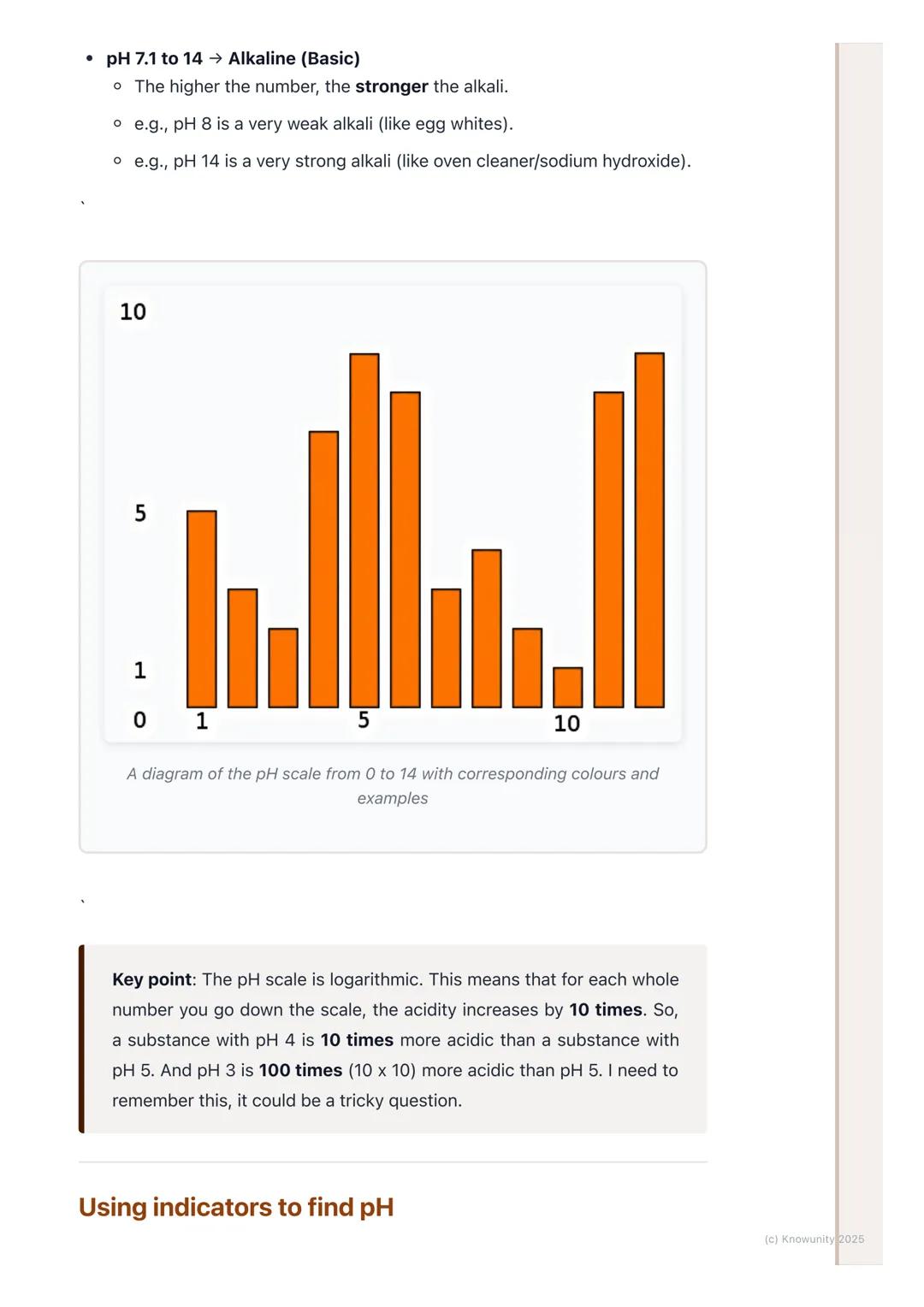
How Strong is Strong?
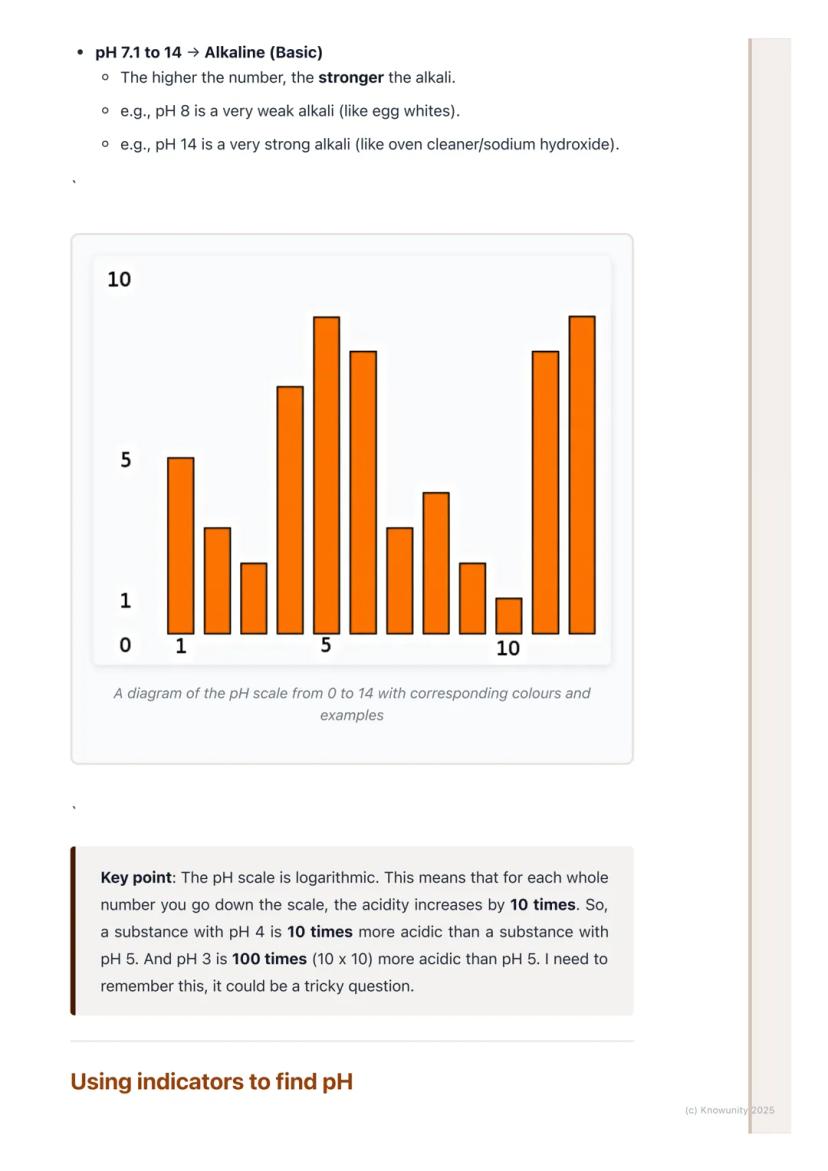
The pH scale breaks down into three clear zones that you need to master. Acidic substances get stronger as the numbers get smaller - so pH 1 battery acid will definitely ruin your day more than pH 6 milk will.
At exactly pH 7, you've got neutral territory. Pure water sits here perfectly balanced, neither acidic nor alkaline. It's your reference point for everything else.
Alkaline substances work the opposite way - higher numbers mean stronger alkalis. pH 8 egg whites are pretty mild, but pH 14 oven cleaner is seriously dangerous stuff that'll burn through skin.
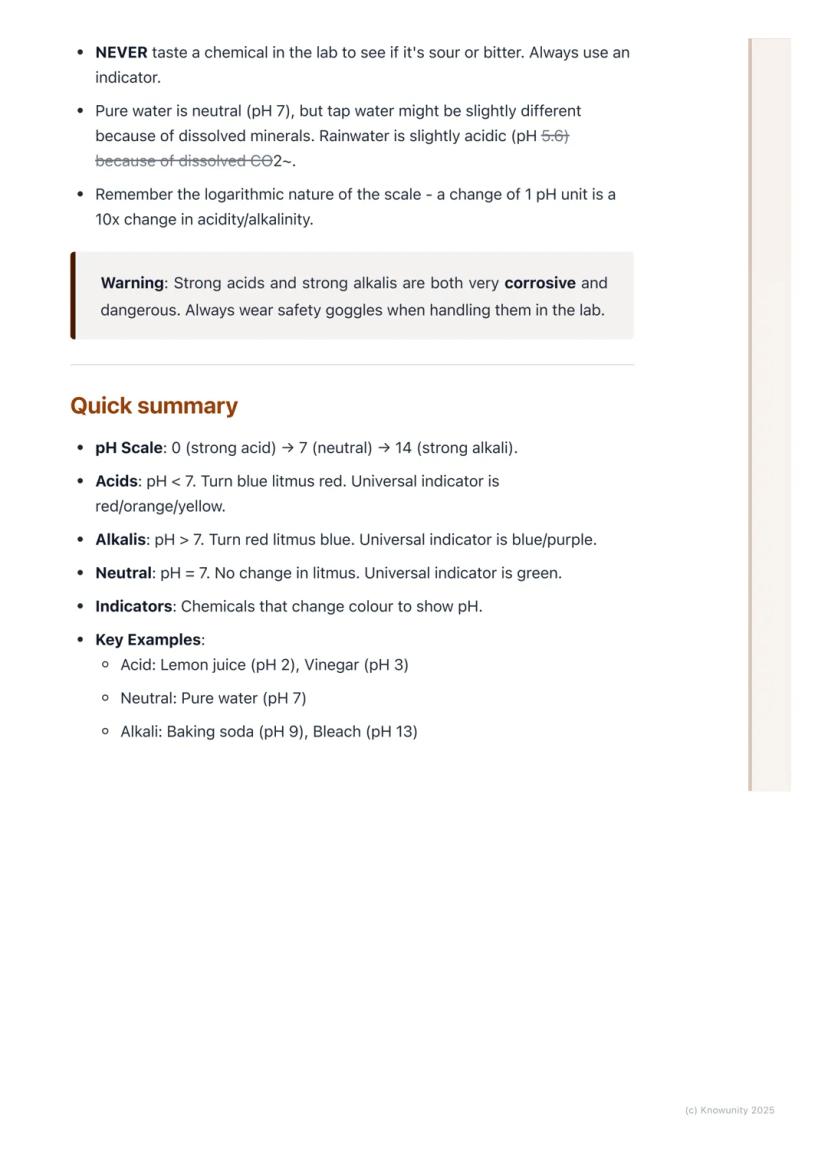
Remember This: Each step down the pH scale means 10 times more acidic. So pH 3 is 100 times more acidic than pH 5!
3
of 5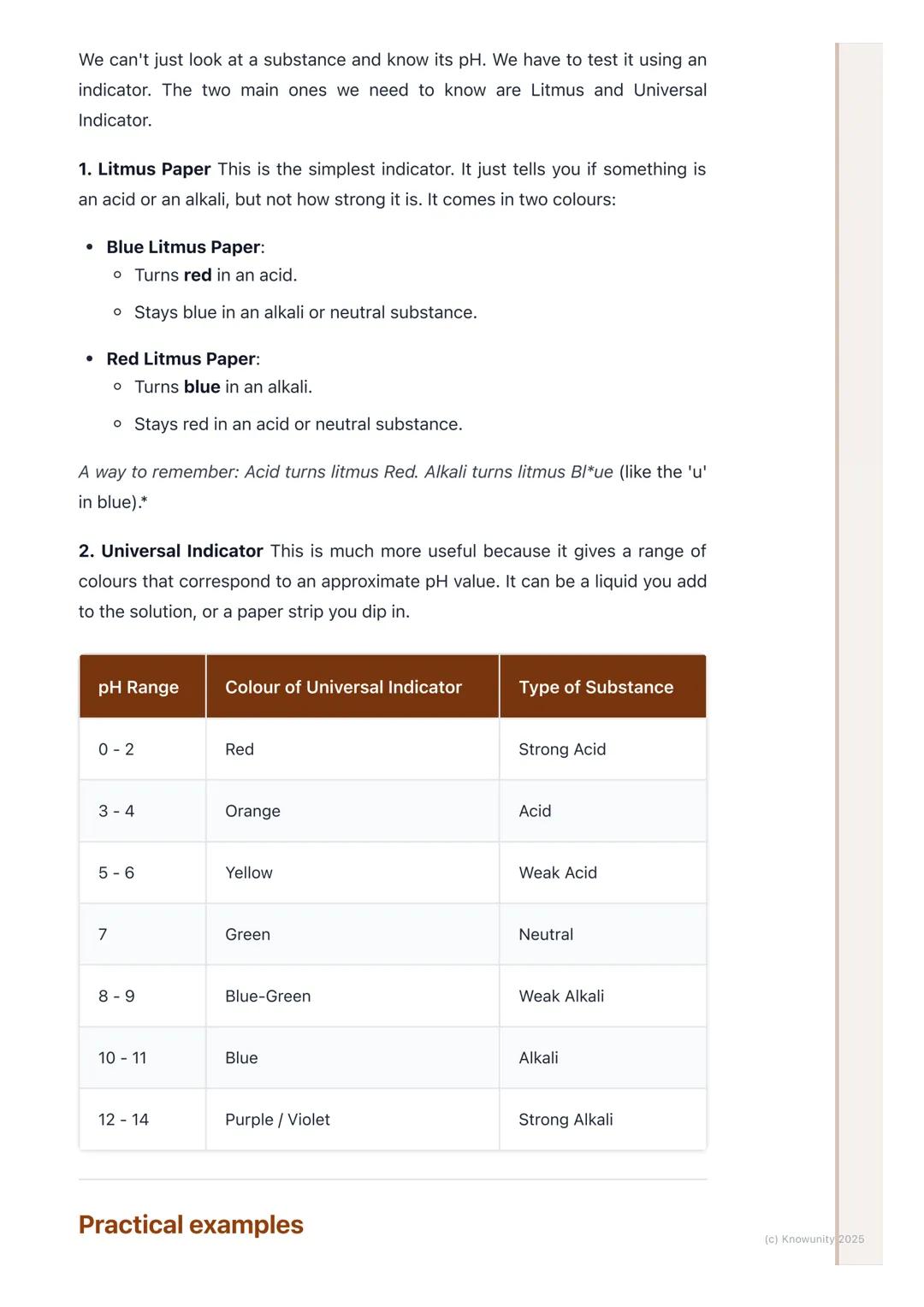
Testing pH with Indicators
You can't just eyeball a substance and guess its pH - you need indicators, which are special chemicals that change colour based on acidity. There are two main types you'll use in the lab.
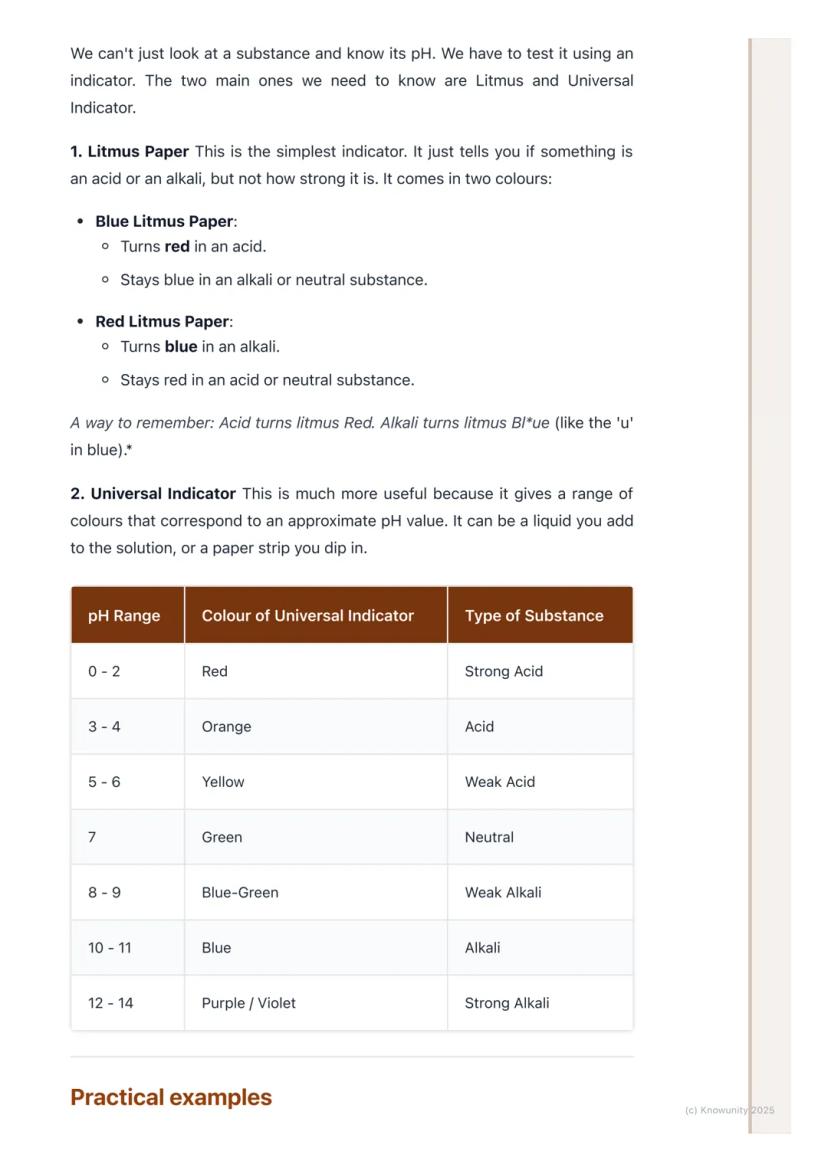
Litmus paper is the simple option that just tells you acid or alkali. Blue litmus turns red in acid (remember: "Acid turns litmus Red"), whilst red litmus turns blue in alkalis. It's handy for quick tests but won't tell you how strong the acid or alkali is.
Universal indicator is where things get interesting. This clever chemical gives you a rainbow of colours that match specific pH ranges. Red means strong acid , orange and yellow show weaker acids, green is neutral, and blue through to purple indicates increasingly strong alkalis.
Lab Tip: Universal indicator comes as both liquid drops and test strips - both work the same way and give you an actual pH reading.
4
of 5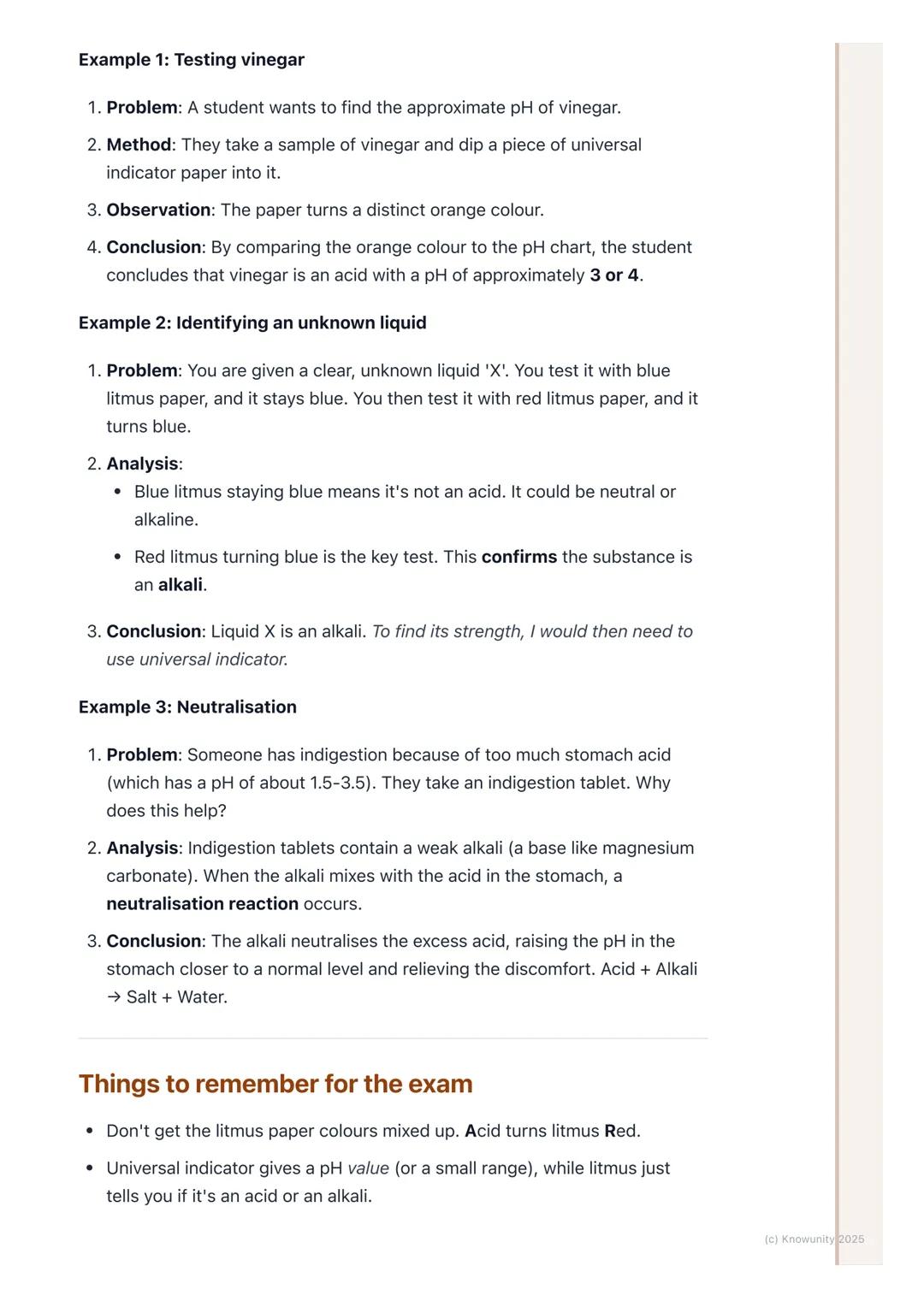
Real-World pH Examples
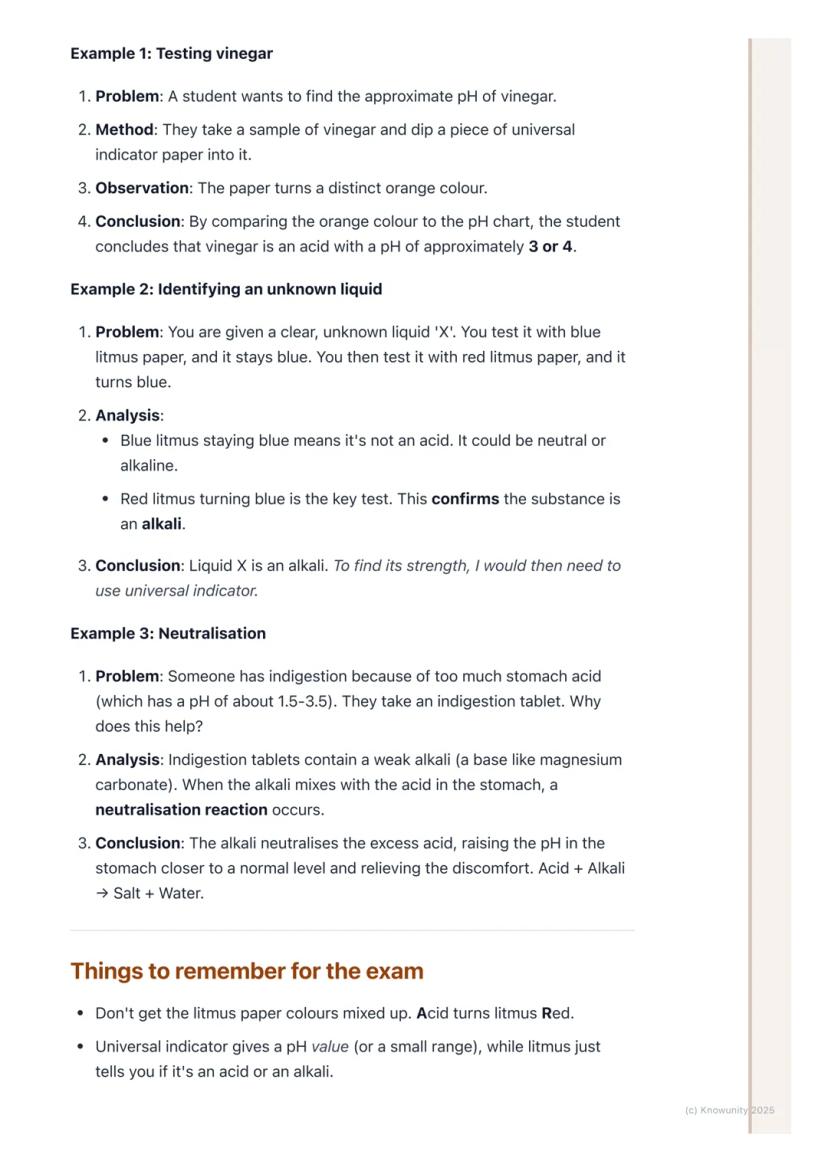
Let's say you're testing household vinegar with universal indicator paper. Dip it in, and you'll see it turn orange, telling you the vinegar is acidic with a pH around 3-4. That's exactly what you'd expect from something that tastes so sour!
Here's a trickier scenario: you've got an unknown clear liquid that keeps blue litmus blue but turns red litmus blue. The first test rules out acid (since blue litmus didn't change), and the second test confirms it's definitely alkaline. You'd need universal indicator to find out exactly how strong.
Neutralisation happens everywhere in real life. When you take an antacid for heartburn, you're adding a mild alkali to neutralise excess stomach acid. The reaction brings your stomach pH back closer to normal, which stops the burning sensation.
Safety First: Never taste chemicals to test if they're acidic! Always use indicators - your tongue isn't worth the risk.
5
of 5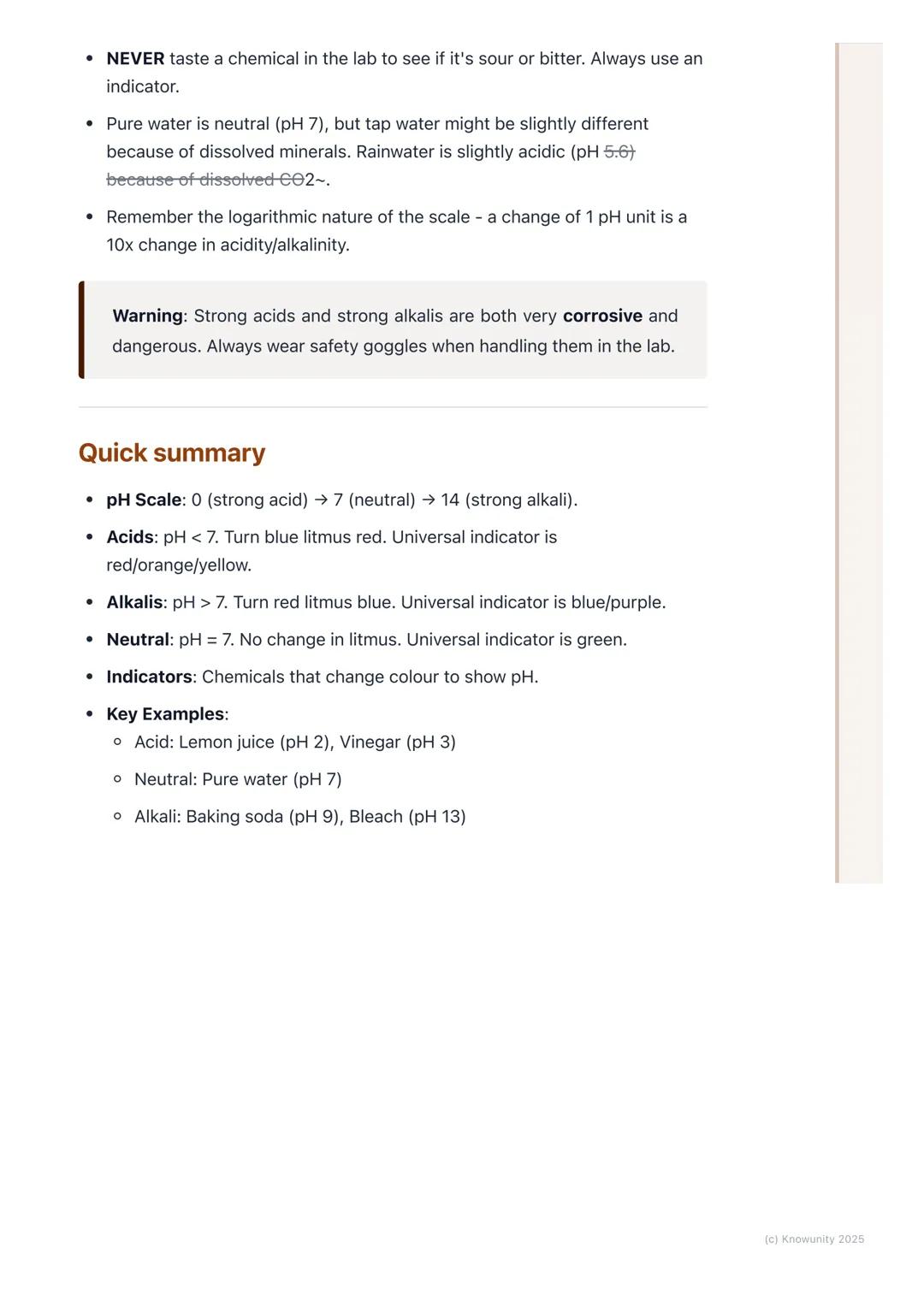
Key Points for Success
Remember that pure water is neutral at pH 7, but tap water might be slightly different due to dissolved minerals. Rainwater is actually slightly acidic (pH 5.6) because it picks up carbon dioxide from the atmosphere.
For your exams, focus on the indicator colour changes: acids turn blue litmus red and make universal indicator red/orange/yellow, whilst alkalis turn red litmus blue and make universal indicator blue/purple. Neutral substances keep blue litmus blue, leave red litmus red, and turn universal indicator green.
The most common mistake? Mixing up litmus colours. Just remember the simple rule: acid makes litmus red, alkali makes litmus blue. Strong acids and alkalis are both corrosive and dangerous - always wear safety goggles when handling them.
Exam Success: Know your examples! Lemon juice (pH 2), vinegar (pH 3), pure water (pH 7), baking soda (pH 9), and household bleach (pH 13).
Νομίζαμε ότι δε θα ρωτούσες ποτέ...
Τι είναι ο AI σύντροφος του Knowunity;
Ο AI σύντροφός μας είναι ειδικά σχεδιασμένος για τις ανάγκες των μαθητών. Βασισμένοι στα εκατομμύρια κομμάτια Περιεχομένων που έχουμε στην πλατφόρμα, μπορούμε να παρέχουμε πραγματικά ουσιαστικές και σχετικές απαντήσεις στους μαθητές. Αλλά δεν αφορά μόνο τις απαντήσεις, ο σύντροφος είναι ακόμη περισσότερο για την καθοδήγηση των μαθητών στις καθημερινές τους μαθησιακές προκλήσεις, με εξατομικευμένα προγράμματα μελέτης, κουίζ ή Περιεχόμενα στη Συνομιλία και 100% εξατομίκευση βασισμένη στις δεξιότητες και την ανάπτυξη των μαθητών.
Πού μπορώ να κατεβάσω την εφαρμογή Knowunity;
Μπορείτε να κατεβάσετε την εφαρμογή από το Google Play Store και το Apple App Store.
Πώς μπορώ να λάβω την πληρωμή μου; Πόσα μπορώ να κερδίσω;
Ναι, έχετε δωρεάν πρόσβαση στο περιεχόμενο της εφαρμογής και στον AI companion μας. Για να ξεκλειδώσετε ορισμένες λειτουργίες της εφαρμογής, μπορείτε να αγοράσετε το Knowunity Pro.
Πιο δημοφιλή περιεχόμενα στο Science
7ScienceScience/Physics notes - Speed, density, work
Speed density work formulas
3rd Year81
ScienceAtomic Structure and the Periodic Table
Students will learn about the structure of atoms, including protons, neutrons, and electrons, and how elements are organised and classified in the Periodic Table based on their electronic configuration and chemical properties.
5th Year41
ScienceHuman Body Systems
An introduction to major human body systems such as the digestive, circulatory, respiratory, and nervous systems, understanding their basic functions.
2nd Year131
ScienceJunior Cert Science Notes: The Cell
Notes on the Cell
3rd Year261
ScienceCells
Junior cert science cells summary
1st Year611
ScienceHuman Reproductive System
A basic overview of the male and female reproductive systems, including their main structures and functions.
TY191
ScienceLight and Optics
Exploring the properties of light, including how it travels, reflects, and refracts, and how we perceive colours.
2nd Year50
Πιο δημοφιλή περιεχόμενα
9 Irish
IrishIrish oral questions and answers
Questions and answers for the leaving cert oral
5th Year4264
 English
Key Quotes : Sive
Key Quotes and explanations: Sive
6th Year2842
IrishIrish oral questions
Outline of oral questions
5th Year2055
IrishIníon- le hÁine Durkin
Aine Durkin’s poem, Iníon: Themes & summary
5th Year850
IrishIrish poetry 2027
Iníon + Dínit an Bhróin
5th Year1133
IrishLC HL notes- Iníon (poem)
Includes poem in English and Irish, theme, key words & phrases
5th Year2284
EnglishCultural Context : Shawshank Redemption : Sive : Small Things Like These
Comparative Study : Cultural Context : Shawshank Redemption, Sive and Small Things Like These
6th Year1430
IrishMo Ghrá-sa (Idir Lúibíní)
Notes on mo ghrá-sa
5th Year380
IrishAn Gaeilge Aiste
Irish Language essay
6th Year1320
Δε μπορείς να βρεις αυτό που ψάχνεις; Εξερεύνησε άλλα μαθήματα.
Κριτικές από τους χρήστες μας. Έχουν όλα τα καλά — και το ίδιο θα είχες κι εσύ.
4.6/5App Store
4.7/5Google Play
Η εφαρμογή είναι πολύ εύκολη στη χρήση και καλά σχεδιασμένη. Έχω βρει ό,τι έψαχνα μέχρι τώρα και έχω μάθει πολλά από τις παρουσιάσεις! Σίγουρα θα χρησιμοποιήσω την εφαρμογή για μια εργασία του μαθήματος! Και φυσικά βοηθάει πολύ και ως έμπνευση.
Στέφαν Σχρήστης iOS
Αυτή η εφαρμογή είναι πραγματικά τέλεια. Υπάρχουν τόσες πολλές σημειώσεις μελέτης και βοήθεια [...]. Το μάθημα που με δυσκολεύει είναι τα Γαλλικά, για παράδειγμα, και η εφαρμογή έχει τόσες επιλογές για βοήθεια. Χάρη σε αυτή την εφαρμογή, έχω βελτιώσει τα Γαλλικά μου. Θα την πρότεινα σε οποιονδήποτε.
Σαμάνθα Κλιχχρήστης Android
Ουάου, είμαι πραγματικά εντυπωσιασμένος. Δοκίμασα την εφαρμογή επειδή την είδα διαφημισμένη πολλές φορές και έμεινα άφωνος. Αυτή η εφαρμογή είναι Η ΒΟΗΘΕΙΑ που χρειάζεσαι για το σχολείο και πάνω απ' όλα, προσφέρει τόσα πράγματα, όπως ασκήσεις και φύλλα γεγονότων, που ήταν ΠΟΛΥ χρήσιμα για μένα προσωπικά.
Άνναχρήστης iOS
Science5 προβολές·Ενημερώθηκε Jun 16, 2026·5 σελίδεςThe Ultimate Guide to the pH Scale
The pH scale is your key to understanding how acidic or alkaline substances are around you - from the lemon juice in your kitchen to the soap you wash with. It's a simple 0-14 scale that scientists use everywhere, and...
1
of 5
Κάνε εγγραφή για να δεις το ΠΕΡΙΕΧΟΜΕΝΟ. Είναι δωρεάν!
- Πρόσβαση σε όλα τα έγγραφα
- Βελτίωσε τους βαθμούς σου
- Γίνε μέλος με εκατομμύρια μαθητές
Understanding the pH Scale Basics
Ever wondered why lemons taste so sour or why soap feels slippery? It's all about pH - which stands for 'potential of Hydrogen' and measures how acidic or alkaline something is.
The pH scale runs from 0 to 14, and it's dead simple once you know the rules. Acids have a pH less than 7 and taste sour (think vinegar or citrus fruits), whilst alkalis have a pH greater than 7 and feel soapy to touch. Right in the middle at pH 7 is neutral - like pure water.
Here's what makes this tricky: the scale is logarithmic. This means each whole number represents a 10-times change in strength. So battery acid at pH 1 isn't just a bit stronger than lemon juice at pH 2 - it's actually 10 times stronger!
Key Insight: All alkalis are bases, but not all bases are alkalis. Alkalis are simply bases that can dissolve in water.
2
of 5Κάνε εγγραφή για να δεις το ΠΕΡΙΕΧΟΜΕΝΟ. Είναι δωρεάν!
- Πρόσβαση σε όλα τα έγγραφα
- Βελτίωσε τους βαθμούς σου
- Γίνε μέλος με εκατομμύρια μαθητές
How Strong is Strong?
The pH scale breaks down into three clear zones that you need to master. Acidic substances get stronger as the numbers get smaller - so pH 1 battery acid will definitely ruin your day more than pH 6 milk will.
At exactly pH 7, you've got neutral territory. Pure water sits here perfectly balanced, neither acidic nor alkaline. It's your reference point for everything else.
Alkaline substances work the opposite way - higher numbers mean stronger alkalis. pH 8 egg whites are pretty mild, but pH 14 oven cleaner is seriously dangerous stuff that'll burn through skin.
Remember This: Each step down the pH scale means 10 times more acidic. So pH 3 is 100 times more acidic than pH 5!
3
of 5Κάνε εγγραφή για να δεις το ΠΕΡΙΕΧΟΜΕΝΟ. Είναι δωρεάν!
- Πρόσβαση σε όλα τα έγγραφα
- Βελτίωσε τους βαθμούς σου
- Γίνε μέλος με εκατομμύρια μαθητές
Testing pH with Indicators
You can't just eyeball a substance and guess its pH - you need indicators, which are special chemicals that change colour based on acidity. There are two main types you'll use in the lab.
Litmus paper is the simple option that just tells you acid or alkali. Blue litmus turns red in acid (remember: "Acid turns litmus Red"), whilst red litmus turns blue in alkalis. It's handy for quick tests but won't tell you how strong the acid or alkali is.
Universal indicator is where things get interesting. This clever chemical gives you a rainbow of colours that match specific pH ranges. Red means strong acid , orange and yellow show weaker acids, green is neutral, and blue through to purple indicates increasingly strong alkalis.
Lab Tip: Universal indicator comes as both liquid drops and test strips - both work the same way and give you an actual pH reading.
4
of 5Κάνε εγγραφή για να δεις το ΠΕΡΙΕΧΟΜΕΝΟ. Είναι δωρεάν!
- Πρόσβαση σε όλα τα έγγραφα
- Βελτίωσε τους βαθμούς σου
- Γίνε μέλος με εκατομμύρια μαθητές
Real-World pH Examples
Let's say you're testing household vinegar with universal indicator paper. Dip it in, and you'll see it turn orange, telling you the vinegar is acidic with a pH around 3-4. That's exactly what you'd expect from something that tastes so sour!
Here's a trickier scenario: you've got an unknown clear liquid that keeps blue litmus blue but turns red litmus blue. The first test rules out acid (since blue litmus didn't change), and the second test confirms it's definitely alkaline. You'd need universal indicator to find out exactly how strong.
Neutralisation happens everywhere in real life. When you take an antacid for heartburn, you're adding a mild alkali to neutralise excess stomach acid. The reaction brings your stomach pH back closer to normal, which stops the burning sensation.
Safety First: Never taste chemicals to test if they're acidic! Always use indicators - your tongue isn't worth the risk.
5
of 5Κάνε εγγραφή για να δεις το ΠΕΡΙΕΧΟΜΕΝΟ. Είναι δωρεάν!
- Πρόσβαση σε όλα τα έγγραφα
- Βελτίωσε τους βαθμούς σου
- Γίνε μέλος με εκατομμύρια μαθητές
Key Points for Success
Remember that pure water is neutral at pH 7, but tap water might be slightly different due to dissolved minerals. Rainwater is actually slightly acidic (pH 5.6) because it picks up carbon dioxide from the atmosphere.
For your exams, focus on the indicator colour changes: acids turn blue litmus red and make universal indicator red/orange/yellow, whilst alkalis turn red litmus blue and make universal indicator blue/purple. Neutral substances keep blue litmus blue, leave red litmus red, and turn universal indicator green.
The most common mistake? Mixing up litmus colours. Just remember the simple rule: acid makes litmus red, alkali makes litmus blue. Strong acids and alkalis are both corrosive and dangerous - always wear safety goggles when handling them.
Exam Success: Know your examples! Lemon juice (pH 2), vinegar (pH 3), pure water (pH 7), baking soda (pH 9), and household bleach (pH 13).
Νομίζαμε ότι δε θα ρωτούσες ποτέ...
Τι είναι ο AI σύντροφος του Knowunity;
Ο AI σύντροφός μας είναι ειδικά σχεδιασμένος για τις ανάγκες των μαθητών. Βασισμένοι στα εκατομμύρια κομμάτια Περιεχομένων που έχουμε στην πλατφόρμα, μπορούμε να παρέχουμε πραγματικά ουσιαστικές και σχετικές απαντήσεις στους μαθητές. Αλλά δεν αφορά μόνο τις απαντήσεις, ο σύντροφος είναι ακόμη περισσότερο για την καθοδήγηση των μαθητών στις καθημερινές τους μαθησιακές προκλήσεις, με εξατομικευμένα προγράμματα μελέτης, κουίζ ή Περιεχόμενα στη Συνομιλία και 100% εξατομίκευση βασισμένη στις δεξιότητες και την ανάπτυξη των μαθητών.
Πού μπορώ να κατεβάσω την εφαρμογή Knowunity;
Μπορείτε να κατεβάσετε την εφαρμογή από το Google Play Store και το Apple App Store.
Πώς μπορώ να λάβω την πληρωμή μου; Πόσα μπορώ να κερδίσω;
Ναι, έχετε δωρεάν πρόσβαση στο περιεχόμενο της εφαρμογής και στον AI companion μας. Για να ξεκλειδώσετε ορισμένες λειτουργίες της εφαρμογής, μπορείτε να αγοράσετε το Knowunity Pro.
Πιο δημοφιλή περιεχόμενα στο Science
7ScienceScience/Physics notes - Speed, density, work
Speed density work formulas
3rd Year81
ScienceAtomic Structure and the Periodic Table
Students will learn about the structure of atoms, including protons, neutrons, and electrons, and how elements are organised and classified in the Periodic Table based on their electronic configuration and chemical properties.
5th Year41
ScienceHuman Body Systems
An introduction to major human body systems such as the digestive, circulatory, respiratory, and nervous systems, understanding their basic functions.
2nd Year131
ScienceJunior Cert Science Notes: The Cell
Notes on the Cell
3rd Year261
ScienceCells
Junior cert science cells summary
1st Year611
ScienceHuman Reproductive System
A basic overview of the male and female reproductive systems, including their main structures and functions.
TY191
ScienceLight and Optics
Exploring the properties of light, including how it travels, reflects, and refracts, and how we perceive colours.
2nd Year50
Πιο δημοφιλή περιεχόμενα
9IrishIrish oral questions and answers
Questions and answers for the leaving cert oral
5th Year4264
EnglishKey Quotes : Sive
Key Quotes and explanations: Sive
6th Year2842
IrishIrish oral questions
Outline of oral questions
5th Year2055
IrishIníon- le hÁine Durkin
Aine Durkin’s poem, Iníon: Themes & summary
5th Year850
IrishIrish poetry 2027
Iníon + Dínit an Bhróin
5th Year1133
IrishLC HL notes- Iníon (poem)
Includes poem in English and Irish, theme, key words & phrases
5th Year2284
EnglishCultural Context : Shawshank Redemption : Sive : Small Things Like These
Comparative Study : Cultural Context : Shawshank Redemption, Sive and Small Things Like These
6th Year1430
IrishMo Ghrá-sa (Idir Lúibíní)
Notes on mo ghrá-sa
5th Year380
IrishAn Gaeilge Aiste
Irish Language essay
6th Year1320
Δε μπορείς να βρεις αυτό που ψάχνεις; Εξερεύνησε άλλα μαθήματα.
Κριτικές από τους χρήστες μας. Έχουν όλα τα καλά — και το ίδιο θα είχες κι εσύ.
4.6/5App Store
4.7/5Google Play
Η εφαρμογή είναι πολύ εύκολη στη χρήση και καλά σχεδιασμένη. Έχω βρει ό,τι έψαχνα μέχρι τώρα και έχω μάθει πολλά από τις παρουσιάσεις! Σίγουρα θα χρησιμοποιήσω την εφαρμογή για μια εργασία του μαθήματος! Και φυσικά βοηθάει πολύ και ως έμπνευση.
Στέφαν Σχρήστης iOS
Αυτή η εφαρμογή είναι πραγματικά τέλεια. Υπάρχουν τόσες πολλές σημειώσεις μελέτης και βοήθεια [...]. Το μάθημα που με δυσκολεύει είναι τα Γαλλικά, για παράδειγμα, και η εφαρμογή έχει τόσες επιλογές για βοήθεια. Χάρη σε αυτή την εφαρμογή, έχω βελτιώσει τα Γαλλικά μου. Θα την πρότεινα σε οποιονδήποτε.
Σαμάνθα Κλιχχρήστης Android
Ουάου, είμαι πραγματικά εντυπωσιασμένος. Δοκίμασα την εφαρμογή επειδή την είδα διαφημισμένη πολλές φορές και έμεινα άφωνος. Αυτή η εφαρμογή είναι Η ΒΟΗΘΕΙΑ που χρειάζεσαι για το σχολείο και πάνω απ' όλα, προσφέρει τόσα πράγματα, όπως ασκήσεις και φύλλα γεγονότων, που ήταν ΠΟΛΥ χρήσιμα για μένα προσωπικά.
Άνναχρήστης iOS