
Linear inequalities are like normal equations, but instead of finding...
 Mathematics2 προβολές·Ενημερώθηκε Jun 13, 2026·6 σελίδες
Mastering Linear Inequalities
1 / 6
1
of 6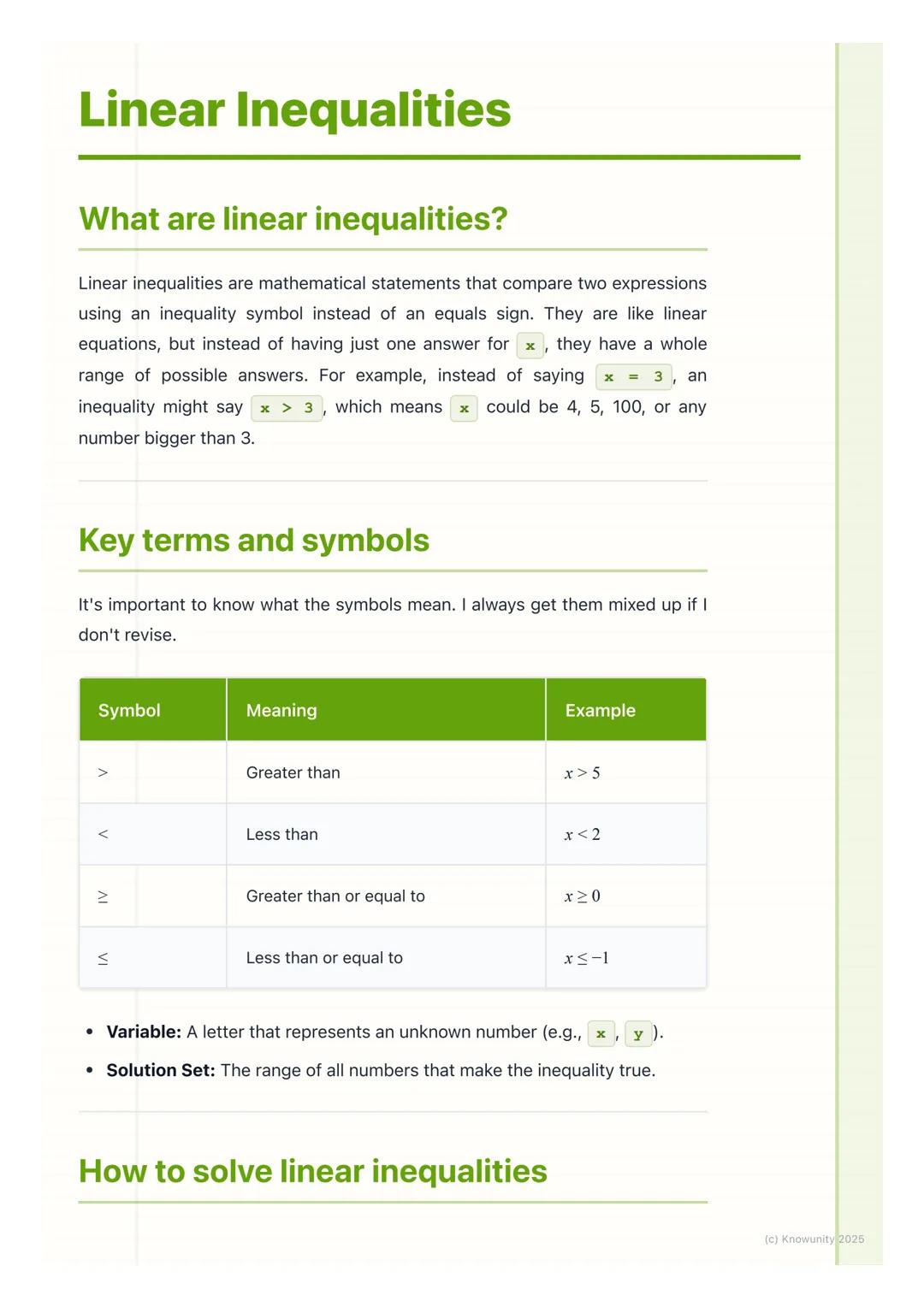
What are Linear Inequalities?
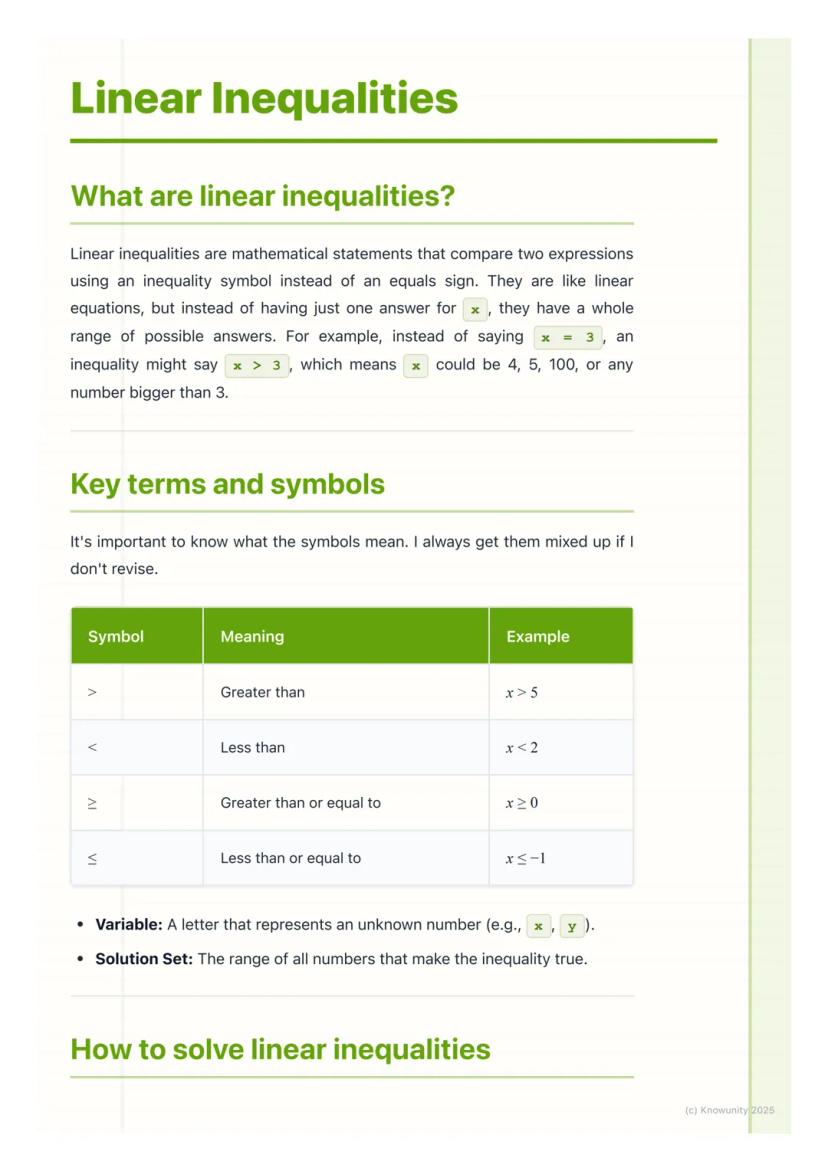
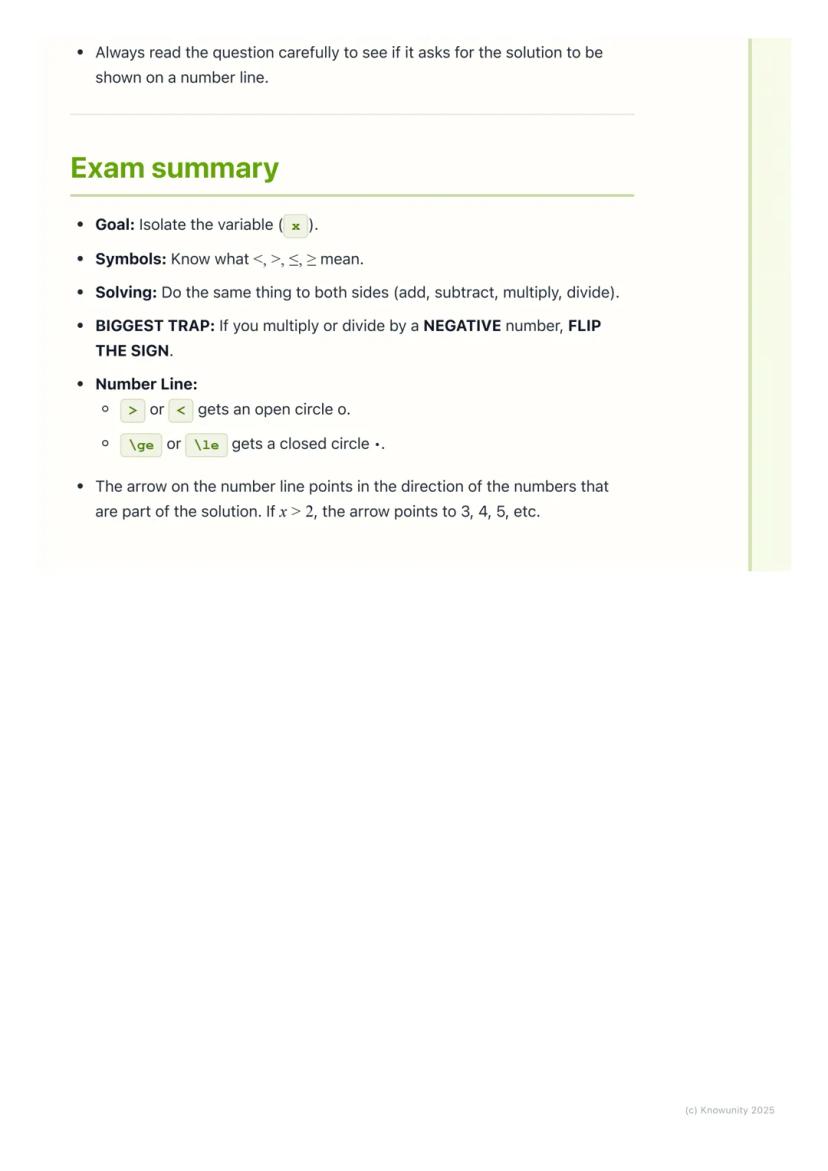
Think of linear inequalities as equations with attitude - they don't settle for just one answer! Instead of saying x = 3, they might say x > 3, meaning x could be any number greater than 3.
The inequality symbols are your new best mates. Greater than (>) and less than (<) exclude the actual number, whilst greater than or equal to (≥) and less than or equal to (≤) include it. A variable like x represents your unknown number, and the solution set is all the numbers that make your inequality true.
Quick Tip: Remember that > points to the bigger side - if you get confused, think of it as a hungry mouth wanting to eat the larger number!
2
of 6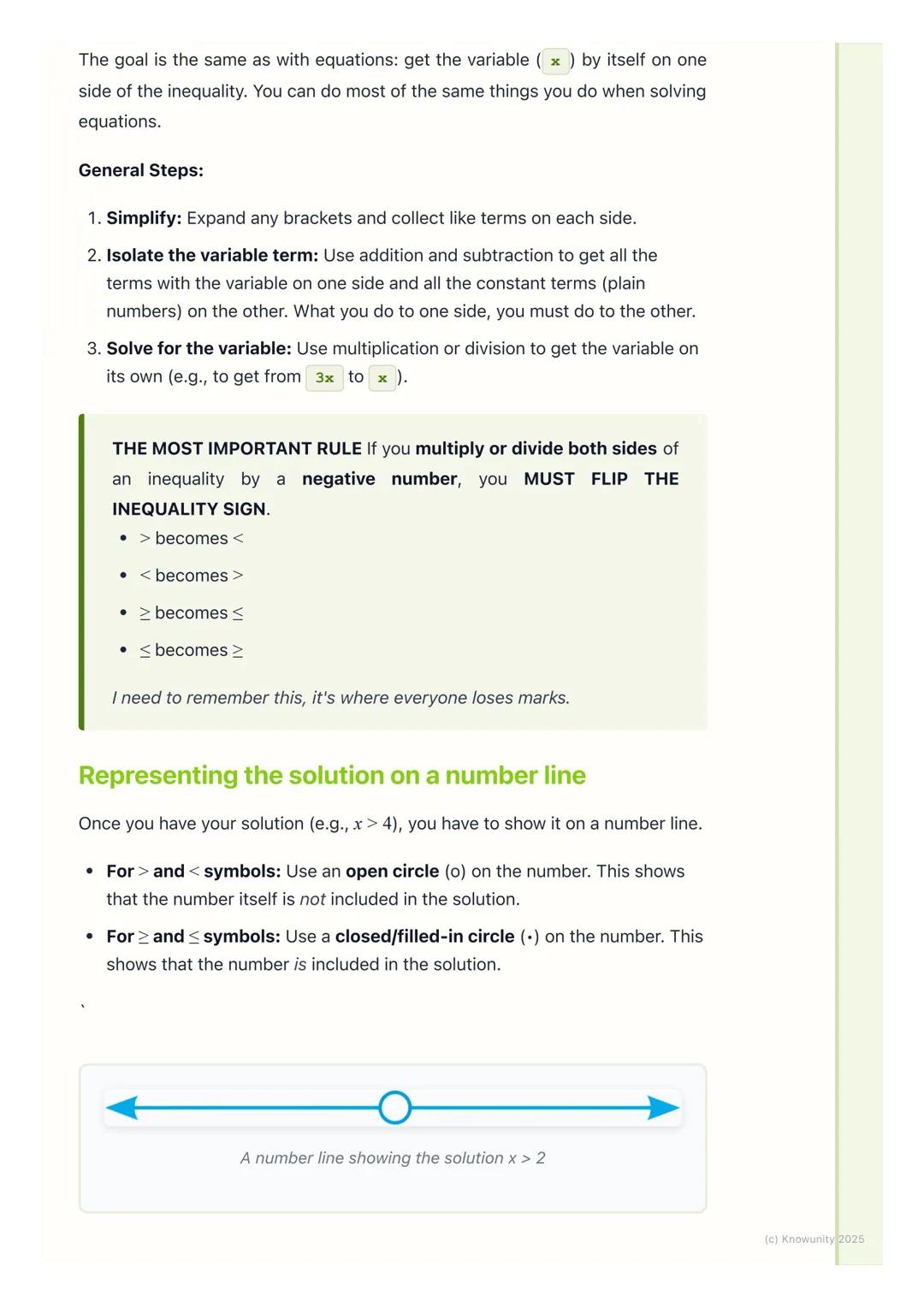
Solving Linear Inequalities - The Process
Solving inequalities follows the same steps as normal equations: simplify, isolate the variable term, then solve. You can add, subtract, multiply, and divide just like usual equations.
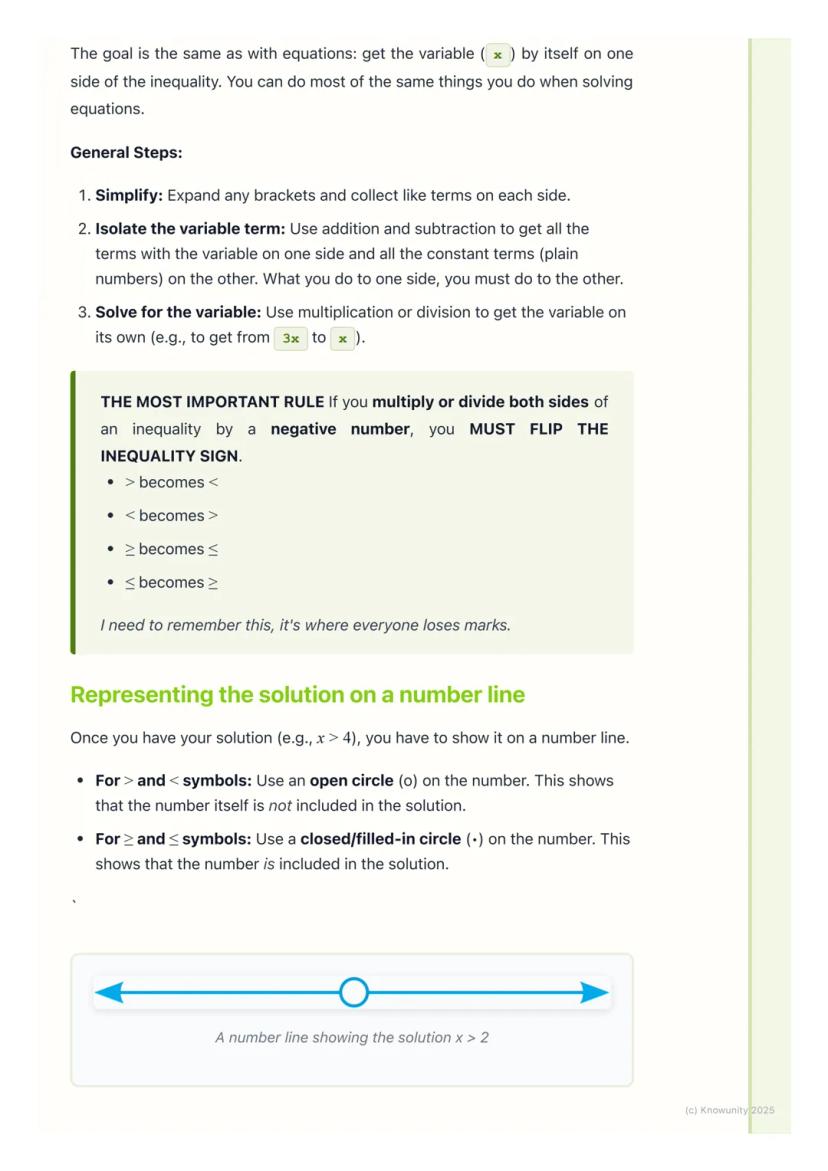
However, there's one massive rule that trips everyone up: when you multiply or divide both sides by a negative number, you must flip the inequality sign. So > becomes <, and ≤ becomes ≥.
Once you've got your solution, you'll often need to show it on a number line. Use an open circle for > and < (the number isn't included) and a closed circle for ≥ and ≤ (the number is included).
Don't Forget: The sign-flipping rule is where most students lose marks - it's the number one exam trap!
3
of 6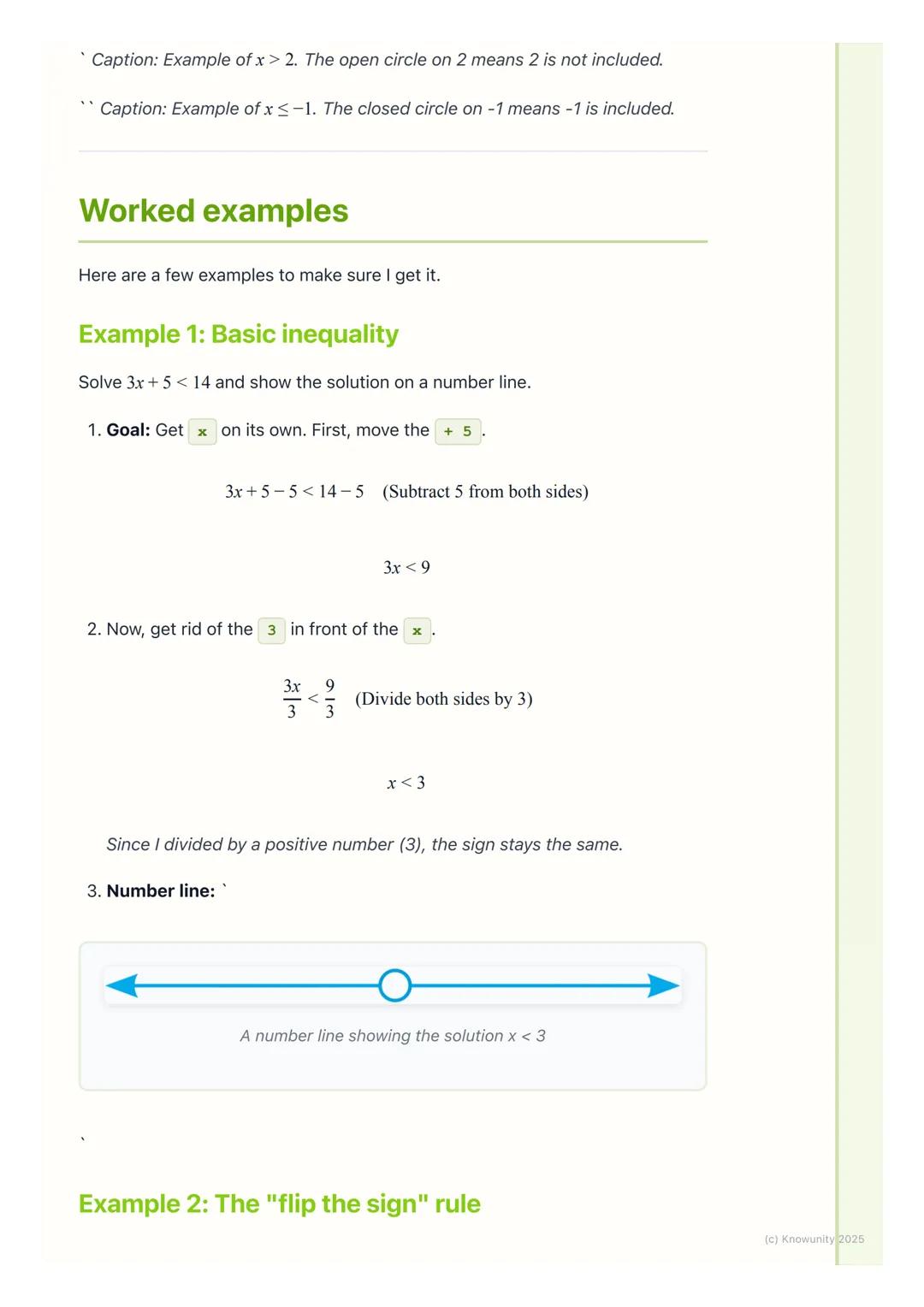
Worked Examples - Getting the Hang of It
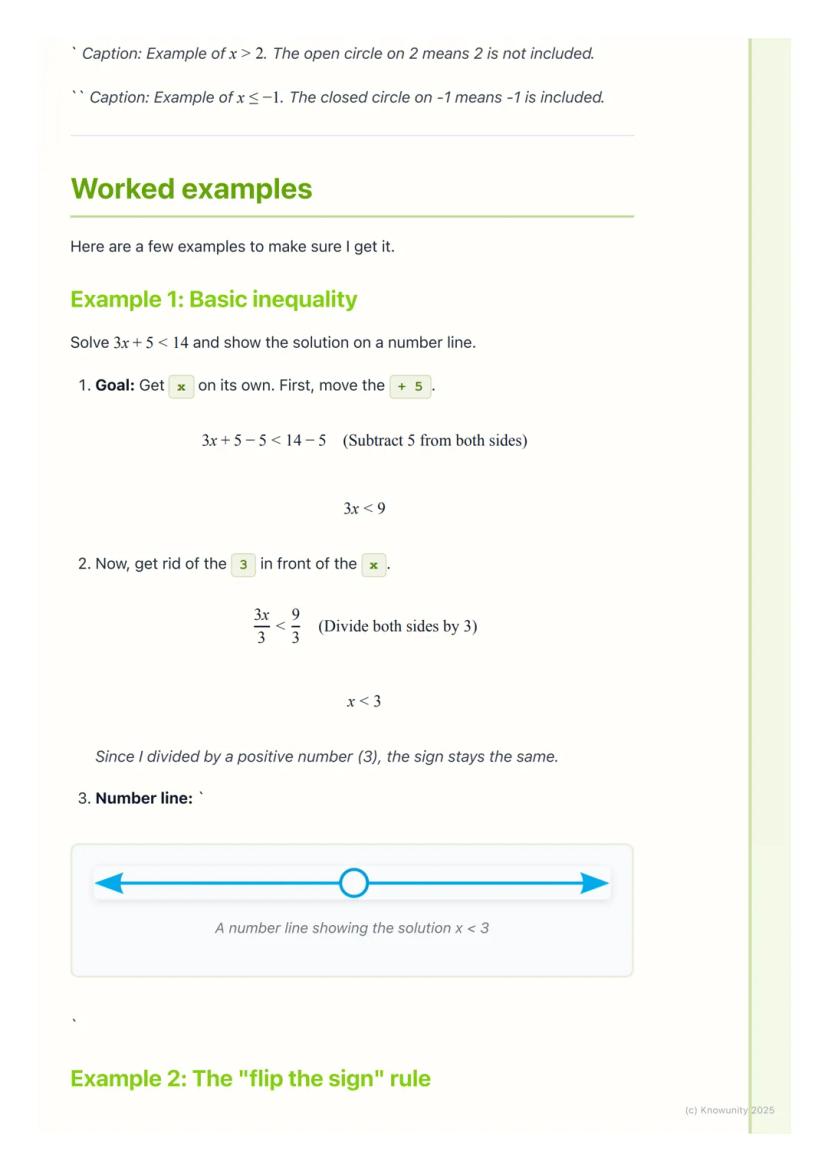
Let's tackle 3x + 5 < 14. First, subtract 5 from both sides to get 3x < 9. Then divide by 3 (positive number, so no sign flip) to get x < 3. On your number line, use an open circle at 3 with an arrow pointing left.
For the sign-flipping example, try 12 - 2x ≤ 6. Subtract 12 from both sides to get -2x ≤ -6. Now divide by -2 (negative!), so flip the sign: x ≥ 3. Your number line shows a closed circle at 3 pointing right.
Pro Strategy: When solving, pretend it's a normal equation until you hit that negative multiplication or division - then remember to flip!
4
of 6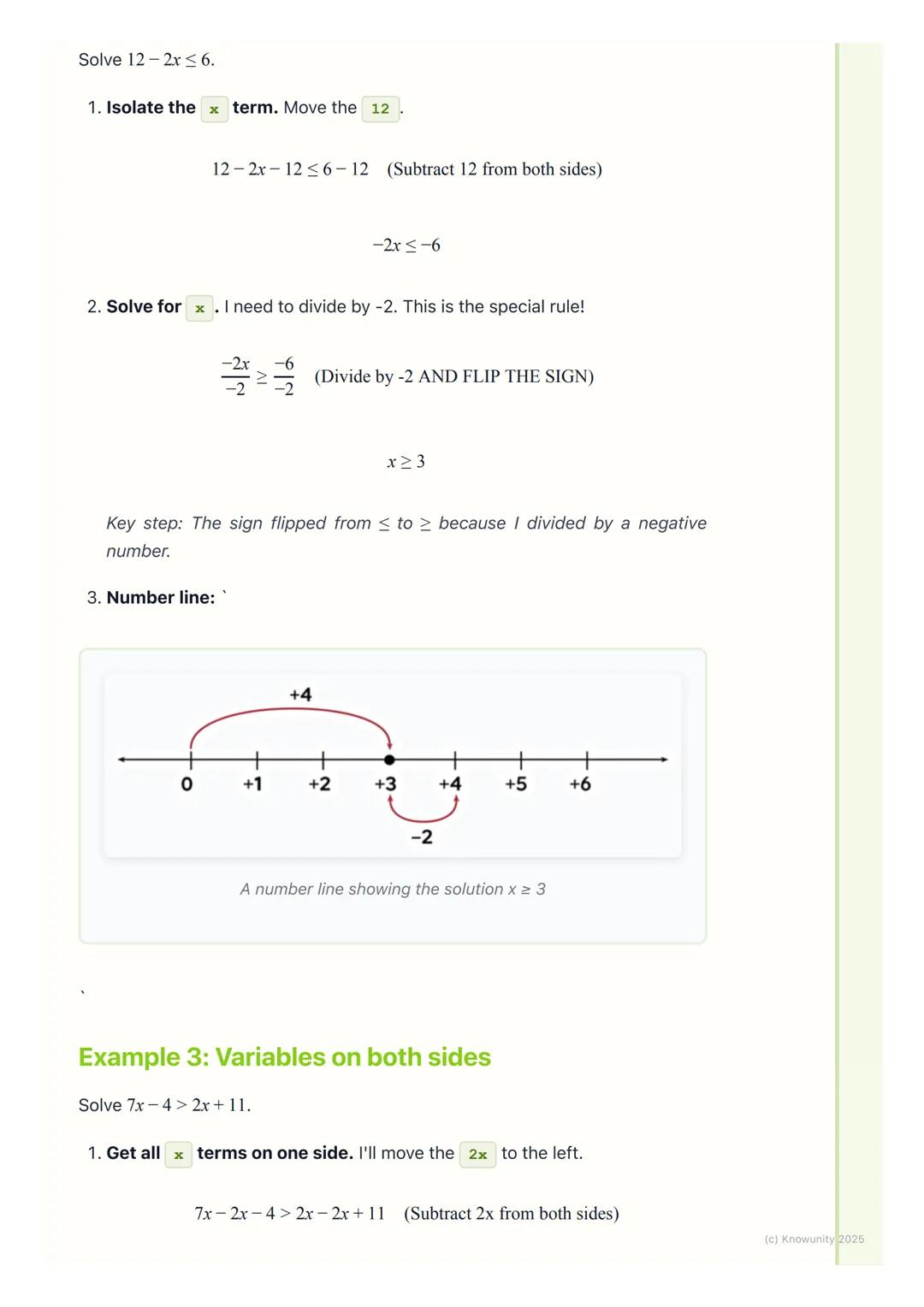
Variables on Both Sides
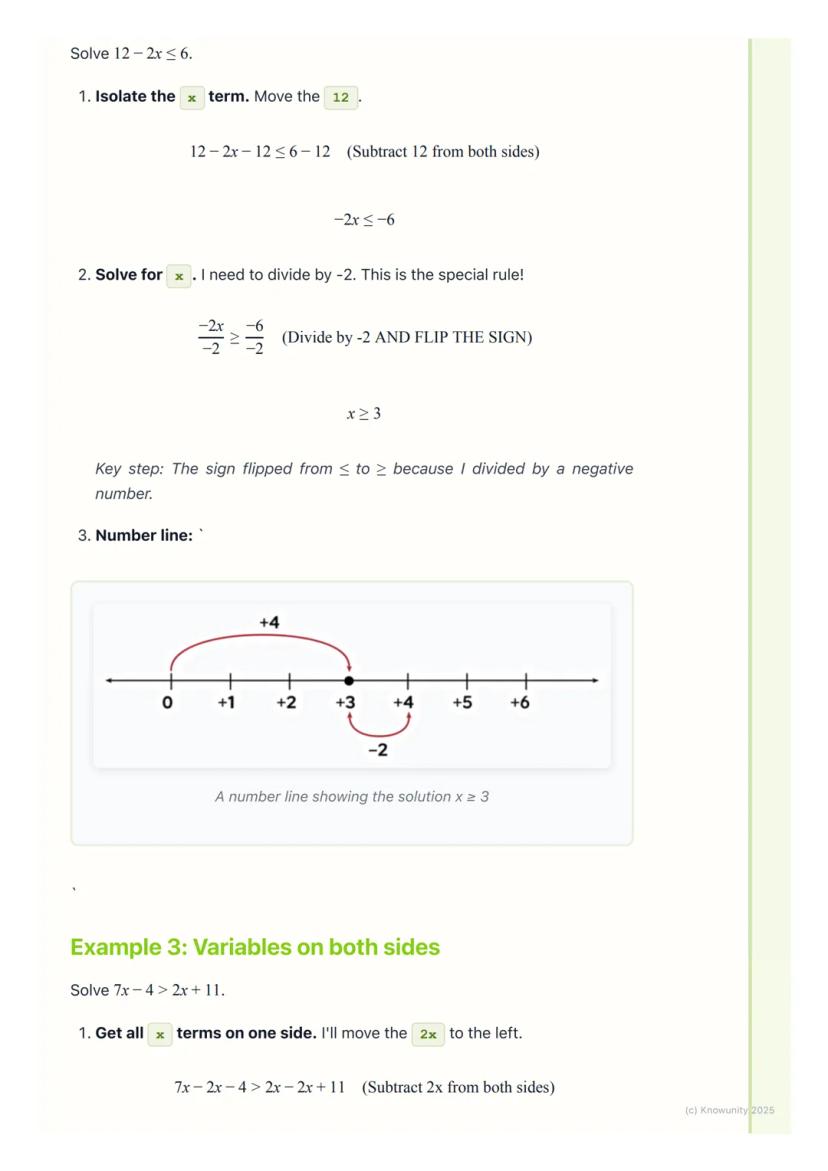
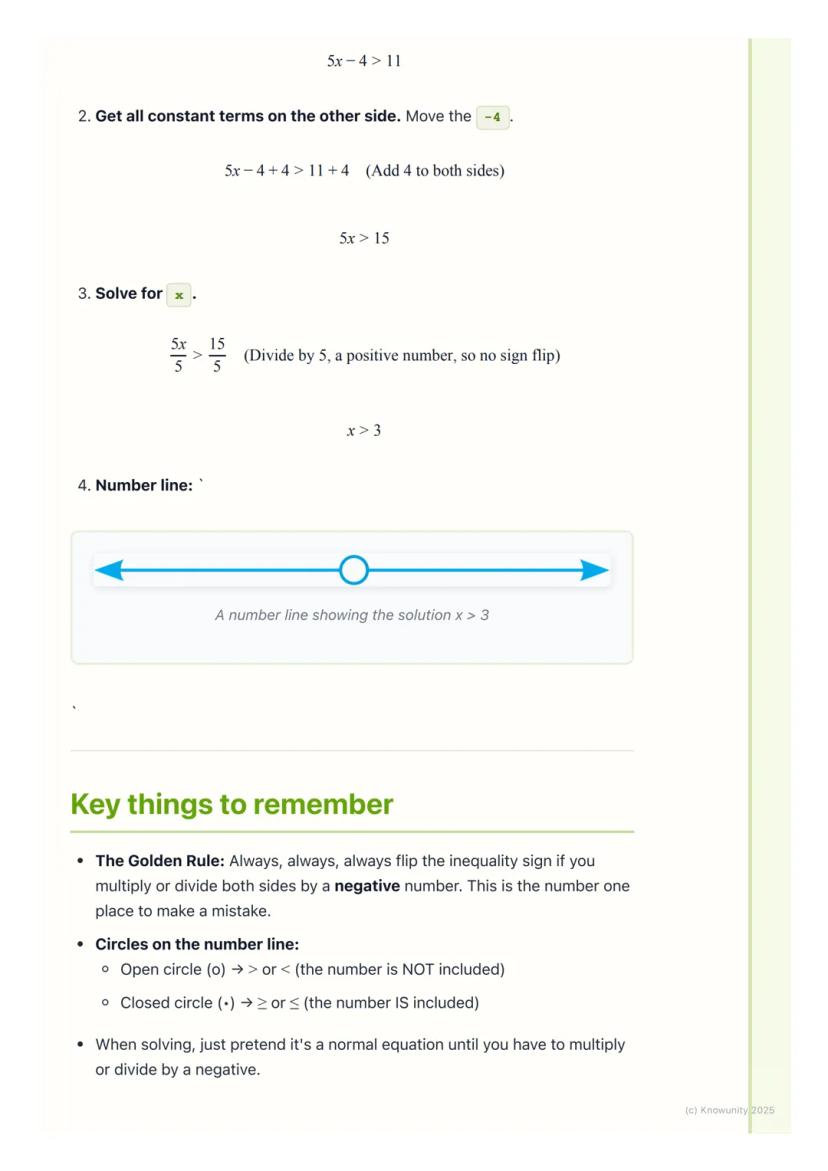
When you've got variables on both sides like 7x - 4 > 2x + 11, don't panic! Move all x terms to one side by subtracting 2x from both sides: 5x - 4 > 11.
Add 4 to both sides to get 5x > 15. Finally, divide by 5 (positive number) to get x > 3. Since you divided by a positive, the inequality sign stays the same.
The key is treating it like any other equation - just keep that sign-flipping rule in your back pocket for when you need it.
Remember: Always double-check whether you're multiplying or dividing by a positive or negative number - it makes all the difference!
5
of 6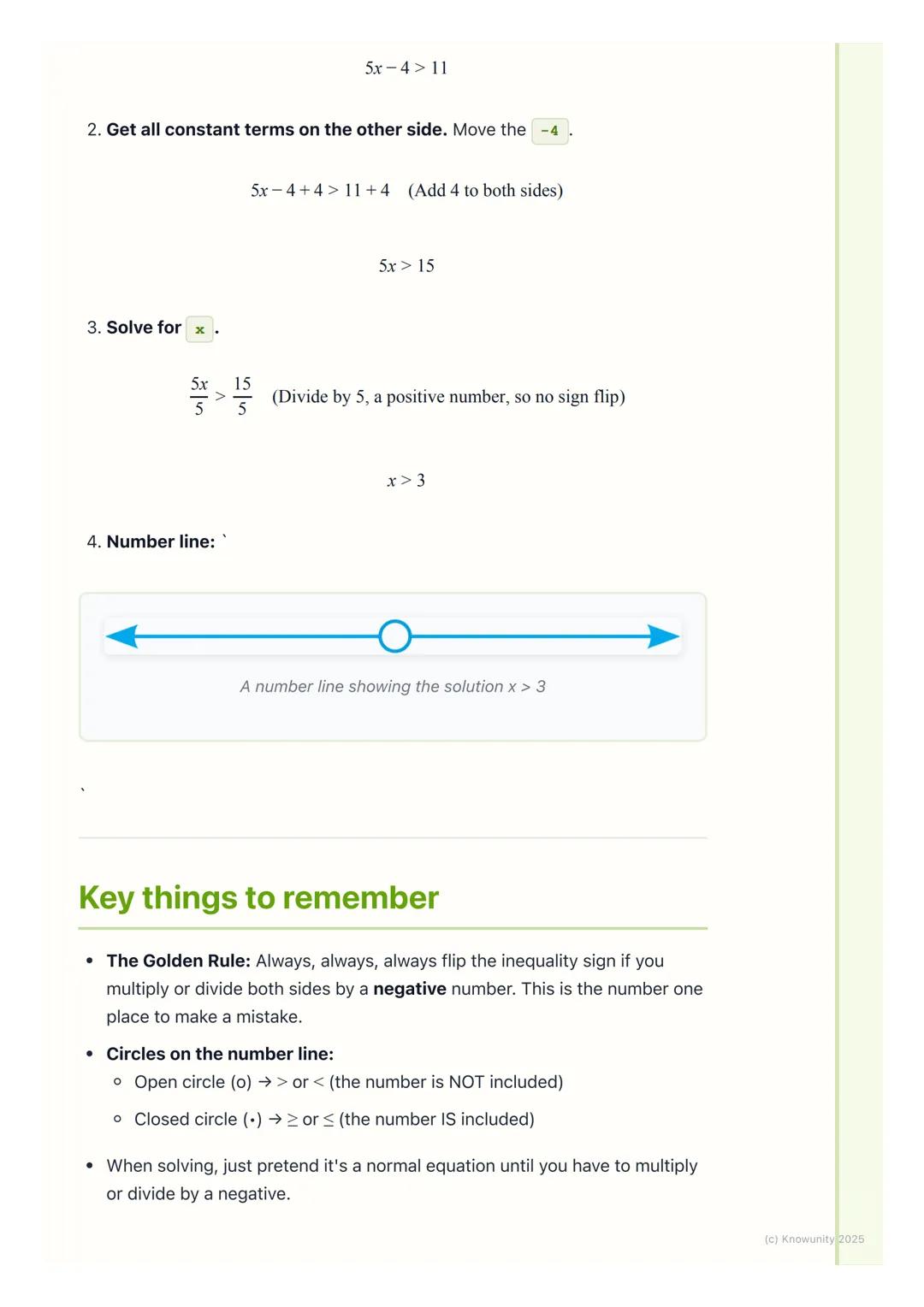
Number Lines and Visual Solutions
Your number line is like a visual map of your solution. The circle tells you whether the boundary number is included, and the arrow shows which direction contains your solutions.
For open circles (> or <), imagine the number is "off-limits" - you can get infinitely close but never actually reach it. For closed circles (≥ or ≤), the number is part of your solution family.
The arrow direction is logical: if x > 3, then 4, 5, 6 and beyond all work, so your arrow points right towards those larger numbers.
Visual Trick: Think of the arrow as pointing towards all the numbers that would make your inequality true - it's your solution's home!
6
of 6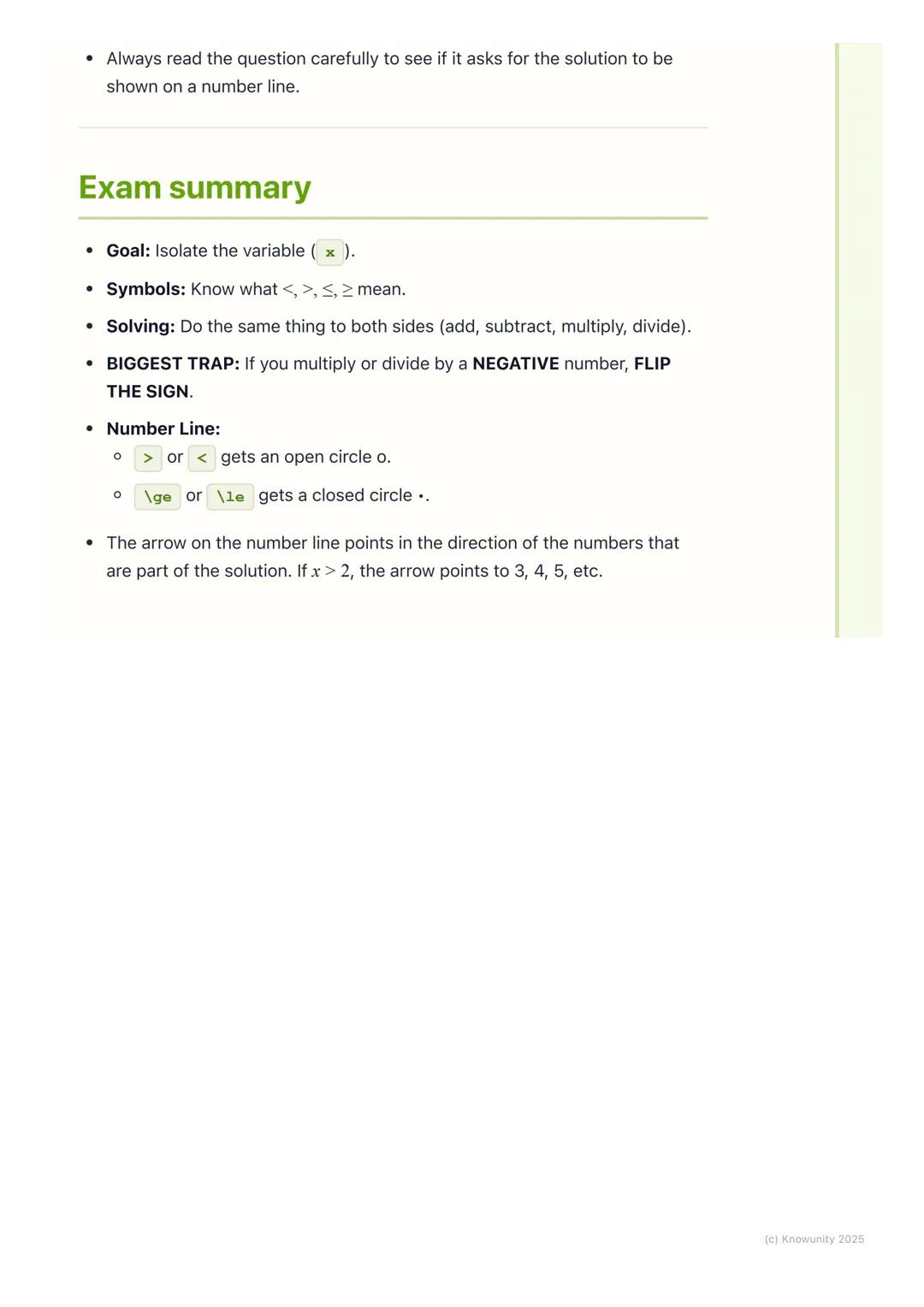
Exam Success - Key Takeaways
Your exam strategy should focus on the basics: isolate the variable using the same operations on both sides. Know your inequality symbols inside out, and always check if you're multiplying or dividing by a negative.
The biggest exam trap is forgetting to flip the sign when working with negatives. Make this your automatic reflex - negative operation means flip the sign!
For number line questions, remember that open circles go with > and <, whilst closed circles pair with ≥ and ≤. Your arrow direction shows where the solutions live.
Exam Confidence: Master the sign-flipping rule and you've conquered the hardest part - the rest is just like solving regular equations!
Νομίζαμε ότι δε θα ρωτούσες ποτέ...
Τι είναι ο AI σύντροφος του Knowunity;
Ο AI σύντροφός μας είναι ειδικά σχεδιασμένος για τις ανάγκες των μαθητών. Βασισμένοι στα εκατομμύρια κομμάτια Περιεχομένων που έχουμε στην πλατφόρμα, μπορούμε να παρέχουμε πραγματικά ουσιαστικές και σχετικές απαντήσεις στους μαθητές. Αλλά δεν αφορά μόνο τις απαντήσεις, ο σύντροφος είναι ακόμη περισσότερο για την καθοδήγηση των μαθητών στις καθημερινές τους μαθησιακές προκλήσεις, με εξατομικευμένα προγράμματα μελέτης, κουίζ ή Περιεχόμενα στη Συνομιλία και 100% εξατομίκευση βασισμένη στις δεξιότητες και την ανάπτυξη των μαθητών.
Πού μπορώ να κατεβάσω την εφαρμογή Knowunity;
Μπορείτε να κατεβάσετε την εφαρμογή από το Google Play Store και το Apple App Store.
Πώς μπορώ να λάβω την πληρωμή μου; Πόσα μπορώ να κερδίσω;
Ναι, έχετε δωρεάν πρόσβαση στο περιεχόμενο της εφαρμογής και στον AI companion μας. Για να ξεκλειδώσετε ορισμένες λειτουργίες της εφαρμογής, μπορείτε να αγοράσετε το Knowunity Pro.
Πιο δημοφιλή περιεχόμενα στο Mathematics
8MathematicsAlgebra
Algebra
5th Year91
MathematicsAlgebra 2
Algebra notes focusing on the factor theorem, completing the square, -b formula, graphs of polynomials
5th Year130
MathematicsSolving Equations
This section focuses on solving one-step and two-step linear equations to find the value of an unknown variable.
1st Year131
MathematicsArithmetic sequences and series
With examples
5th Year130
MathematicsIntroduction to Probability
This topic introduces basic probability concepts, including calculating the probability of simple events and understanding the difference between experimental and theoretical probability.
2nd Year91
MathematicsMaths jc algebra
Maths jc
1st Year230
MathematicsNatural Numbers and Integers
Students will learn about positive whole numbers, zero, and negative whole numbers, and how to add, subtract, multiply, and divide them correctly.
1st Year131
MathematicsDifferential Calculus
Calculus is a topic that comes up nearly everywhere on your maths LC. This is just starter notes that could be useful end of 5th year or start of 6th year
5th Year271
Πιο δημοφιλή περιεχόμενα
9 Irish
IrishIrish oral questions and answers
Questions and answers for the leaving cert oral
5th Year4264
 English
Key Quotes : Sive
Key Quotes and explanations: Sive
6th Year2842
IrishIrish oral questions
Outline of oral questions
5th Year2055
IrishIníon- le hÁine Durkin
Aine Durkin’s poem, Iníon: Themes & summary
5th Year890
IrishIrish poetry 2027
Iníon + Dínit an Bhróin
5th Year1153
IrishLC HL notes- Iníon (poem)
Includes poem in English and Irish, theme, key words & phrases
5th Year2304
EnglishCultural Context : Shawshank Redemption : Sive : Small Things Like These
Comparative Study : Cultural Context : Shawshank Redemption, Sive and Small Things Like These
6th Year1430
IrishMo Ghrá-sa (Idir Lúibíní)
Notes on mo ghrá-sa
5th Year380
IrishAn Gaeilge Aiste
Irish Language essay
6th Year1320
Δε μπορείς να βρεις αυτό που ψάχνεις; Εξερεύνησε άλλα μαθήματα.
Κριτικές από τους χρήστες μας. Έχουν όλα τα καλά — και το ίδιο θα είχες κι εσύ.
4.6/5App Store
4.7/5Google Play
Η εφαρμογή είναι πολύ εύκολη στη χρήση και καλά σχεδιασμένη. Έχω βρει ό,τι έψαχνα μέχρι τώρα και έχω μάθει πολλά από τις παρουσιάσεις! Σίγουρα θα χρησιμοποιήσω την εφαρμογή για μια εργασία του μαθήματος! Και φυσικά βοηθάει πολύ και ως έμπνευση.
Στέφαν Σχρήστης iOS
Αυτή η εφαρμογή είναι πραγματικά τέλεια. Υπάρχουν τόσες πολλές σημειώσεις μελέτης και βοήθεια [...]. Το μάθημα που με δυσκολεύει είναι τα Γαλλικά, για παράδειγμα, και η εφαρμογή έχει τόσες επιλογές για βοήθεια. Χάρη σε αυτή την εφαρμογή, έχω βελτιώσει τα Γαλλικά μου. Θα την πρότεινα σε οποιονδήποτε.
Σαμάνθα Κλιχχρήστης Android
Ουάου, είμαι πραγματικά εντυπωσιασμένος. Δοκίμασα την εφαρμογή επειδή την είδα διαφημισμένη πολλές φορές και έμεινα άφωνος. Αυτή η εφαρμογή είναι Η ΒΟΗΘΕΙΑ που χρειάζεσαι για το σχολείο και πάνω απ' όλα, προσφέρει τόσα πράγματα, όπως ασκήσεις και φύλλα γεγονότων, που ήταν ΠΟΛΥ χρήσιμα για μένα προσωπικά.
Άνναχρήστης iOS
Mathematics2 προβολές·Ενημερώθηκε Jun 13, 2026·6 σελίδεςMastering Linear Inequalities
Linear inequalities are like normal equations, but instead of finding one exact answer, you get a whole range of possible solutions. They use symbols like > and < instead of equals signs, and mastering them is crucial for your maths...
1
of 6
Κάνε εγγραφή για να δεις το ΠΕΡΙΕΧΟΜΕΝΟ. Είναι δωρεάν!
- Πρόσβαση σε όλα τα έγγραφα
- Βελτίωσε τους βαθμούς σου
- Γίνε μέλος με εκατομμύρια μαθητές
What are Linear Inequalities?
Think of linear inequalities as equations with attitude - they don't settle for just one answer! Instead of saying x = 3, they might say x > 3, meaning x could be any number greater than 3.
The inequality symbols are your new best mates. Greater than (>) and less than (<) exclude the actual number, whilst greater than or equal to (≥) and less than or equal to (≤) include it. A variable like x represents your unknown number, and the solution set is all the numbers that make your inequality true.
Quick Tip: Remember that > points to the bigger side - if you get confused, think of it as a hungry mouth wanting to eat the larger number!
2
of 6Κάνε εγγραφή για να δεις το ΠΕΡΙΕΧΟΜΕΝΟ. Είναι δωρεάν!
- Πρόσβαση σε όλα τα έγγραφα
- Βελτίωσε τους βαθμούς σου
- Γίνε μέλος με εκατομμύρια μαθητές
Solving Linear Inequalities - The Process
Solving inequalities follows the same steps as normal equations: simplify, isolate the variable term, then solve. You can add, subtract, multiply, and divide just like usual equations.
However, there's one massive rule that trips everyone up: when you multiply or divide both sides by a negative number, you must flip the inequality sign. So > becomes <, and ≤ becomes ≥.
Once you've got your solution, you'll often need to show it on a number line. Use an open circle for > and < (the number isn't included) and a closed circle for ≥ and ≤ (the number is included).
Don't Forget: The sign-flipping rule is where most students lose marks - it's the number one exam trap!
3
of 6Κάνε εγγραφή για να δεις το ΠΕΡΙΕΧΟΜΕΝΟ. Είναι δωρεάν!
- Πρόσβαση σε όλα τα έγγραφα
- Βελτίωσε τους βαθμούς σου
- Γίνε μέλος με εκατομμύρια μαθητές
Worked Examples - Getting the Hang of It
Let's tackle 3x + 5 < 14. First, subtract 5 from both sides to get 3x < 9. Then divide by 3 (positive number, so no sign flip) to get x < 3. On your number line, use an open circle at 3 with an arrow pointing left.
For the sign-flipping example, try 12 - 2x ≤ 6. Subtract 12 from both sides to get -2x ≤ -6. Now divide by -2 (negative!), so flip the sign: x ≥ 3. Your number line shows a closed circle at 3 pointing right.
Pro Strategy: When solving, pretend it's a normal equation until you hit that negative multiplication or division - then remember to flip!
4
of 6Κάνε εγγραφή για να δεις το ΠΕΡΙΕΧΟΜΕΝΟ. Είναι δωρεάν!
- Πρόσβαση σε όλα τα έγγραφα
- Βελτίωσε τους βαθμούς σου
- Γίνε μέλος με εκατομμύρια μαθητές
Variables on Both Sides
When you've got variables on both sides like 7x - 4 > 2x + 11, don't panic! Move all x terms to one side by subtracting 2x from both sides: 5x - 4 > 11.
Add 4 to both sides to get 5x > 15. Finally, divide by 5 (positive number) to get x > 3. Since you divided by a positive, the inequality sign stays the same.
The key is treating it like any other equation - just keep that sign-flipping rule in your back pocket for when you need it.
Remember: Always double-check whether you're multiplying or dividing by a positive or negative number - it makes all the difference!
5
of 6Κάνε εγγραφή για να δεις το ΠΕΡΙΕΧΟΜΕΝΟ. Είναι δωρεάν!
- Πρόσβαση σε όλα τα έγγραφα
- Βελτίωσε τους βαθμούς σου
- Γίνε μέλος με εκατομμύρια μαθητές
Number Lines and Visual Solutions
Your number line is like a visual map of your solution. The circle tells you whether the boundary number is included, and the arrow shows which direction contains your solutions.
For open circles (> or <), imagine the number is "off-limits" - you can get infinitely close but never actually reach it. For closed circles (≥ or ≤), the number is part of your solution family.
The arrow direction is logical: if x > 3, then 4, 5, 6 and beyond all work, so your arrow points right towards those larger numbers.
Visual Trick: Think of the arrow as pointing towards all the numbers that would make your inequality true - it's your solution's home!
6
of 6Κάνε εγγραφή για να δεις το ΠΕΡΙΕΧΟΜΕΝΟ. Είναι δωρεάν!
- Πρόσβαση σε όλα τα έγγραφα
- Βελτίωσε τους βαθμούς σου
- Γίνε μέλος με εκατομμύρια μαθητές
Exam Success - Key Takeaways
Your exam strategy should focus on the basics: isolate the variable using the same operations on both sides. Know your inequality symbols inside out, and always check if you're multiplying or dividing by a negative.
The biggest exam trap is forgetting to flip the sign when working with negatives. Make this your automatic reflex - negative operation means flip the sign!
For number line questions, remember that open circles go with > and <, whilst closed circles pair with ≥ and ≤. Your arrow direction shows where the solutions live.
Exam Confidence: Master the sign-flipping rule and you've conquered the hardest part - the rest is just like solving regular equations!
Νομίζαμε ότι δε θα ρωτούσες ποτέ...
Τι είναι ο AI σύντροφος του Knowunity;
Ο AI σύντροφός μας είναι ειδικά σχεδιασμένος για τις ανάγκες των μαθητών. Βασισμένοι στα εκατομμύρια κομμάτια Περιεχομένων που έχουμε στην πλατφόρμα, μπορούμε να παρέχουμε πραγματικά ουσιαστικές και σχετικές απαντήσεις στους μαθητές. Αλλά δεν αφορά μόνο τις απαντήσεις, ο σύντροφος είναι ακόμη περισσότερο για την καθοδήγηση των μαθητών στις καθημερινές τους μαθησιακές προκλήσεις, με εξατομικευμένα προγράμματα μελέτης, κουίζ ή Περιεχόμενα στη Συνομιλία και 100% εξατομίκευση βασισμένη στις δεξιότητες και την ανάπτυξη των μαθητών.
Πού μπορώ να κατεβάσω την εφαρμογή Knowunity;
Μπορείτε να κατεβάσετε την εφαρμογή από το Google Play Store και το Apple App Store.
Πώς μπορώ να λάβω την πληρωμή μου; Πόσα μπορώ να κερδίσω;
Ναι, έχετε δωρεάν πρόσβαση στο περιεχόμενο της εφαρμογής και στον AI companion μας. Για να ξεκλειδώσετε ορισμένες λειτουργίες της εφαρμογής, μπορείτε να αγοράσετε το Knowunity Pro.
Πιο δημοφιλή περιεχόμενα στο Mathematics
8MathematicsAlgebra
Algebra
5th Year91
MathematicsAlgebra 2
Algebra notes focusing on the factor theorem, completing the square, -b formula, graphs of polynomials
5th Year130
MathematicsSolving Equations
This section focuses on solving one-step and two-step linear equations to find the value of an unknown variable.
1st Year131
MathematicsArithmetic sequences and series
With examples
5th Year130
MathematicsIntroduction to Probability
This topic introduces basic probability concepts, including calculating the probability of simple events and understanding the difference between experimental and theoretical probability.
2nd Year91
MathematicsMaths jc algebra
Maths jc
1st Year230
MathematicsNatural Numbers and Integers
Students will learn about positive whole numbers, zero, and negative whole numbers, and how to add, subtract, multiply, and divide them correctly.
1st Year131
MathematicsDifferential Calculus
Calculus is a topic that comes up nearly everywhere on your maths LC. This is just starter notes that could be useful end of 5th year or start of 6th year
5th Year271
Πιο δημοφιλή περιεχόμενα
9IrishIrish oral questions and answers
Questions and answers for the leaving cert oral
5th Year4264
EnglishKey Quotes : Sive
Key Quotes and explanations: Sive
6th Year2842
IrishIrish oral questions
Outline of oral questions
5th Year2055
IrishIníon- le hÁine Durkin
Aine Durkin’s poem, Iníon: Themes & summary
5th Year890
IrishIrish poetry 2027
Iníon + Dínit an Bhróin
5th Year1153
IrishLC HL notes- Iníon (poem)
Includes poem in English and Irish, theme, key words & phrases
5th Year2304
EnglishCultural Context : Shawshank Redemption : Sive : Small Things Like These
Comparative Study : Cultural Context : Shawshank Redemption, Sive and Small Things Like These
6th Year1430
IrishMo Ghrá-sa (Idir Lúibíní)
Notes on mo ghrá-sa
5th Year380
IrishAn Gaeilge Aiste
Irish Language essay
6th Year1320
Δε μπορείς να βρεις αυτό που ψάχνεις; Εξερεύνησε άλλα μαθήματα.
Κριτικές από τους χρήστες μας. Έχουν όλα τα καλά — και το ίδιο θα είχες κι εσύ.
4.6/5App Store
4.7/5Google Play
Η εφαρμογή είναι πολύ εύκολη στη χρήση και καλά σχεδιασμένη. Έχω βρει ό,τι έψαχνα μέχρι τώρα και έχω μάθει πολλά από τις παρουσιάσεις! Σίγουρα θα χρησιμοποιήσω την εφαρμογή για μια εργασία του μαθήματος! Και φυσικά βοηθάει πολύ και ως έμπνευση.
Στέφαν Σχρήστης iOS
Αυτή η εφαρμογή είναι πραγματικά τέλεια. Υπάρχουν τόσες πολλές σημειώσεις μελέτης και βοήθεια [...]. Το μάθημα που με δυσκολεύει είναι τα Γαλλικά, για παράδειγμα, και η εφαρμογή έχει τόσες επιλογές για βοήθεια. Χάρη σε αυτή την εφαρμογή, έχω βελτιώσει τα Γαλλικά μου. Θα την πρότεινα σε οποιονδήποτε.
Σαμάνθα Κλιχχρήστης Android
Ουάου, είμαι πραγματικά εντυπωσιασμένος. Δοκίμασα την εφαρμογή επειδή την είδα διαφημισμένη πολλές φορές και έμεινα άφωνος. Αυτή η εφαρμογή είναι Η ΒΟΗΘΕΙΑ που χρειάζεσαι για το σχολείο και πάνω απ' όλα, προσφέρει τόσα πράγματα, όπως ασκήσεις και φύλλα γεγονότων, που ήταν ΠΟΛΥ χρήσιμα για μένα προσωπικά.
Άνναχρήστης iOS