
Biomechanics might sound complicated, but it's just the physics behind...
 LCPE20 προβολές·Ενημερώθηκε Jun 11, 2026·8 σελίδες
Understanding Biomechanics: Principles of Movement Efficiency
1 / 8
1
of 8
Understanding Biomechanics Basics
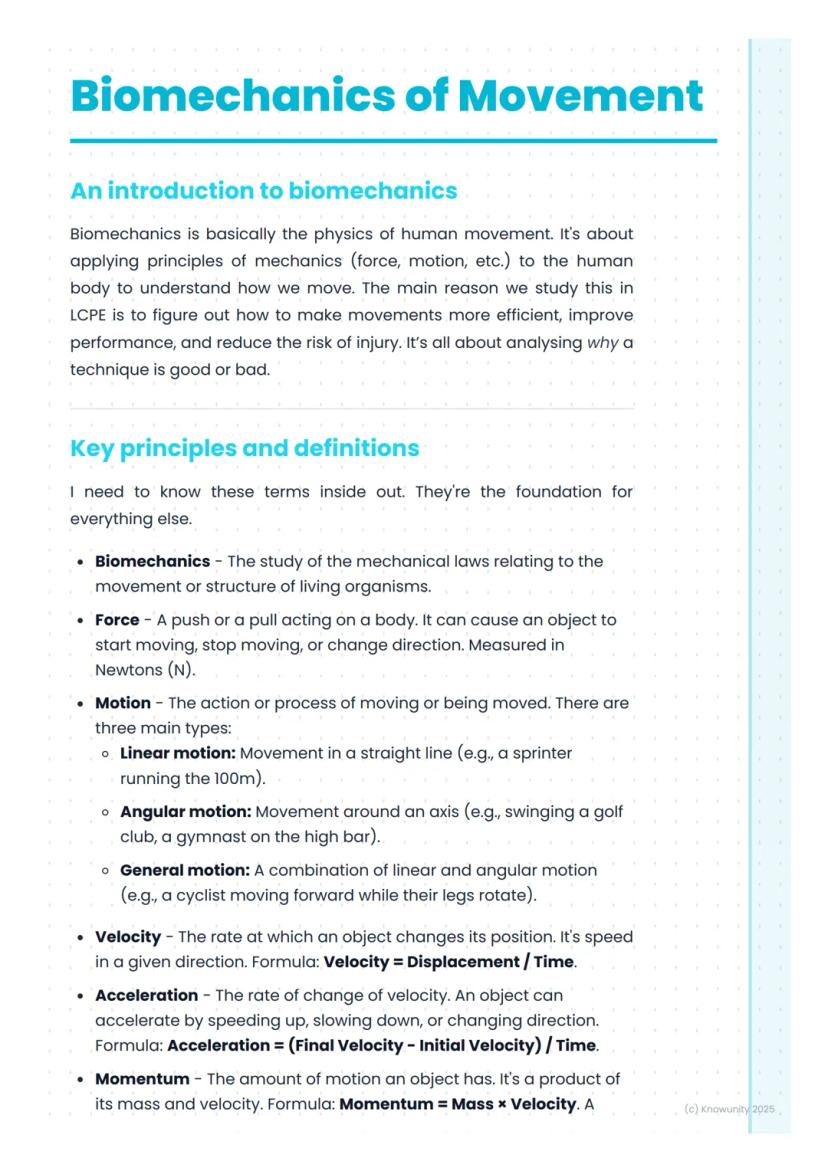
Biomechanics is essentially physics applied to human movement. It explains why some techniques work brilliantly whilst others fall flat, and it's your key to understanding how athletes can move more efficiently and safely.
The fundamental concepts you need to master include force (any push or pull measured in Newtons), motion (which comes in three types: linear like sprinting, angular like swinging a hurley, and general motion combining both), and velocity (speed with direction). Acceleration tells us how quickly velocity changes, whilst momentum combines mass and velocity to show how much "oomph" a moving object has.
Your centre of mass is your body's theoretical balance point – usually around your navel when standing still. Stability is your ability to resist being moved or to return to your original position. These concepts work together to explain every sporting movement you'll ever see.
Key Point: Don't just memorise definitions – think about how you see these principles in action during your favourite sports!
2
of 8
Newton's Laws in Sport
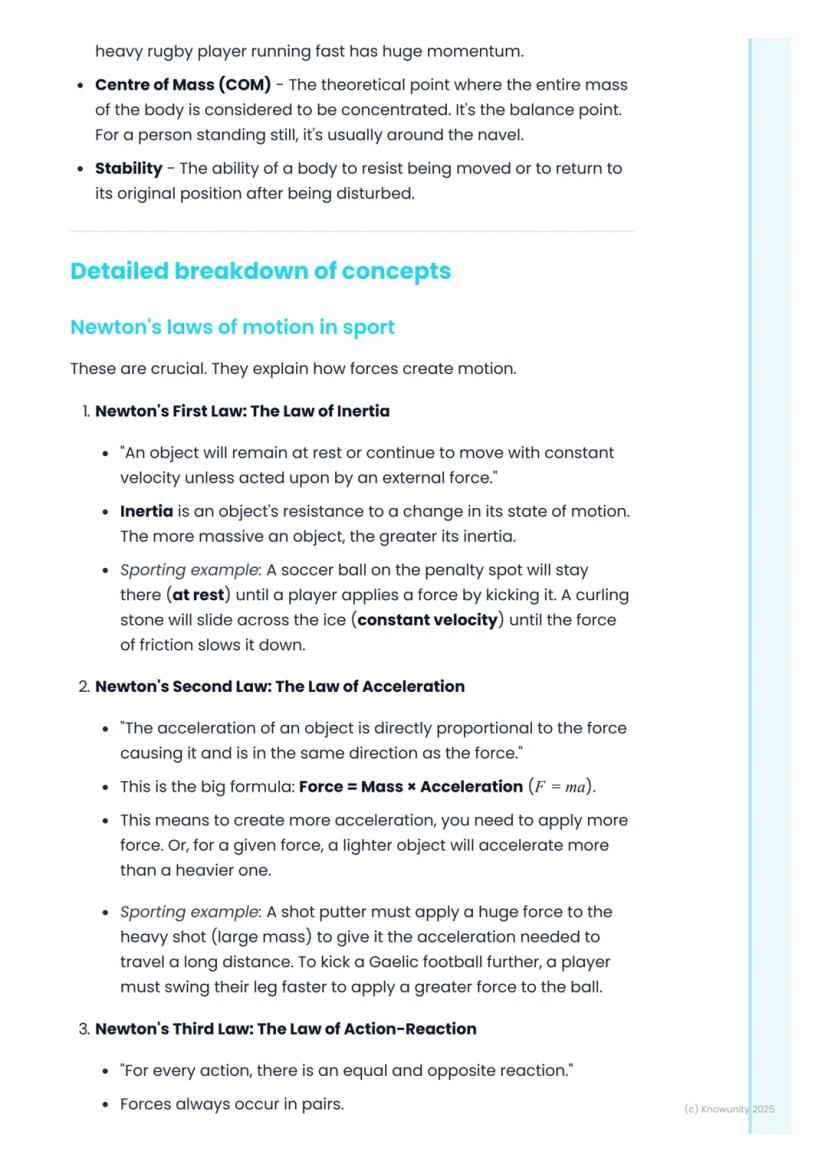
Newton's three laws govern every sporting movement you can imagine. Newton's First Law (inertia) explains why a Gaelic football stays put until you kick it, and why it keeps flying until air resistance slows it down. Objects resist changes to their motion – the heavier they are, the more they resist.
Newton's Second Law gives us the crucial formula: Force = Mass × Acceleration. This explains why shot putters need massive force to accelerate that heavy ball, or why a lighter hurley can be swung faster than a heavier one. Want more acceleration? Apply more force or reduce the mass.
Newton's Third Law states that every action has an equal and opposite reaction. When you jump, you push down on the ground with a certain force, and the ground pushes back up on you with exactly the same force – that's what launches you into the air.
Remember: These laws work together in every sport – a sprinter uses all three when exploding from the blocks!
3
of 8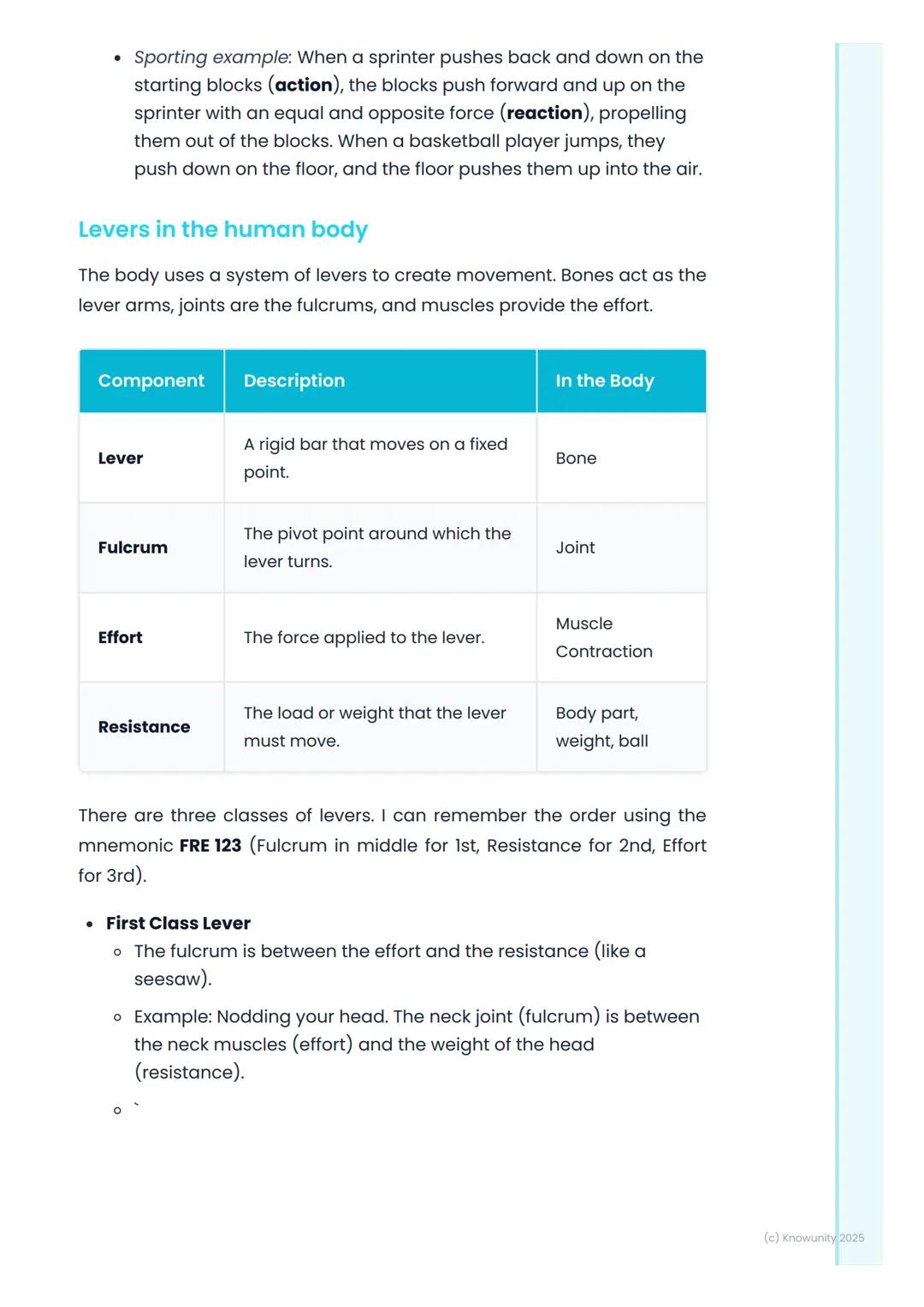
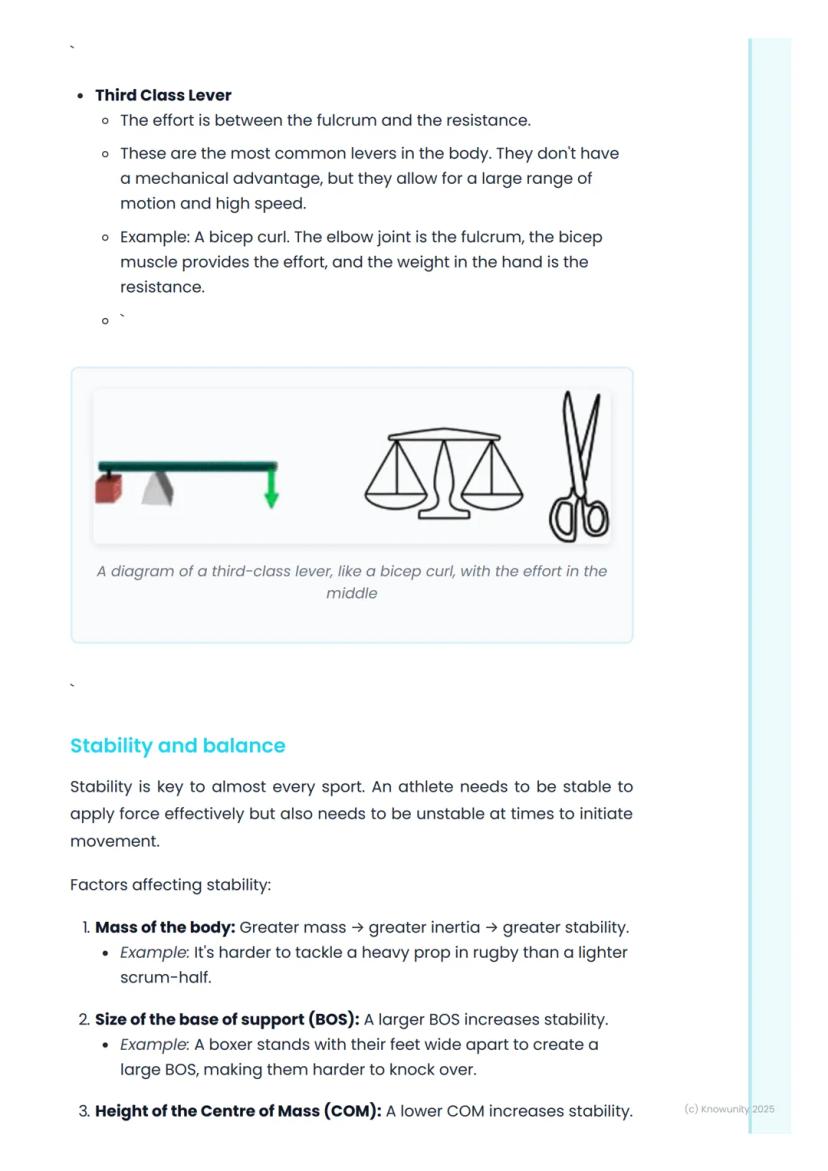
The Body's Lever System
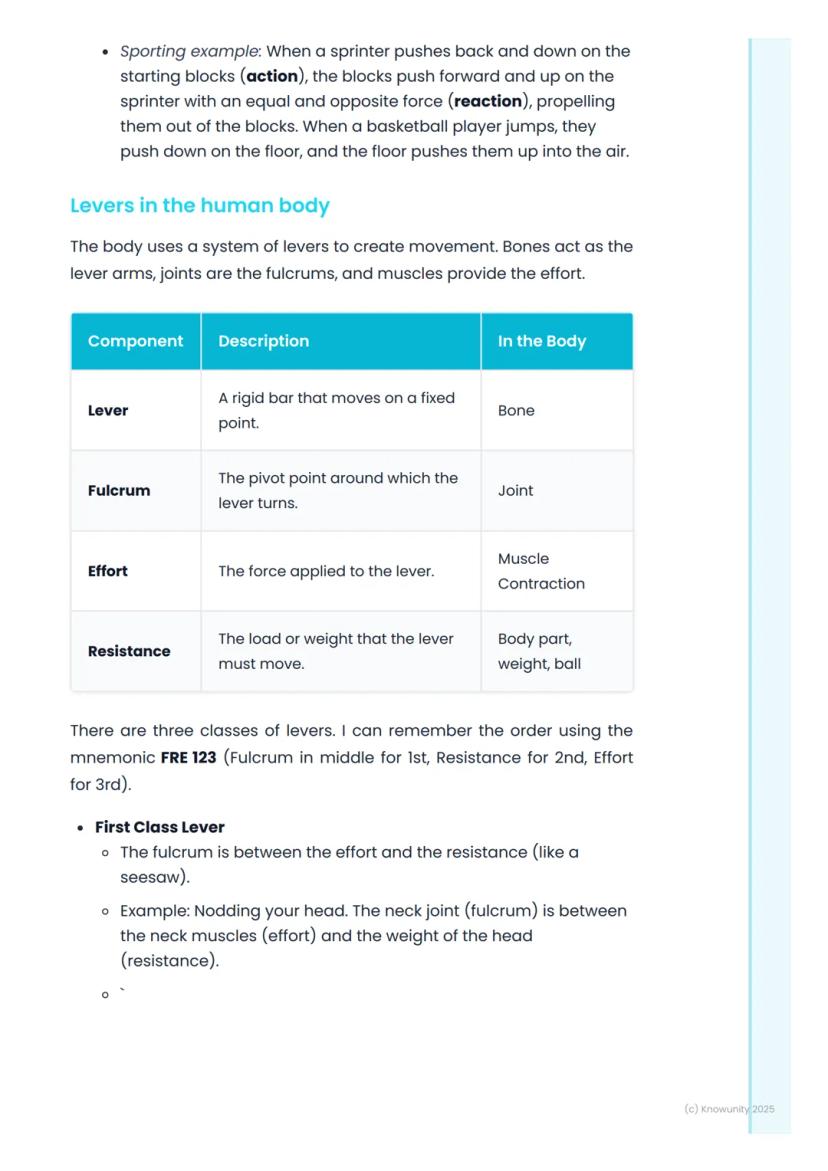
Your body is basically a complex system of levers working together. Bones act as lever arms, joints serve as fulcrums, and muscles provide the effort to move loads like your body weight or sports equipment.
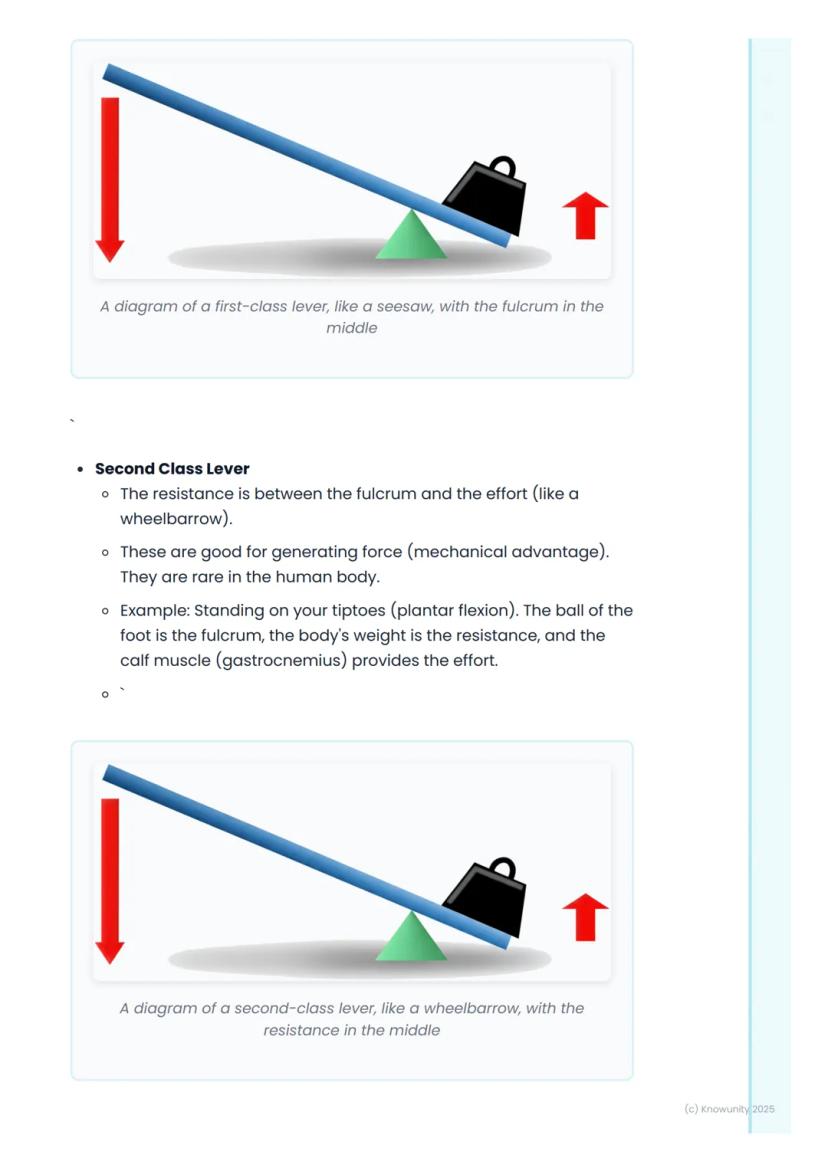
There are three classes of levers, and you can remember them with "FRE 123" – First class has the fulcrum in the middle (like nodding your head), second class has the resistance in the middle (like standing on your tiptoes), and third class has the effort in the middle (like doing a bicep curl).
Third-class levers are the most common in your body. They don't give you a mechanical advantage for strength, but they're brilliant for creating speed and range of motion. That's why you can swing a hurley or tennis racket so quickly – your arm acts as a third-class lever system.
Think About It: Every time you throw, kick, or swing something, you're using multiple lever systems working in sequence!
4
of 8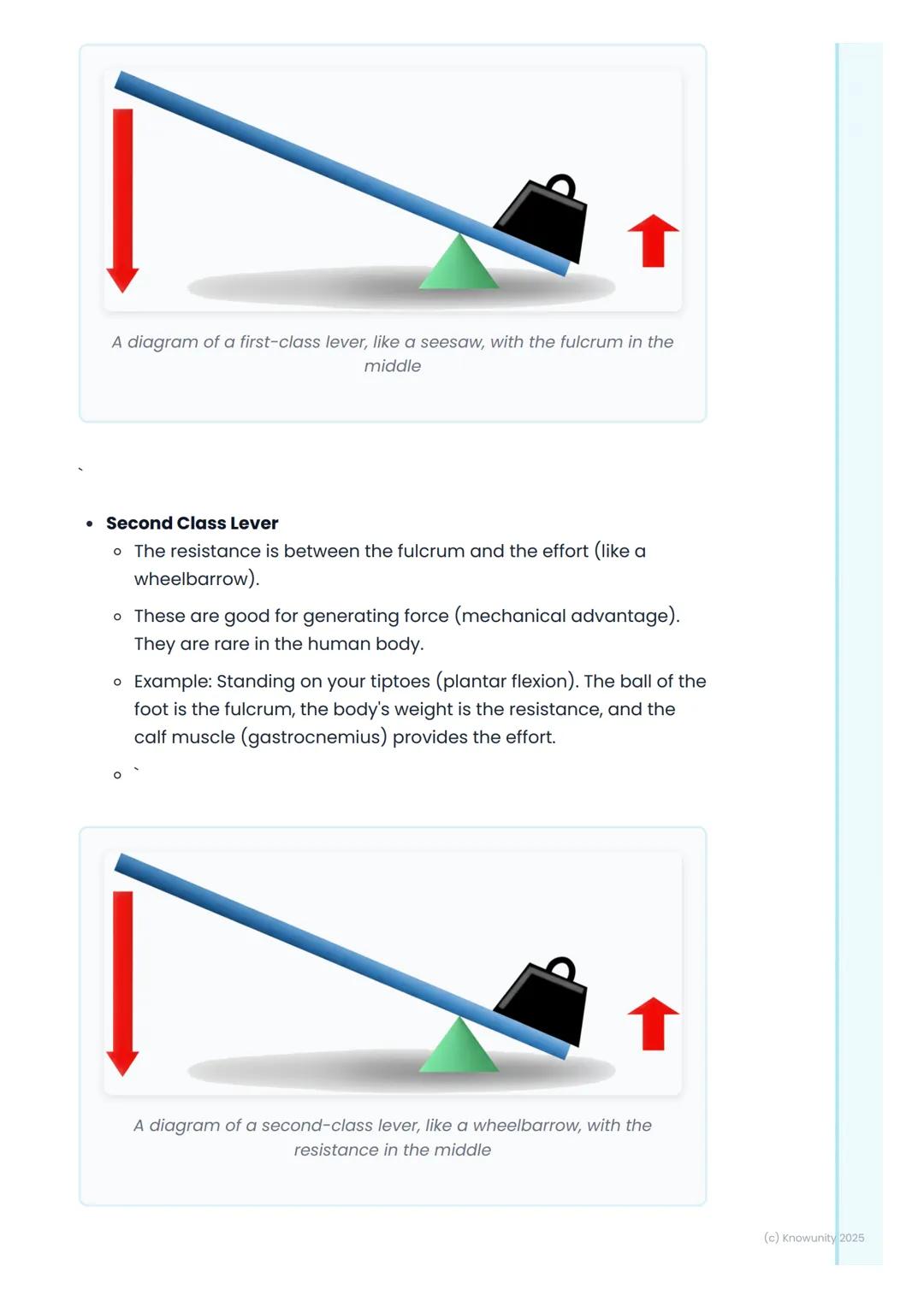
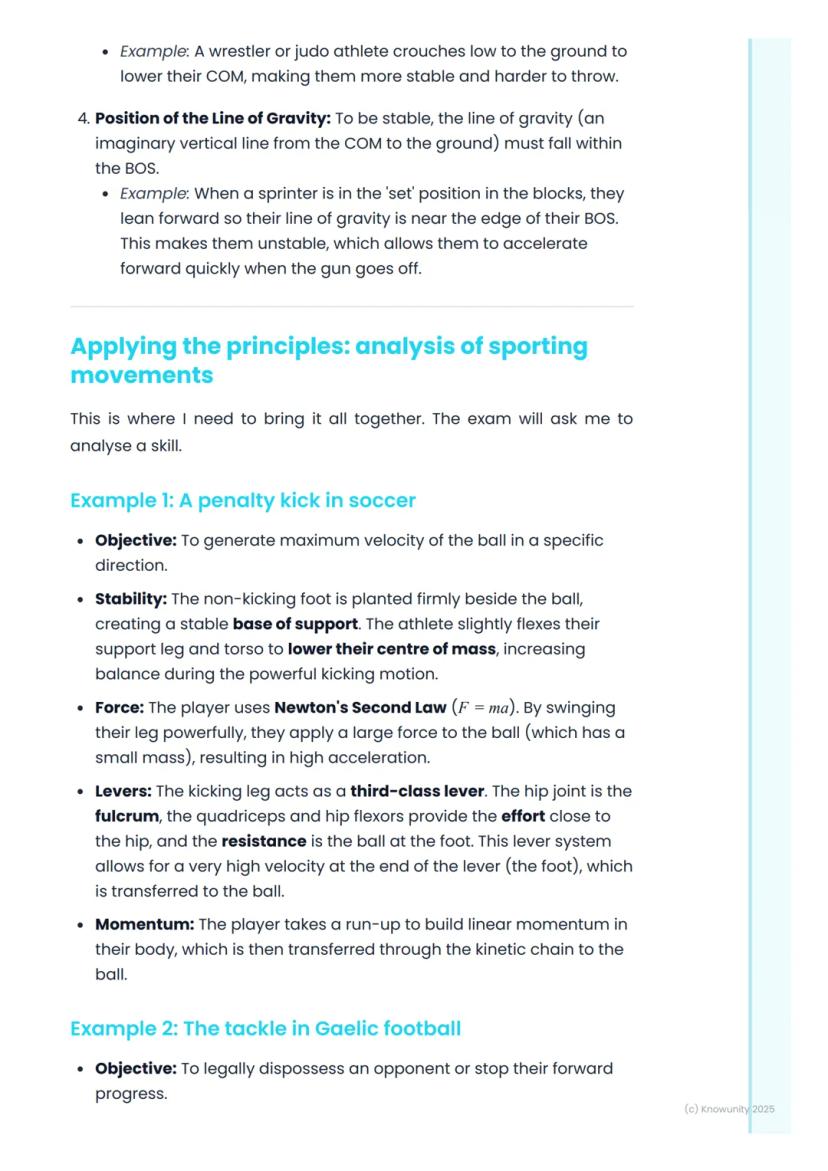
Mastering Stability and Balance
Stability isn't just about standing still – it's about controlling your body's position to perform effectively. Athletes need to be stable when applying force but unstable when they want to move quickly.
Four key factors affect your stability: greater body mass increases stability (harder to move a heavy rugby prop than a lightweight winger), wider base of support makes you more stable (boxers stand with feet apart), lower centre of mass increases stability (wrestlers crouch low), and keeping your line of gravity within your base of support maintains balance.
Smart athletes manipulate these factors constantly. A sprinter in the blocks deliberately becomes unstable by leaning forward, positioning their line of gravity at the edge of their base of support. This makes them ready to explode forward the moment the gun fires.
Pro Tip: Watch how different sports require different stability strategies – compare a gymnast on beam to a rugby player in a scrum!
5
of 8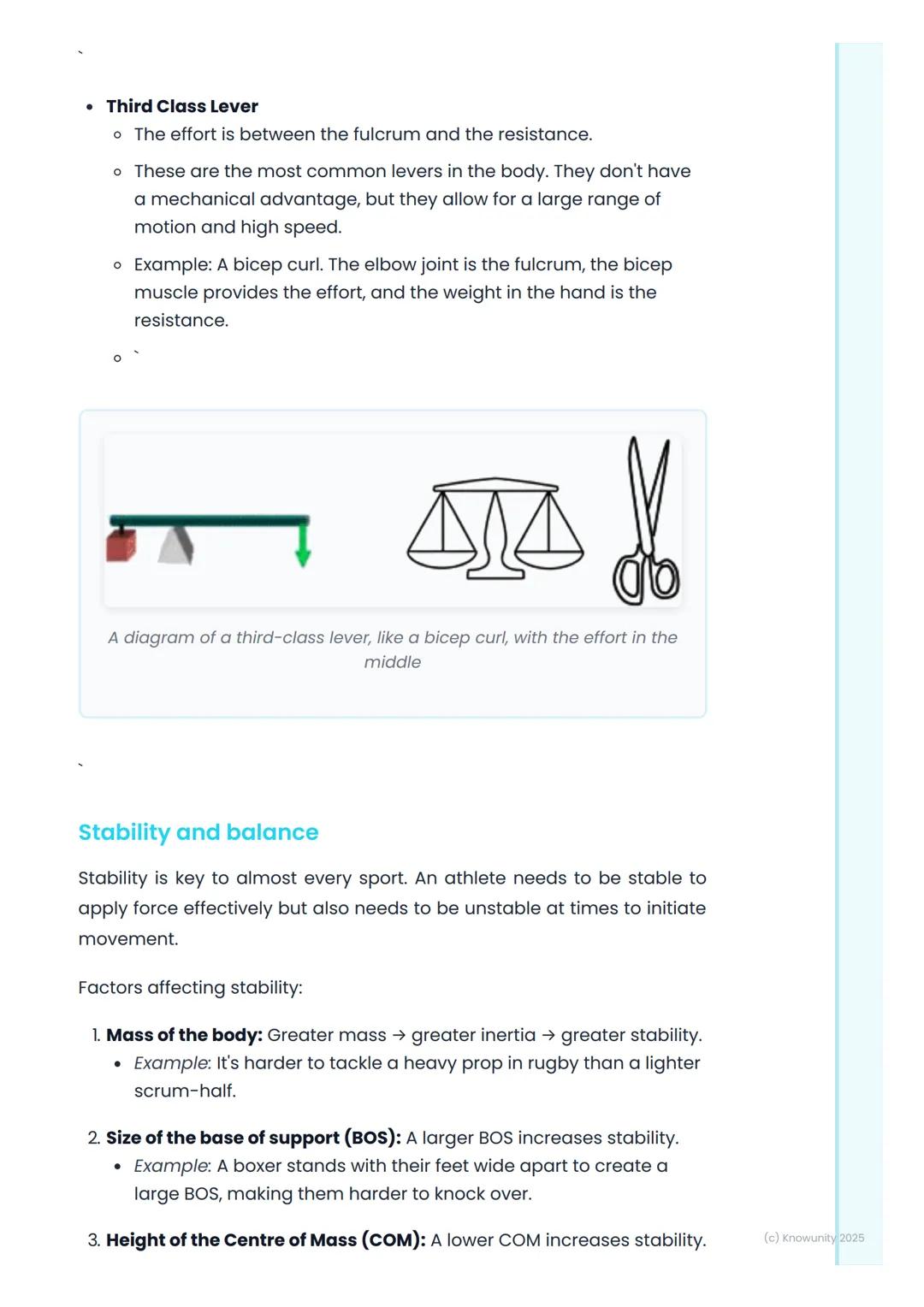
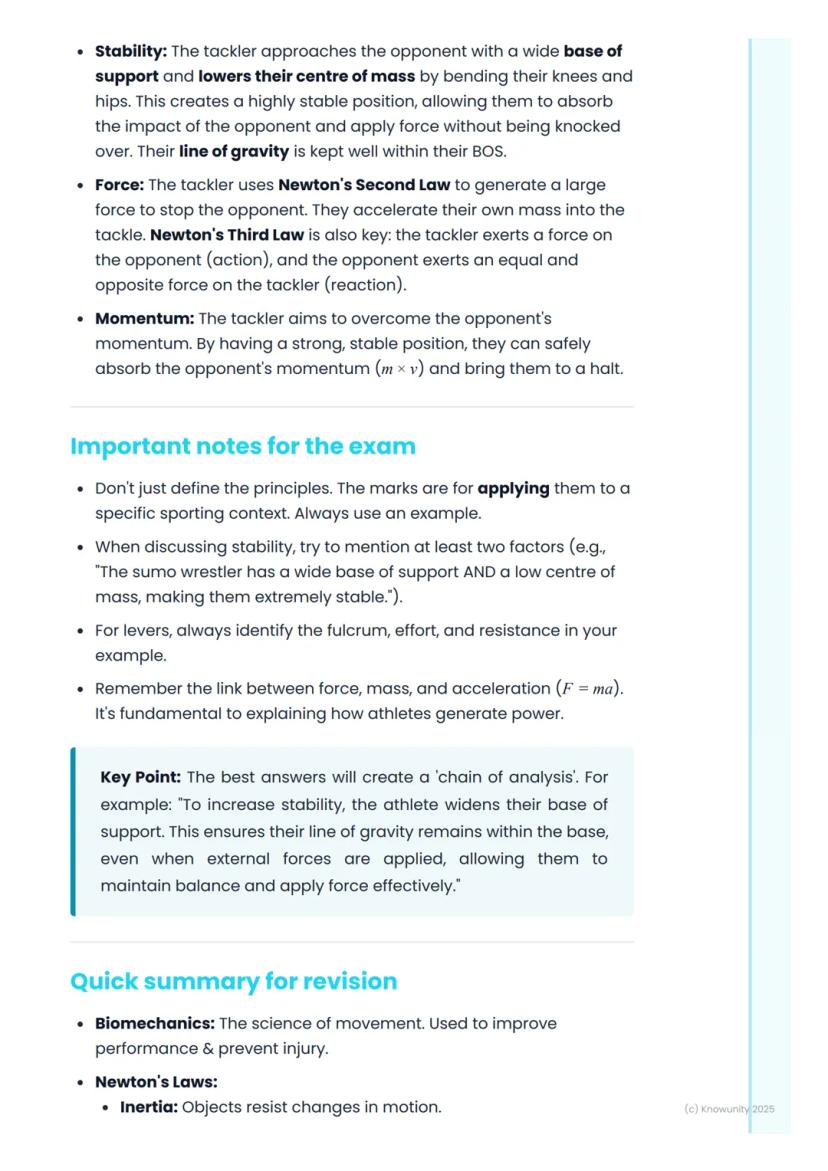
Analysing Real Sporting Movements
Let's put theory into practice with a penalty kick in soccer. The player plants their non-kicking foot firmly beside the ball, creating a stable base whilst slightly lowering their centre of mass. They use Newton's Second Law by swinging their leg powerfully to apply massive force to the lightweight ball, creating huge acceleration.
The kicking leg works as a third-class lever – hip joint as fulcrum, leg muscles providing effort, and the ball as resistance. This lever system allows incredible speed at the foot, which transfers to the ball. The run-up builds linear momentum that flows through the kinetic chain.
In contrast, a tackle in Gaelic football focuses on stability and force absorption. The tackler widens their base of support and lowers their centre of mass, creating a rock-solid platform. They use their own momentum to overcome the opponent's momentum, whilst Newton's Third Law explains the equal and opposite forces at impact.
Exam Success: Always link multiple principles together – show how stability enables force application, or how lever systems create the momentum needed for effective performance!
6
of 8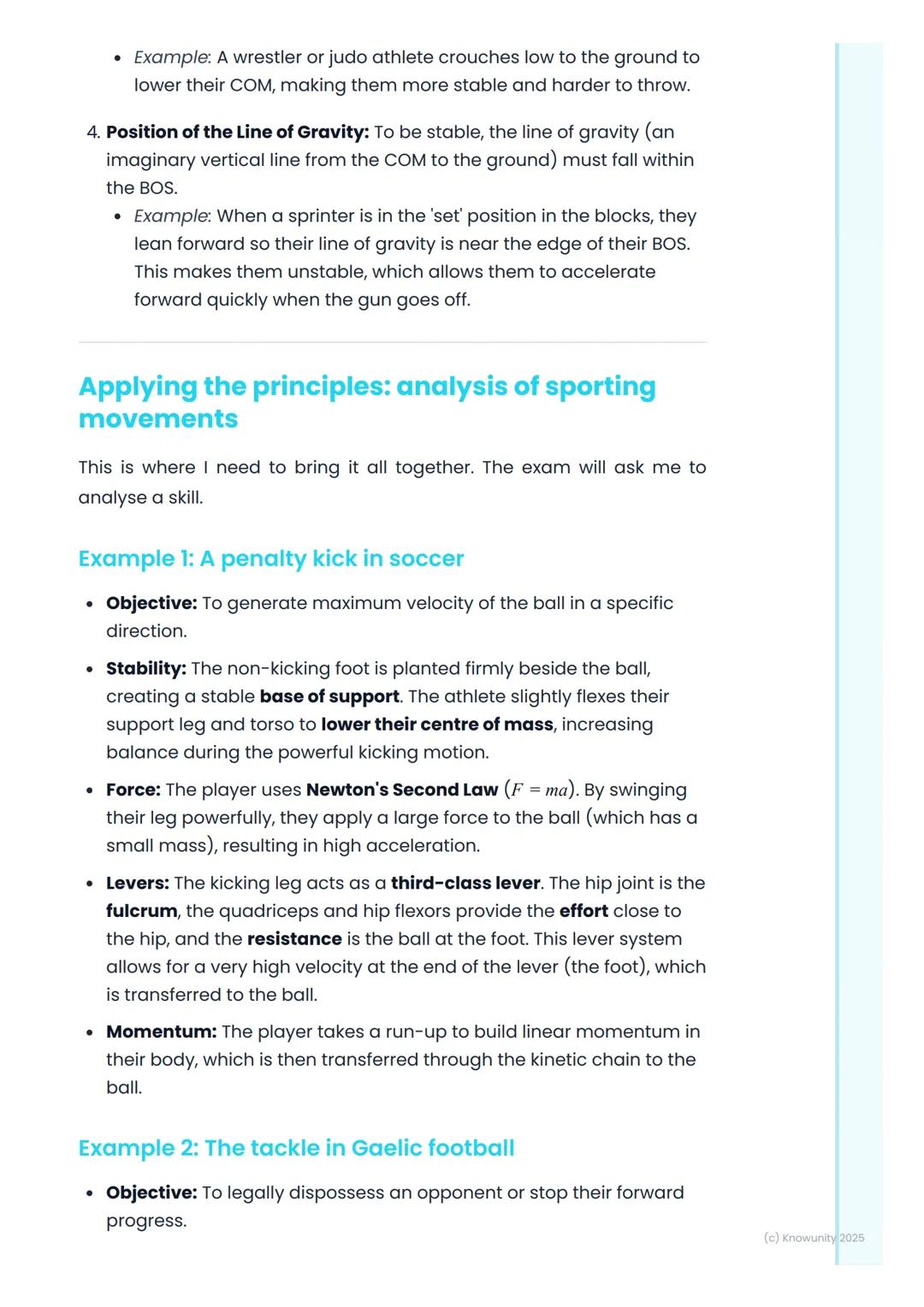
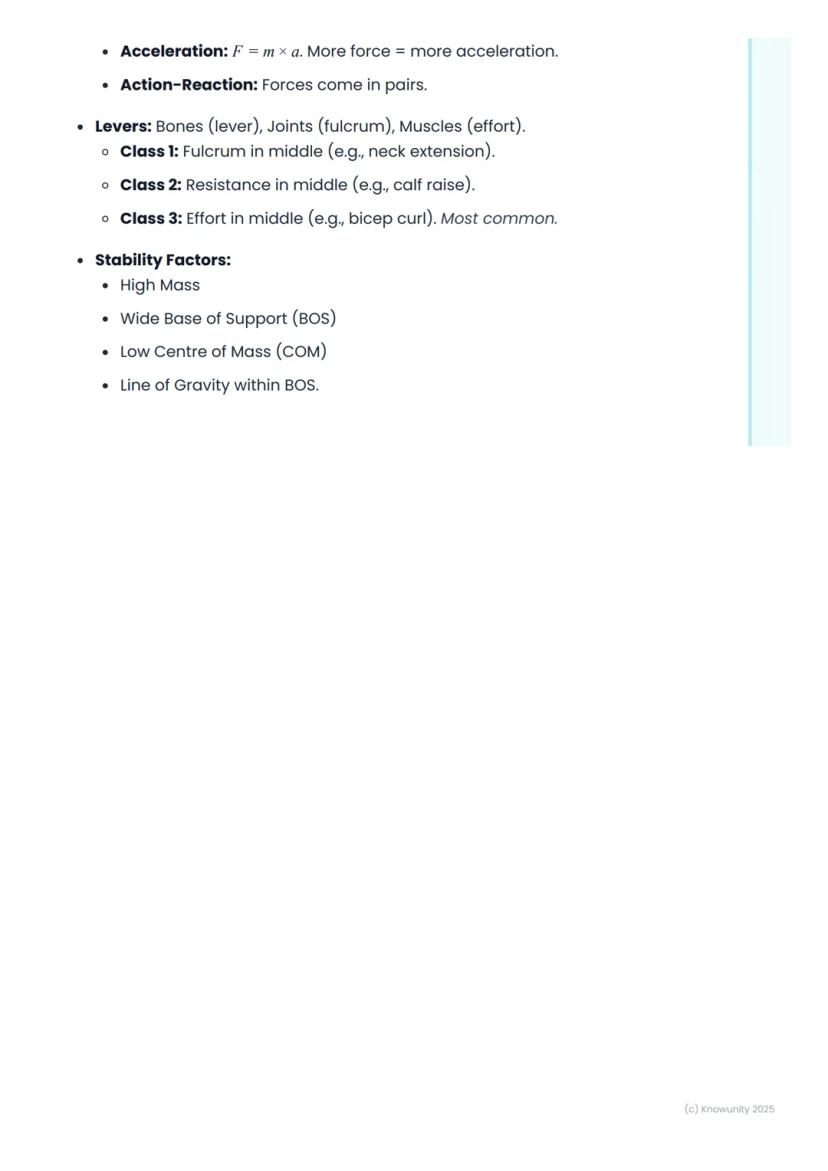
Quick Revision Summary
Newton's Laws: Inertia (objects resist change), F = ma (more force equals more acceleration), and action-reaction (forces always come in pairs). These explain every sporting movement from diving to weightlifting.
Lever Classes: First class has fulcrum in middle (neck movements), second class has resistance in middle (calf raises), third class has effort in middle (most body movements). Remember "FRE 123" for the order.
Stability Factors: High mass, wide base of support, low centre of mass, and line of gravity within base of support. Athletes manipulate these constantly – stable when applying force, unstable when initiating movement. Master these principles and you'll understand the "why" behind every technique in sport.
Final Thought: Biomechanics isn't just theory – it's the science that helps athletes break records and avoid injuries. These principles are your toolkit for understanding human movement!
7
of 8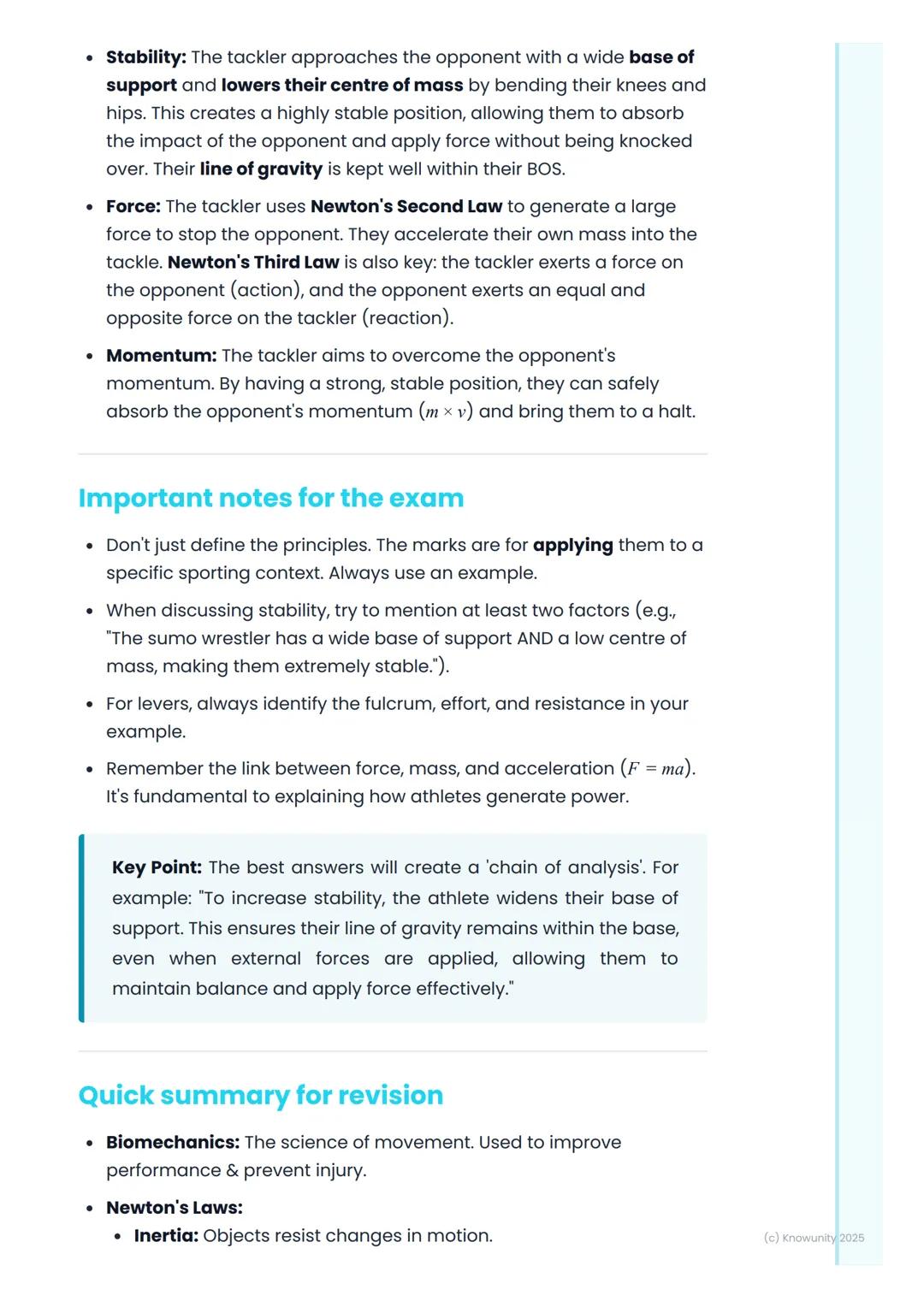
8
of 8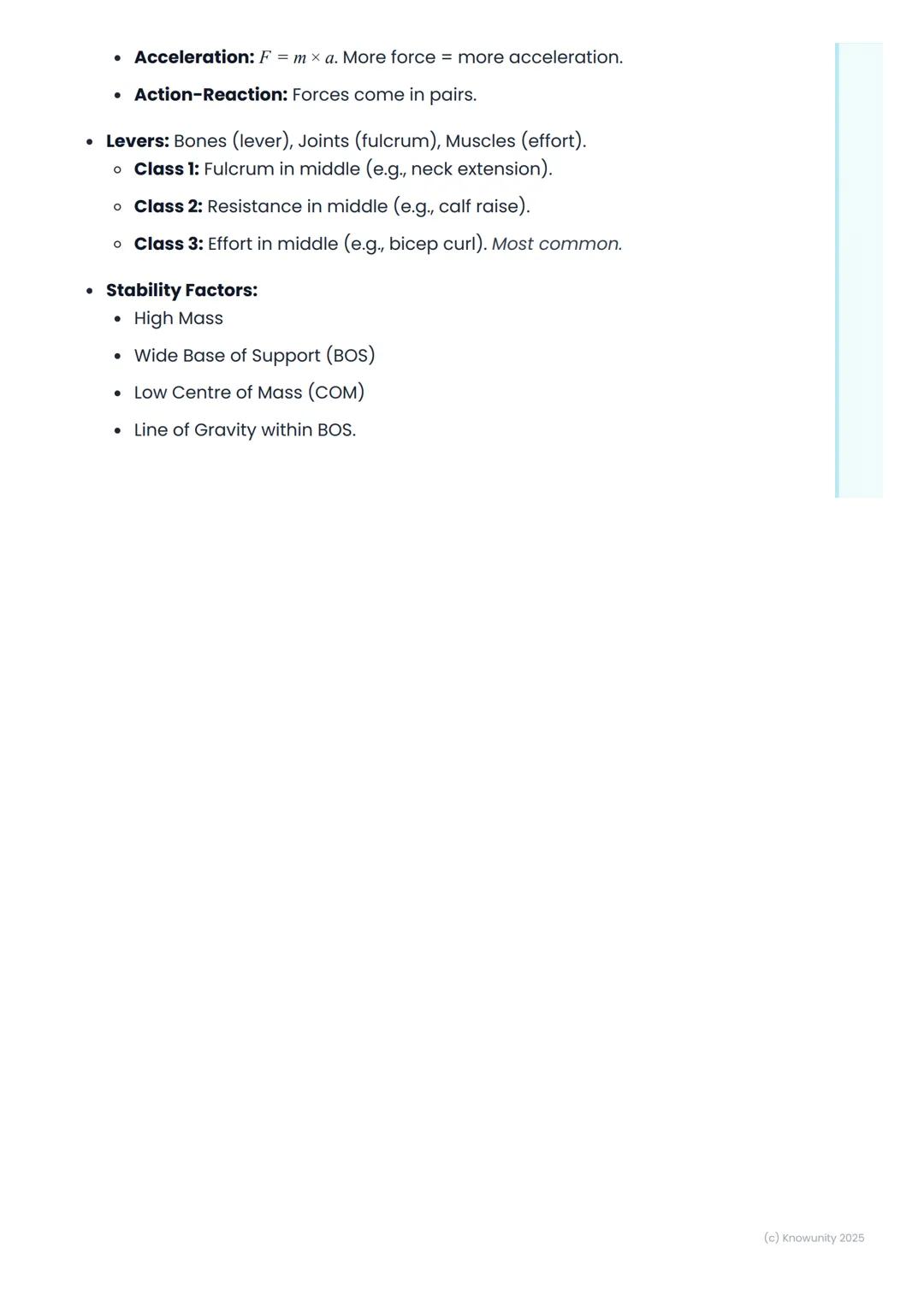
Νομίζαμε ότι δε θα ρωτούσες ποτέ...
Τι είναι ο AI σύντροφος του Knowunity;
Ο AI σύντροφός μας είναι ειδικά σχεδιασμένος για τις ανάγκες των μαθητών. Βασισμένοι στα εκατομμύρια κομμάτια Περιεχομένων που έχουμε στην πλατφόρμα, μπορούμε να παρέχουμε πραγματικά ουσιαστικές και σχετικές απαντήσεις στους μαθητές. Αλλά δεν αφορά μόνο τις απαντήσεις, ο σύντροφος είναι ακόμη περισσότερο για την καθοδήγηση των μαθητών στις καθημερινές τους μαθησιακές προκλήσεις, με εξατομικευμένα προγράμματα μελέτης, κουίζ ή Περιεχόμενα στη Συνομιλία και 100% εξατομίκευση βασισμένη στις δεξιότητες και την ανάπτυξη των μαθητών.
Πού μπορώ να κατεβάσω την εφαρμογή Knowunity;
Μπορείτε να κατεβάσετε την εφαρμογή από το Google Play Store και το Apple App Store.
Πώς μπορώ να λάβω την πληρωμή μου; Πόσα μπορώ να κερδίσω;
Ναι, έχετε δωρεάν πρόσβαση στο περιεχόμενο της εφαρμογής και στον AI companion μας. Για να ξεκλειδώσετε ορισμένες λειτουργίες της εφαρμογής, μπορείτε να αγοράσετε το Knowunity Pro.
Πιο δημοφιλή περιεχόμενα στο LCPE
3Πιο δημοφιλή περιεχόμενα
9Δε μπορείς να βρεις αυτό που ψάχνεις; Εξερεύνησε άλλα μαθήματα.
Κριτικές από τους χρήστες μας. Έχουν όλα τα καλά — και το ίδιο θα είχες κι εσύ.
4.6/5App Store
4.7/5Google Play
Η εφαρμογή είναι πολύ εύκολη στη χρήση και καλά σχεδιασμένη. Έχω βρει ό,τι έψαχνα μέχρι τώρα και έχω μάθει πολλά από τις παρουσιάσεις! Σίγουρα θα χρησιμοποιήσω την εφαρμογή για μια εργασία του μαθήματος! Και φυσικά βοηθάει πολύ και ως έμπνευση.
Στέφαν Σχρήστης iOS
Αυτή η εφαρμογή είναι πραγματικά τέλεια. Υπάρχουν τόσες πολλές σημειώσεις μελέτης και βοήθεια [...]. Το μάθημα που με δυσκολεύει είναι τα Γαλλικά, για παράδειγμα, και η εφαρμογή έχει τόσες επιλογές για βοήθεια. Χάρη σε αυτή την εφαρμογή, έχω βελτιώσει τα Γαλλικά μου. Θα την πρότεινα σε οποιονδήποτε.
Σαμάνθα Κλιχχρήστης Android
Ουάου, είμαι πραγματικά εντυπωσιασμένος. Δοκίμασα την εφαρμογή επειδή την είδα διαφημισμένη πολλές φορές και έμεινα άφωνος. Αυτή η εφαρμογή είναι Η ΒΟΗΘΕΙΑ που χρειάζεσαι για το σχολείο και πάνω απ' όλα, προσφέρει τόσα πράγματα, όπως ασκήσεις και φύλλα γεγονότων, που ήταν ΠΟΛΥ χρήσιμα για μένα προσωπικά.
Άνναχρήστης iOS
LCPE20 προβολές·Ενημερώθηκε Jun 11, 2026·8 σελίδεςUnderstanding Biomechanics: Principles of Movement Efficiency
Biomechanics might sound complicated, but it's just the physics behind how you move – and it's everywhere in sport. Understanding these principles will help you analyse why certain techniques work better than others and how athletes can improve their performance...
1
of 8
Κάνε εγγραφή για να δεις το ΠΕΡΙΕΧΟΜΕΝΟ. Είναι δωρεάν!
- Πρόσβαση σε όλα τα έγγραφα
- Βελτίωσε τους βαθμούς σου
- Γίνε μέλος με εκατομμύρια μαθητές
Understanding Biomechanics Basics
Biomechanics is essentially physics applied to human movement. It explains why some techniques work brilliantly whilst others fall flat, and it's your key to understanding how athletes can move more efficiently and safely.
The fundamental concepts you need to master include force (any push or pull measured in Newtons), motion (which comes in three types: linear like sprinting, angular like swinging a hurley, and general motion combining both), and velocity (speed with direction). Acceleration tells us how quickly velocity changes, whilst momentum combines mass and velocity to show how much "oomph" a moving object has.
Your centre of mass is your body's theoretical balance point – usually around your navel when standing still. Stability is your ability to resist being moved or to return to your original position. These concepts work together to explain every sporting movement you'll ever see.
Key Point: Don't just memorise definitions – think about how you see these principles in action during your favourite sports!
2
of 8Κάνε εγγραφή για να δεις το ΠΕΡΙΕΧΟΜΕΝΟ. Είναι δωρεάν!
- Πρόσβαση σε όλα τα έγγραφα
- Βελτίωσε τους βαθμούς σου
- Γίνε μέλος με εκατομμύρια μαθητές
Newton's Laws in Sport
Newton's three laws govern every sporting movement you can imagine. Newton's First Law (inertia) explains why a Gaelic football stays put until you kick it, and why it keeps flying until air resistance slows it down. Objects resist changes to their motion – the heavier they are, the more they resist.
Newton's Second Law gives us the crucial formula: Force = Mass × Acceleration. This explains why shot putters need massive force to accelerate that heavy ball, or why a lighter hurley can be swung faster than a heavier one. Want more acceleration? Apply more force or reduce the mass.
Newton's Third Law states that every action has an equal and opposite reaction. When you jump, you push down on the ground with a certain force, and the ground pushes back up on you with exactly the same force – that's what launches you into the air.
Remember: These laws work together in every sport – a sprinter uses all three when exploding from the blocks!
3
of 8Κάνε εγγραφή για να δεις το ΠΕΡΙΕΧΟΜΕΝΟ. Είναι δωρεάν!
- Πρόσβαση σε όλα τα έγγραφα
- Βελτίωσε τους βαθμούς σου
- Γίνε μέλος με εκατομμύρια μαθητές
The Body's Lever System
Your body is basically a complex system of levers working together. Bones act as lever arms, joints serve as fulcrums, and muscles provide the effort to move loads like your body weight or sports equipment.
There are three classes of levers, and you can remember them with "FRE 123" – First class has the fulcrum in the middle (like nodding your head), second class has the resistance in the middle (like standing on your tiptoes), and third class has the effort in the middle (like doing a bicep curl).
Third-class levers are the most common in your body. They don't give you a mechanical advantage for strength, but they're brilliant for creating speed and range of motion. That's why you can swing a hurley or tennis racket so quickly – your arm acts as a third-class lever system.
Think About It: Every time you throw, kick, or swing something, you're using multiple lever systems working in sequence!
4
of 8Κάνε εγγραφή για να δεις το ΠΕΡΙΕΧΟΜΕΝΟ. Είναι δωρεάν!
- Πρόσβαση σε όλα τα έγγραφα
- Βελτίωσε τους βαθμούς σου
- Γίνε μέλος με εκατομμύρια μαθητές
Mastering Stability and Balance
Stability isn't just about standing still – it's about controlling your body's position to perform effectively. Athletes need to be stable when applying force but unstable when they want to move quickly.
Four key factors affect your stability: greater body mass increases stability (harder to move a heavy rugby prop than a lightweight winger), wider base of support makes you more stable (boxers stand with feet apart), lower centre of mass increases stability (wrestlers crouch low), and keeping your line of gravity within your base of support maintains balance.
Smart athletes manipulate these factors constantly. A sprinter in the blocks deliberately becomes unstable by leaning forward, positioning their line of gravity at the edge of their base of support. This makes them ready to explode forward the moment the gun fires.
Pro Tip: Watch how different sports require different stability strategies – compare a gymnast on beam to a rugby player in a scrum!
5
of 8Κάνε εγγραφή για να δεις το ΠΕΡΙΕΧΟΜΕΝΟ. Είναι δωρεάν!
- Πρόσβαση σε όλα τα έγγραφα
- Βελτίωσε τους βαθμούς σου
- Γίνε μέλος με εκατομμύρια μαθητές
Analysing Real Sporting Movements
Let's put theory into practice with a penalty kick in soccer. The player plants their non-kicking foot firmly beside the ball, creating a stable base whilst slightly lowering their centre of mass. They use Newton's Second Law by swinging their leg powerfully to apply massive force to the lightweight ball, creating huge acceleration.
The kicking leg works as a third-class lever – hip joint as fulcrum, leg muscles providing effort, and the ball as resistance. This lever system allows incredible speed at the foot, which transfers to the ball. The run-up builds linear momentum that flows through the kinetic chain.
In contrast, a tackle in Gaelic football focuses on stability and force absorption. The tackler widens their base of support and lowers their centre of mass, creating a rock-solid platform. They use their own momentum to overcome the opponent's momentum, whilst Newton's Third Law explains the equal and opposite forces at impact.
Exam Success: Always link multiple principles together – show how stability enables force application, or how lever systems create the momentum needed for effective performance!
6
of 8Κάνε εγγραφή για να δεις το ΠΕΡΙΕΧΟΜΕΝΟ. Είναι δωρεάν!
- Πρόσβαση σε όλα τα έγγραφα
- Βελτίωσε τους βαθμούς σου
- Γίνε μέλος με εκατομμύρια μαθητές
Quick Revision Summary
Newton's Laws: Inertia (objects resist change), F = ma (more force equals more acceleration), and action-reaction (forces always come in pairs). These explain every sporting movement from diving to weightlifting.
Lever Classes: First class has fulcrum in middle (neck movements), second class has resistance in middle (calf raises), third class has effort in middle (most body movements). Remember "FRE 123" for the order.
Stability Factors: High mass, wide base of support, low centre of mass, and line of gravity within base of support. Athletes manipulate these constantly – stable when applying force, unstable when initiating movement. Master these principles and you'll understand the "why" behind every technique in sport.
Final Thought: Biomechanics isn't just theory – it's the science that helps athletes break records and avoid injuries. These principles are your toolkit for understanding human movement!
7
of 8Κάνε εγγραφή για να δεις το ΠΕΡΙΕΧΟΜΕΝΟ. Είναι δωρεάν!
- Πρόσβαση σε όλα τα έγγραφα
- Βελτίωσε τους βαθμούς σου
- Γίνε μέλος με εκατομμύρια μαθητές
8
of 8Κάνε εγγραφή για να δεις το ΠΕΡΙΕΧΟΜΕΝΟ. Είναι δωρεάν!
- Πρόσβαση σε όλα τα έγγραφα
- Βελτίωσε τους βαθμούς σου
- Γίνε μέλος με εκατομμύρια μαθητές
Νομίζαμε ότι δε θα ρωτούσες ποτέ...
Τι είναι ο AI σύντροφος του Knowunity;
Ο AI σύντροφός μας είναι ειδικά σχεδιασμένος για τις ανάγκες των μαθητών. Βασισμένοι στα εκατομμύρια κομμάτια Περιεχομένων που έχουμε στην πλατφόρμα, μπορούμε να παρέχουμε πραγματικά ουσιαστικές και σχετικές απαντήσεις στους μαθητές. Αλλά δεν αφορά μόνο τις απαντήσεις, ο σύντροφος είναι ακόμη περισσότερο για την καθοδήγηση των μαθητών στις καθημερινές τους μαθησιακές προκλήσεις, με εξατομικευμένα προγράμματα μελέτης, κουίζ ή Περιεχόμενα στη Συνομιλία και 100% εξατομίκευση βασισμένη στις δεξιότητες και την ανάπτυξη των μαθητών.
Πού μπορώ να κατεβάσω την εφαρμογή Knowunity;
Μπορείτε να κατεβάσετε την εφαρμογή από το Google Play Store και το Apple App Store.
Πώς μπορώ να λάβω την πληρωμή μου; Πόσα μπορώ να κερδίσω;
Ναι, έχετε δωρεάν πρόσβαση στο περιεχόμενο της εφαρμογής και στον AI companion μας. Για να ξεκλειδώσετε ορισμένες λειτουργίες της εφαρμογής, μπορείτε να αγοράσετε το Knowunity Pro.
Πιο δημοφιλή περιεχόμενα στο LCPE
3Πιο δημοφιλή περιεχόμενα
9Δε μπορείς να βρεις αυτό που ψάχνεις; Εξερεύνησε άλλα μαθήματα.
Κριτικές από τους χρήστες μας. Έχουν όλα τα καλά — και το ίδιο θα είχες κι εσύ.
4.6/5App Store
4.7/5Google Play
Η εφαρμογή είναι πολύ εύκολη στη χρήση και καλά σχεδιασμένη. Έχω βρει ό,τι έψαχνα μέχρι τώρα και έχω μάθει πολλά από τις παρουσιάσεις! Σίγουρα θα χρησιμοποιήσω την εφαρμογή για μια εργασία του μαθήματος! Και φυσικά βοηθάει πολύ και ως έμπνευση.
Στέφαν Σχρήστης iOS
Αυτή η εφαρμογή είναι πραγματικά τέλεια. Υπάρχουν τόσες πολλές σημειώσεις μελέτης και βοήθεια [...]. Το μάθημα που με δυσκολεύει είναι τα Γαλλικά, για παράδειγμα, και η εφαρμογή έχει τόσες επιλογές για βοήθεια. Χάρη σε αυτή την εφαρμογή, έχω βελτιώσει τα Γαλλικά μου. Θα την πρότεινα σε οποιονδήποτε.
Σαμάνθα Κλιχχρήστης Android
Ουάου, είμαι πραγματικά εντυπωσιασμένος. Δοκίμασα την εφαρμογή επειδή την είδα διαφημισμένη πολλές φορές και έμεινα άφωνος. Αυτή η εφαρμογή είναι Η ΒΟΗΘΕΙΑ που χρειάζεσαι για το σχολείο και πάνω απ' όλα, προσφέρει τόσα πράγματα, όπως ασκήσεις και φύλλα γεγονότων, που ήταν ΠΟΛΥ χρήσιμα για μένα προσωπικά.
Άνναχρήστης iOS