
Ever wondered why some athletes crumble under pressure whilst others...
 LCPE4 προβολές·Ενημερώθηκε Jun 15, 2026·5 σελίδες
Understanding Arousal and Anxiety: Effects on Performance
1 / 5
1
of 5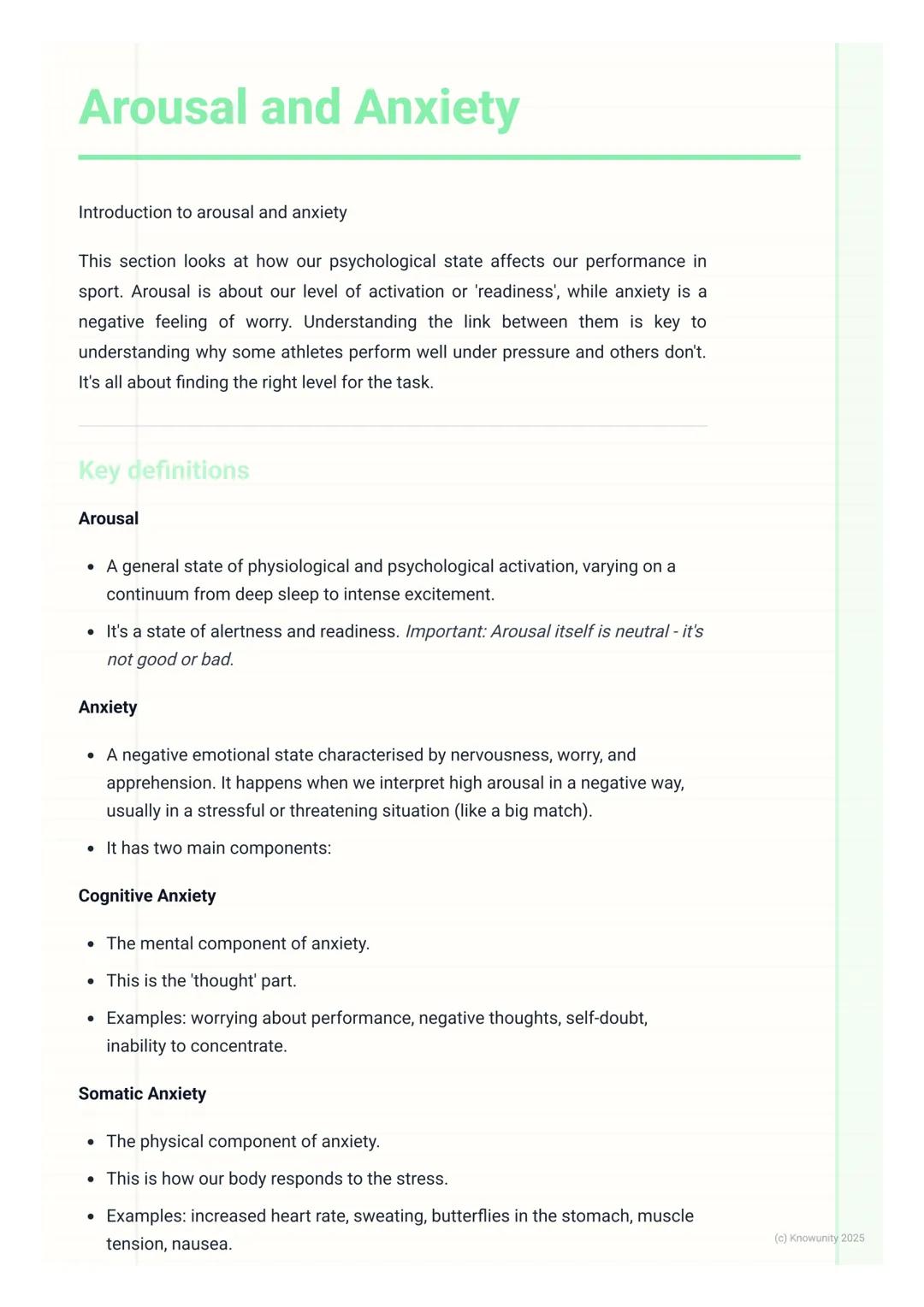
Understanding Arousal and Anxiety
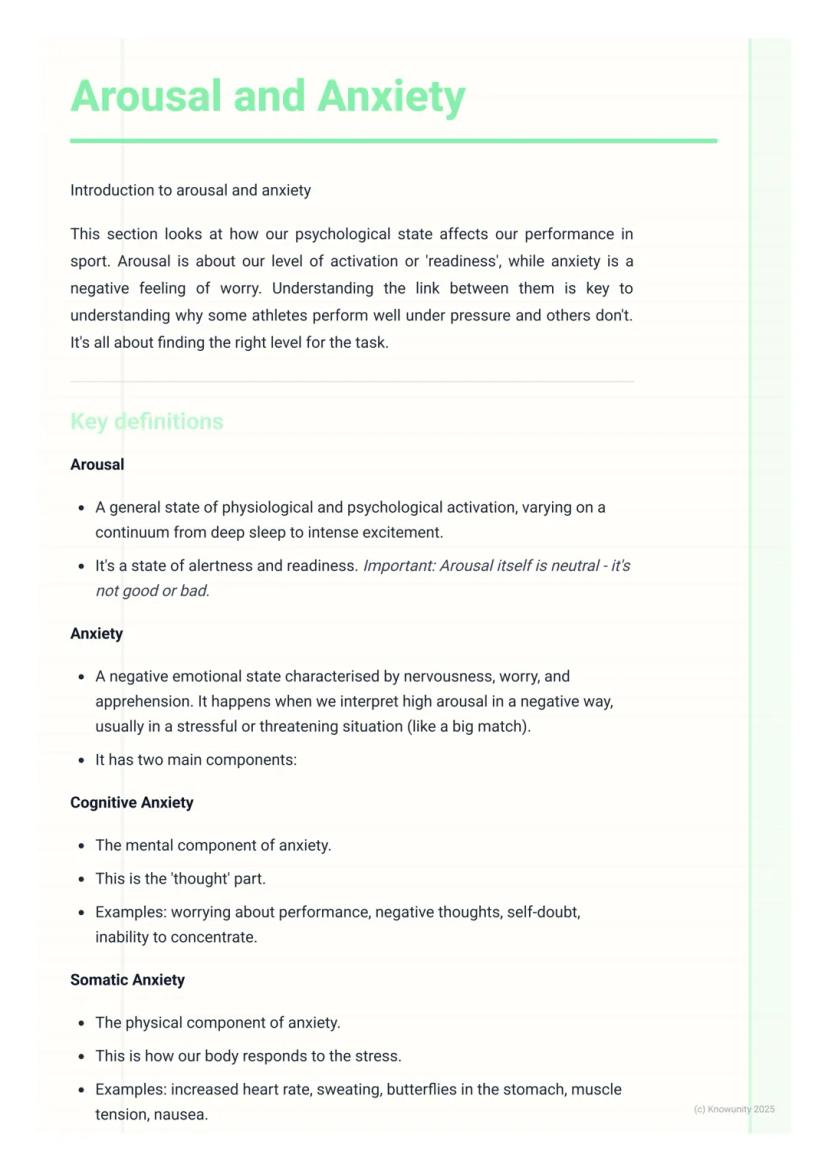
Think of arousal as your body's engine revving up - it's simply your level of alertness and readiness, ranging from being half-asleep to buzzing with excitement. Here's the crucial bit: arousal isn't good or bad, it's completely neutral.
Anxiety, however, is when things go wrong. It's that horrible feeling of worry and nervousness that hits when you interpret high arousal negatively - like when you're about to take a crucial penalty in front of thousands of people.
Anxiety shows up in two ways. Cognitive anxiety messes with your head - think negative thoughts, worrying about failing, or losing concentration. Somatic anxiety attacks your body with symptoms like sweating, butterflies in your stomach, shaking hands, or your heart pounding out of your chest.
Quick Check: Remember that arousal is neutral energy, whilst anxiety is when that energy becomes negative and starts working against you.
2
of 5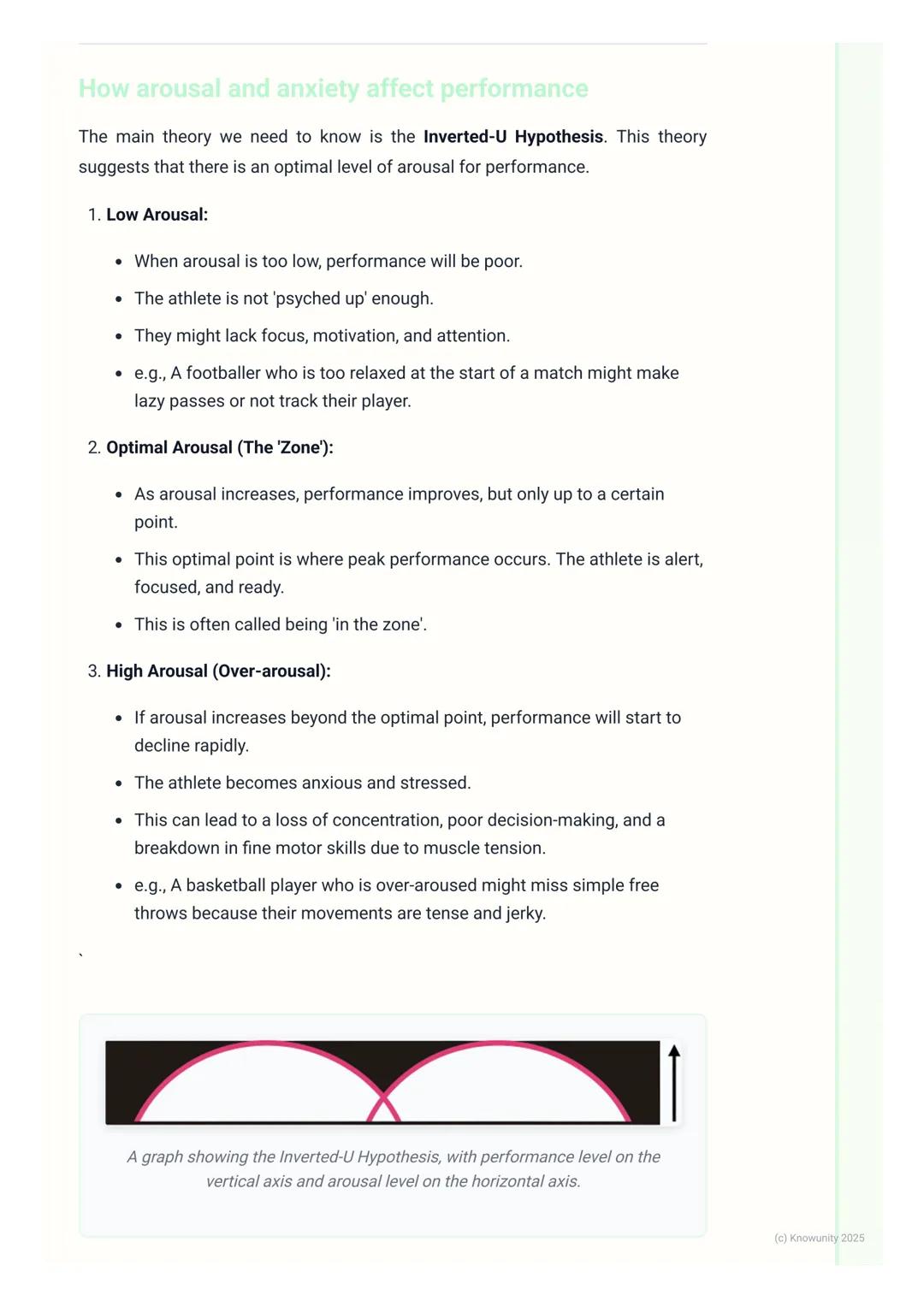
The Inverted-U Hypothesis
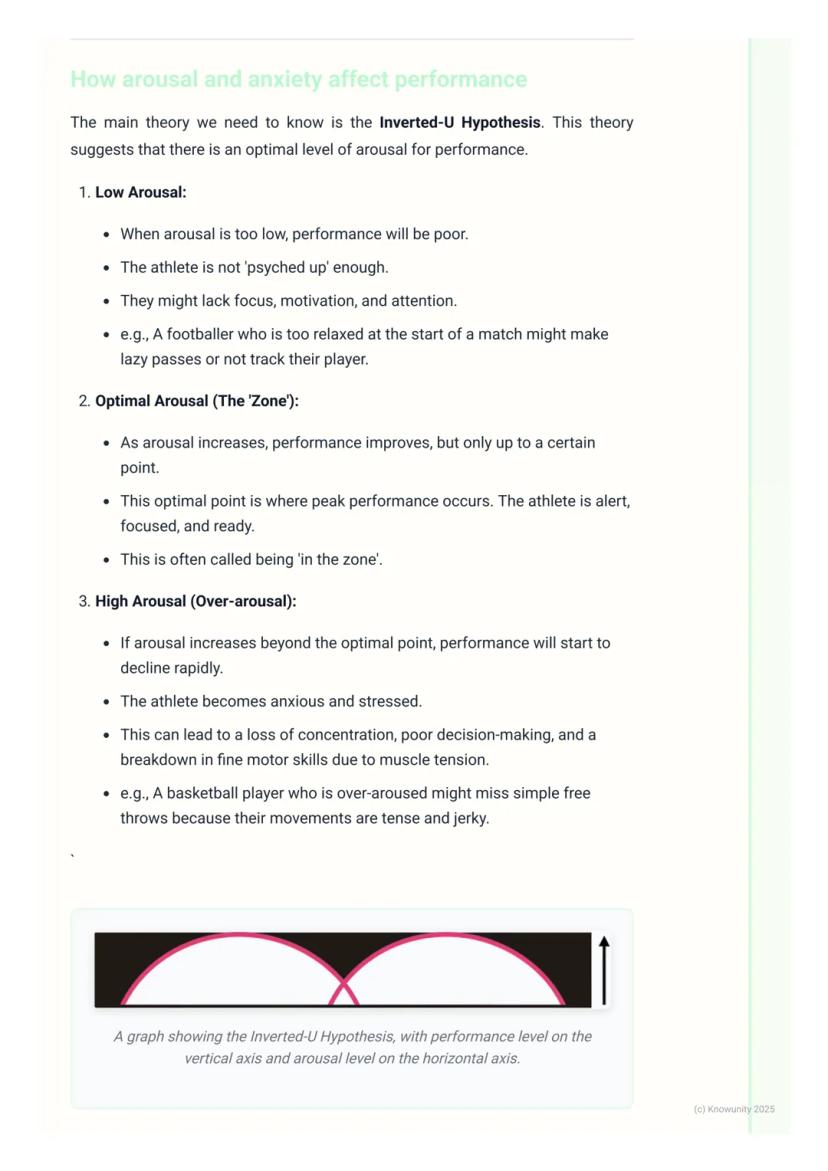
This theory is absolutely essential for understanding sports performance. Picture an upside-down U shape - that's how arousal affects your performance, and it explains why finding the sweet spot matters so much.
When arousal is too low, you'll perform poorly because you're not mentally switched on. You might lack focus or motivation - like a footballer making lazy passes because they're not properly warmed up mentally.
At optimal arousal (the magic zone), you hit peak performance. You're alert, focused, and everything clicks into place. This is what athletes mean when they talk about being "in the zone" - it's genuinely the best feeling in sport.
But push arousal too high and you'll crash spectacularly. Over-arousal triggers anxiety, causing poor decision-making, loss of concentration, and tense muscles that ruin your technique. Think of a basketball player missing simple free throws because they're too wound up.
Performance Tip: Your optimal arousal level isn't fixed - it changes depending on what sport you're playing and how experienced you are.
3
of 5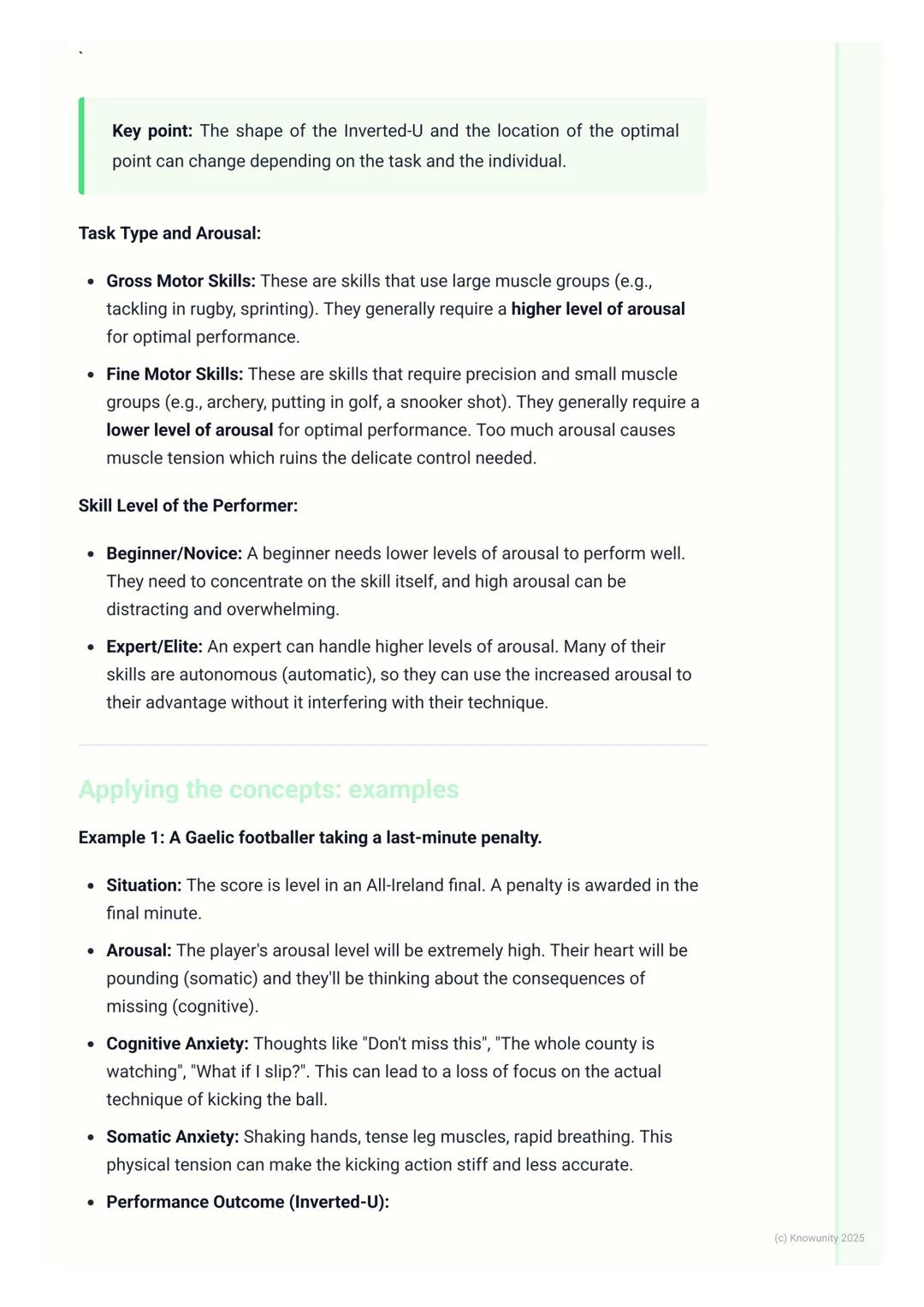
What Affects Your Optimal Arousal Level
Not all sports need the same arousal level, and this is where understanding task types becomes crucial for your performance.
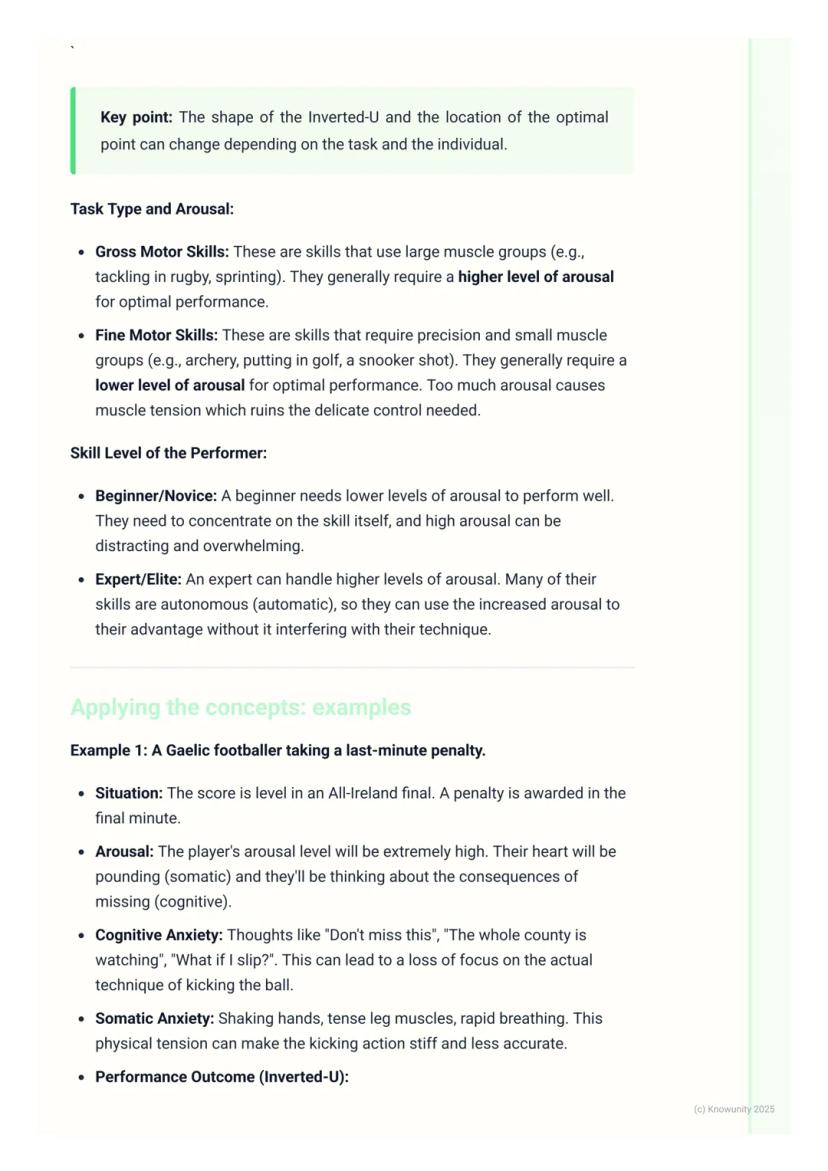
Gross motor skills use big muscle groups - like tackling in rugby or sprinting. These activities can handle much higher arousal levels because the movements are powerful and explosive. Getting properly fired up actually helps your performance here.
Fine motor skills require precision and small muscle control - think archery, putting in golf, or taking a snooker shot. These need much lower arousal levels because too much energy creates muscle tension that destroys the delicate control you need.
Your skill level also matters massively. Beginners need lower arousal to concentrate on learning the basic technique - high arousal just becomes overwhelming and distracting. Expert athletes can handle much higher arousal because their skills are automatic, so they can channel that extra energy positively.
Exam Gold: Always mention both task type and skill level when applying the Inverted-U hypothesis to examples.
4
of 5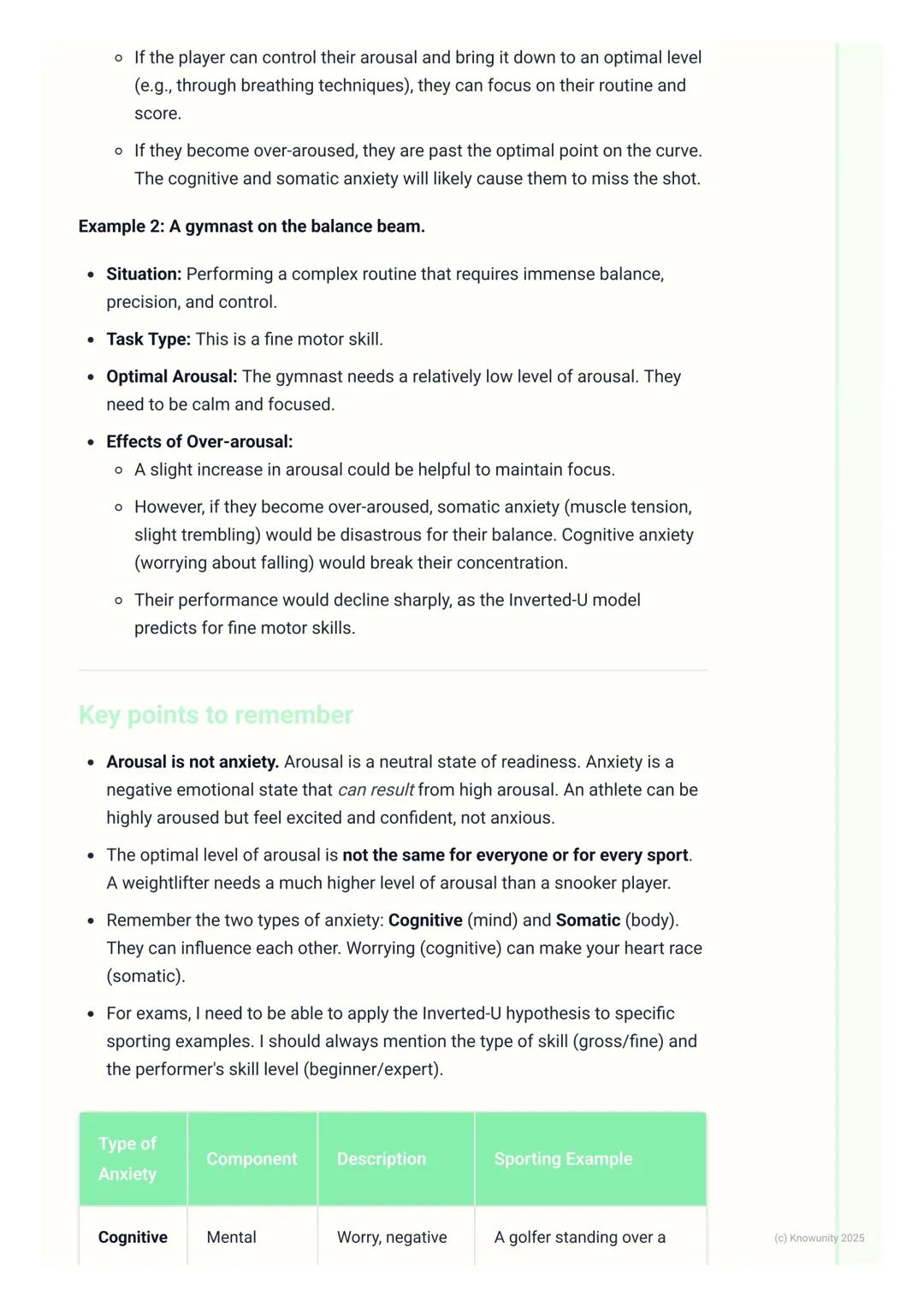
Real-World Examples
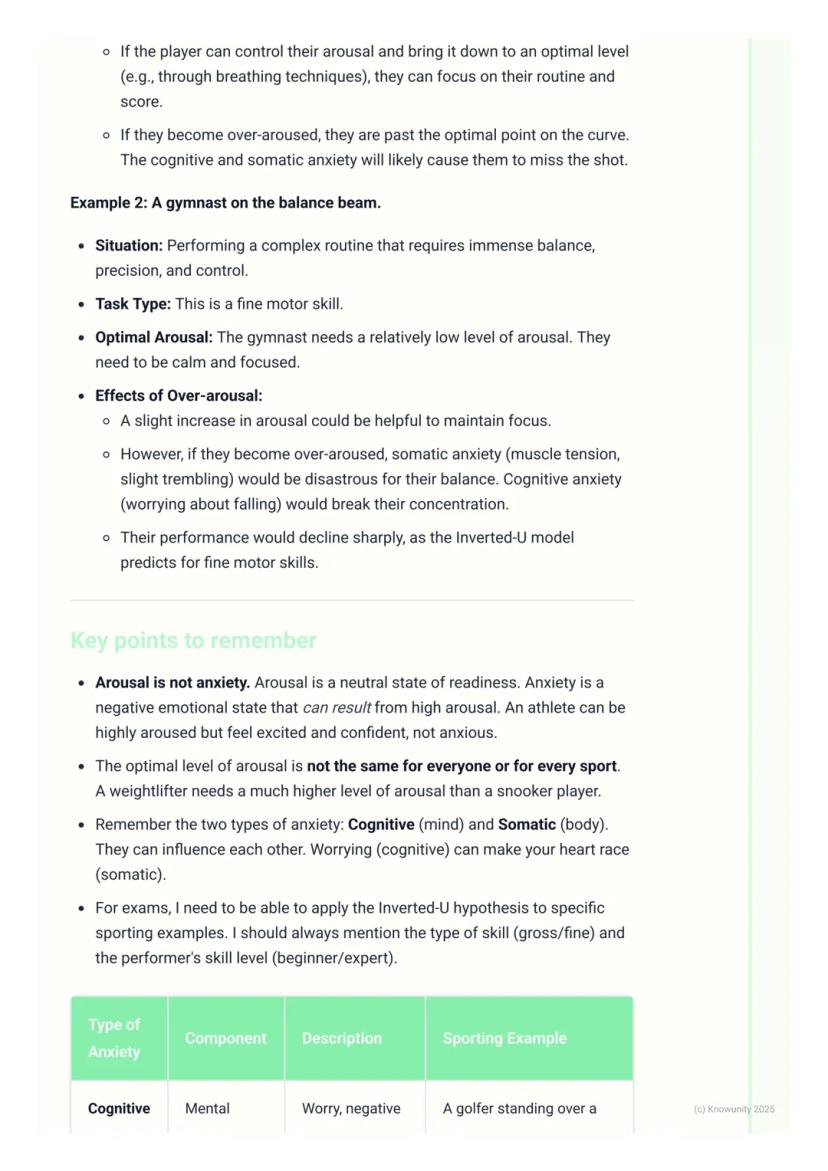
Picture a Gaelic footballer taking a last-minute penalty in an All-Ireland final. Their arousal will be through the roof - heart pounding (somatic anxiety) whilst thinking "don't miss this, everyone's watching" (cognitive anxiety).
If they can control that arousal through breathing techniques and focus on their routine, they'll likely score. But if they become over-aroused, the muscle tension and negative thoughts will probably cause them to miss - they've gone past their optimal point on the curve.
Now consider a gymnast on the balance beam. This fine motor skill needs relatively low arousal for the precision and control required. A slight increase might help focus, but over-arousal would be disastrous - muscle tension would ruin their balance, whilst worrying about falling would shatter their concentration.
The key difference? The footballer can potentially use higher arousal (gross motor skill), whilst the gymnast needs to stay much calmer (fine motor skill). Both need to find their sweet spot, but those spots are in completely different places.
Remember: Arousal and anxiety aren't the same thing - you can be highly aroused but feel excited and confident, not anxious.
5
of 5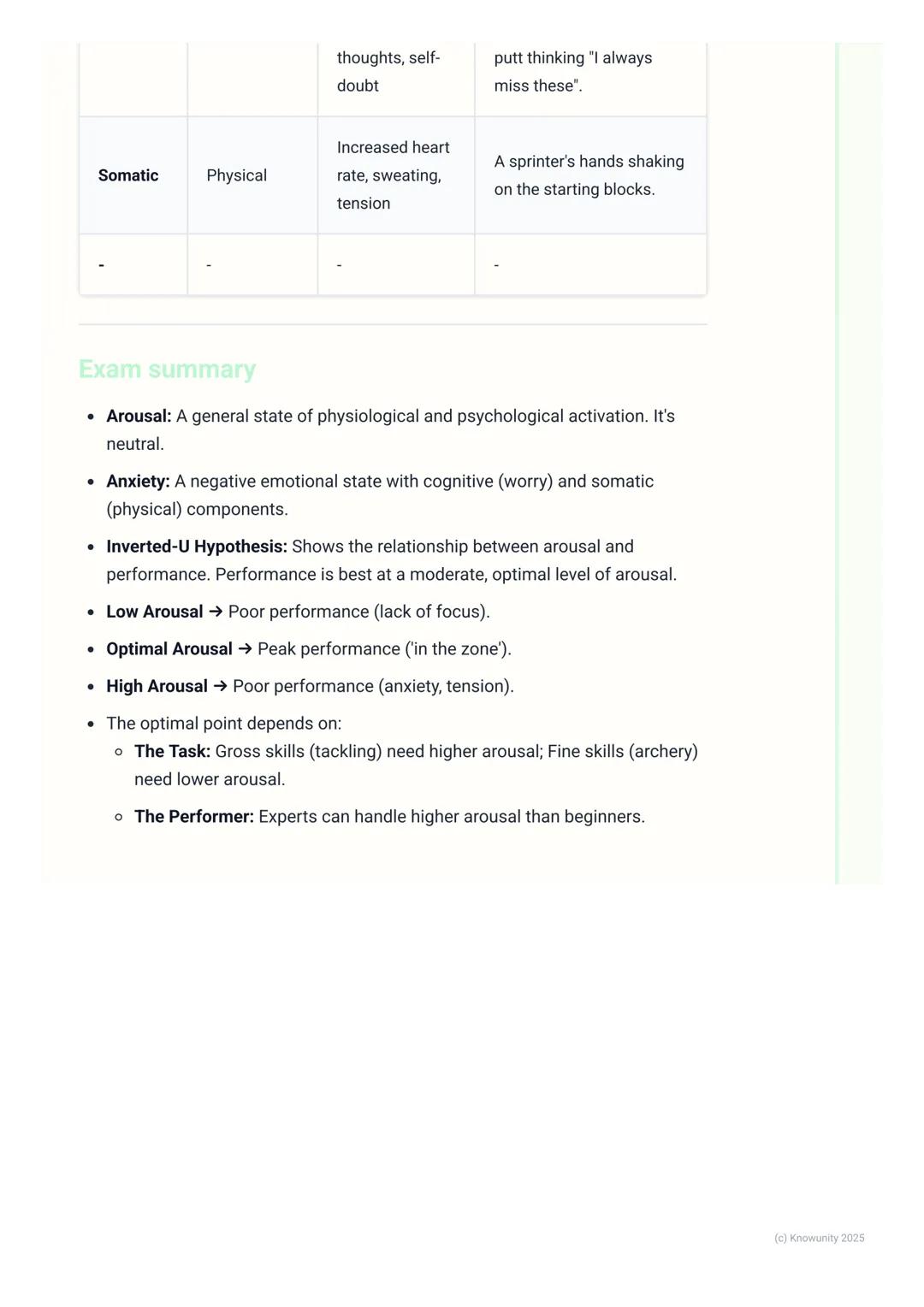
Exam Summary
Arousal is your neutral state of activation - think of it as your psychological and physical readiness level. Anxiety is when high arousal turns negative, creating worry (cognitive anxiety) and physical symptoms like sweating or shaking (somatic anxiety).
The Inverted-U Hypothesis shows that performance peaks at moderate arousal levels. Too low means poor focus, optimal means peak performance, and too high creates anxiety that destroys performance.
Your optimal arousal depends on two key factors. Task type matters - gross motor skills (tackling) can handle higher arousal, whilst fine motor skills (archery) need lower levels. Performer level also counts - experts can cope with higher arousal than beginners.
For your exams, always apply these concepts to specific sporting examples. Mention whether it's a gross or fine motor skill, consider the performer's experience level, and explain how different arousal levels would affect their performance using the Inverted-U model.
Exam Success: Practice applying the Inverted-U hypothesis to different sports scenarios - it's a guaranteed way to pick up marks and show you truly understand the concept.
Νομίζαμε ότι δε θα ρωτούσες ποτέ...
Τι είναι ο AI σύντροφος του Knowunity;
Ο AI σύντροφός μας είναι ειδικά σχεδιασμένος για τις ανάγκες των μαθητών. Βασισμένοι στα εκατομμύρια κομμάτια Περιεχομένων που έχουμε στην πλατφόρμα, μπορούμε να παρέχουμε πραγματικά ουσιαστικές και σχετικές απαντήσεις στους μαθητές. Αλλά δεν αφορά μόνο τις απαντήσεις, ο σύντροφος είναι ακόμη περισσότερο για την καθοδήγηση των μαθητών στις καθημερινές τους μαθησιακές προκλήσεις, με εξατομικευμένα προγράμματα μελέτης, κουίζ ή Περιεχόμενα στη Συνομιλία και 100% εξατομίκευση βασισμένη στις δεξιότητες και την ανάπτυξη των μαθητών.
Πού μπορώ να κατεβάσω την εφαρμογή Knowunity;
Μπορείτε να κατεβάσετε την εφαρμογή από το Google Play Store και το Apple App Store.
Πώς μπορώ να λάβω την πληρωμή μου; Πόσα μπορώ να κερδίσω;
Ναι, έχετε δωρεάν πρόσβαση στο περιεχόμενο της εφαρμογής και στον AI companion μας. Για να ξεκλειδώσετε ορισμένες λειτουργίες της εφαρμογής, μπορείτε να αγοράσετε το Knowunity Pro.
Πιο δημοφιλή περιεχόμενα στο LCPE
4LCPEHealthy Eating Guidelines
This section explores national healthy eating guidelines, such as the food pyramid or healthy eating plate, to promote balanced dietary choices.
5th Year50
LCPEBiomechanics of Movement
Applying fundamental biomechanical principles such as force, motion, levers, and stability to analyse and improve human movement efficiency and performance in sport.
6th Year200
LCPEFactors effecting sports psychology ( confidence and self efficacy)
Higher Level LCPE psychological preprration notes
5th Year230
LCPETechnology in Sport
Investigating how technology is used in areas such as performance analysis, equipment design, officiating, and athlete monitoring to enhance training and competition.
6th Year50
Πιο δημοφιλή περιεχόμενα
9 Irish
IrishIrish oral questions and answers
Questions and answers for the leaving cert oral
5th Year4264
 English
Key Quotes : Sive
Key Quotes and explanations: Sive
6th Year2842
IrishIrish oral questions
Outline of oral questions
5th Year2055
IrishIníon- le hÁine Durkin
Aine Durkin’s poem, Iníon: Themes & summary
5th Year890
IrishIrish poetry 2027
Iníon + Dínit an Bhróin
5th Year1153
IrishLC HL notes- Iníon (poem)
Includes poem in English and Irish, theme, key words & phrases
5th Year2304
EnglishCultural Context : Shawshank Redemption : Sive : Small Things Like These
Comparative Study : Cultural Context : Shawshank Redemption, Sive and Small Things Like These
6th Year1430
IrishMo Ghrá-sa (Idir Lúibíní)
Notes on mo ghrá-sa
5th Year380
IrishAn Gaeilge Aiste
Irish Language essay
6th Year1320
Δε μπορείς να βρεις αυτό που ψάχνεις; Εξερεύνησε άλλα μαθήματα.
Κριτικές από τους χρήστες μας. Έχουν όλα τα καλά — και το ίδιο θα είχες κι εσύ.
4.6/5App Store
4.7/5Google Play
Η εφαρμογή είναι πολύ εύκολη στη χρήση και καλά σχεδιασμένη. Έχω βρει ό,τι έψαχνα μέχρι τώρα και έχω μάθει πολλά από τις παρουσιάσεις! Σίγουρα θα χρησιμοποιήσω την εφαρμογή για μια εργασία του μαθήματος! Και φυσικά βοηθάει πολύ και ως έμπνευση.
Στέφαν Σχρήστης iOS
Αυτή η εφαρμογή είναι πραγματικά τέλεια. Υπάρχουν τόσες πολλές σημειώσεις μελέτης και βοήθεια [...]. Το μάθημα που με δυσκολεύει είναι τα Γαλλικά, για παράδειγμα, και η εφαρμογή έχει τόσες επιλογές για βοήθεια. Χάρη σε αυτή την εφαρμογή, έχω βελτιώσει τα Γαλλικά μου. Θα την πρότεινα σε οποιονδήποτε.
Σαμάνθα Κλιχχρήστης Android
Ουάου, είμαι πραγματικά εντυπωσιασμένος. Δοκίμασα την εφαρμογή επειδή την είδα διαφημισμένη πολλές φορές και έμεινα άφωνος. Αυτή η εφαρμογή είναι Η ΒΟΗΘΕΙΑ που χρειάζεσαι για το σχολείο και πάνω απ' όλα, προσφέρει τόσα πράγματα, όπως ασκήσεις και φύλλα γεγονότων, που ήταν ΠΟΛΥ χρήσιμα για μένα προσωπικά.
Άνναχρήστης iOS
LCPE4 προβολές·Ενημερώθηκε Jun 15, 2026·5 σελίδεςUnderstanding Arousal and Anxiety: Effects on Performance
Ever wondered why some athletes crumble under pressure whilst others thrive? It's all about understanding arousal and anxiety- two psychological states that can make or break your sporting performance. Getting the balance right is the difference between being "in...
1
of 5
Κάνε εγγραφή για να δεις το ΠΕΡΙΕΧΟΜΕΝΟ. Είναι δωρεάν!
- Πρόσβαση σε όλα τα έγγραφα
- Βελτίωσε τους βαθμούς σου
- Γίνε μέλος με εκατομμύρια μαθητές
Understanding Arousal and Anxiety
Think of arousal as your body's engine revving up - it's simply your level of alertness and readiness, ranging from being half-asleep to buzzing with excitement. Here's the crucial bit: arousal isn't good or bad, it's completely neutral.
Anxiety, however, is when things go wrong. It's that horrible feeling of worry and nervousness that hits when you interpret high arousal negatively - like when you're about to take a crucial penalty in front of thousands of people.
Anxiety shows up in two ways. Cognitive anxiety messes with your head - think negative thoughts, worrying about failing, or losing concentration. Somatic anxiety attacks your body with symptoms like sweating, butterflies in your stomach, shaking hands, or your heart pounding out of your chest.
Quick Check: Remember that arousal is neutral energy, whilst anxiety is when that energy becomes negative and starts working against you.
2
of 5Κάνε εγγραφή για να δεις το ΠΕΡΙΕΧΟΜΕΝΟ. Είναι δωρεάν!
- Πρόσβαση σε όλα τα έγγραφα
- Βελτίωσε τους βαθμούς σου
- Γίνε μέλος με εκατομμύρια μαθητές
The Inverted-U Hypothesis
This theory is absolutely essential for understanding sports performance. Picture an upside-down U shape - that's how arousal affects your performance, and it explains why finding the sweet spot matters so much.
When arousal is too low, you'll perform poorly because you're not mentally switched on. You might lack focus or motivation - like a footballer making lazy passes because they're not properly warmed up mentally.
At optimal arousal (the magic zone), you hit peak performance. You're alert, focused, and everything clicks into place. This is what athletes mean when they talk about being "in the zone" - it's genuinely the best feeling in sport.
But push arousal too high and you'll crash spectacularly. Over-arousal triggers anxiety, causing poor decision-making, loss of concentration, and tense muscles that ruin your technique. Think of a basketball player missing simple free throws because they're too wound up.
Performance Tip: Your optimal arousal level isn't fixed - it changes depending on what sport you're playing and how experienced you are.
3
of 5Κάνε εγγραφή για να δεις το ΠΕΡΙΕΧΟΜΕΝΟ. Είναι δωρεάν!
- Πρόσβαση σε όλα τα έγγραφα
- Βελτίωσε τους βαθμούς σου
- Γίνε μέλος με εκατομμύρια μαθητές
What Affects Your Optimal Arousal Level
Not all sports need the same arousal level, and this is where understanding task types becomes crucial for your performance.
Gross motor skills use big muscle groups - like tackling in rugby or sprinting. These activities can handle much higher arousal levels because the movements are powerful and explosive. Getting properly fired up actually helps your performance here.
Fine motor skills require precision and small muscle control - think archery, putting in golf, or taking a snooker shot. These need much lower arousal levels because too much energy creates muscle tension that destroys the delicate control you need.
Your skill level also matters massively. Beginners need lower arousal to concentrate on learning the basic technique - high arousal just becomes overwhelming and distracting. Expert athletes can handle much higher arousal because their skills are automatic, so they can channel that extra energy positively.
Exam Gold: Always mention both task type and skill level when applying the Inverted-U hypothesis to examples.
4
of 5Κάνε εγγραφή για να δεις το ΠΕΡΙΕΧΟΜΕΝΟ. Είναι δωρεάν!
- Πρόσβαση σε όλα τα έγγραφα
- Βελτίωσε τους βαθμούς σου
- Γίνε μέλος με εκατομμύρια μαθητές
Real-World Examples
Picture a Gaelic footballer taking a last-minute penalty in an All-Ireland final. Their arousal will be through the roof - heart pounding (somatic anxiety) whilst thinking "don't miss this, everyone's watching" (cognitive anxiety).
If they can control that arousal through breathing techniques and focus on their routine, they'll likely score. But if they become over-aroused, the muscle tension and negative thoughts will probably cause them to miss - they've gone past their optimal point on the curve.
Now consider a gymnast on the balance beam. This fine motor skill needs relatively low arousal for the precision and control required. A slight increase might help focus, but over-arousal would be disastrous - muscle tension would ruin their balance, whilst worrying about falling would shatter their concentration.
The key difference? The footballer can potentially use higher arousal (gross motor skill), whilst the gymnast needs to stay much calmer (fine motor skill). Both need to find their sweet spot, but those spots are in completely different places.
Remember: Arousal and anxiety aren't the same thing - you can be highly aroused but feel excited and confident, not anxious.
5
of 5Κάνε εγγραφή για να δεις το ΠΕΡΙΕΧΟΜΕΝΟ. Είναι δωρεάν!
- Πρόσβαση σε όλα τα έγγραφα
- Βελτίωσε τους βαθμούς σου
- Γίνε μέλος με εκατομμύρια μαθητές
Exam Summary
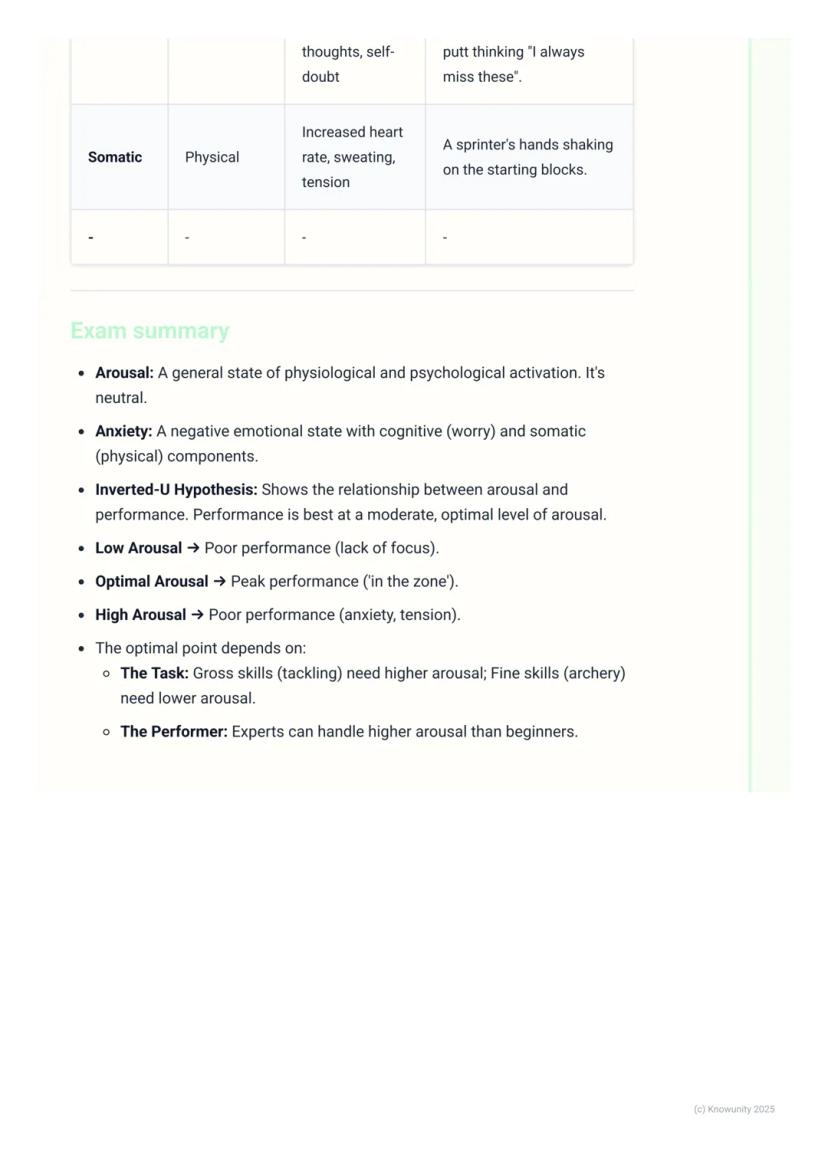
Arousal is your neutral state of activation - think of it as your psychological and physical readiness level. Anxiety is when high arousal turns negative, creating worry (cognitive anxiety) and physical symptoms like sweating or shaking (somatic anxiety).
The Inverted-U Hypothesis shows that performance peaks at moderate arousal levels. Too low means poor focus, optimal means peak performance, and too high creates anxiety that destroys performance.
Your optimal arousal depends on two key factors. Task type matters - gross motor skills (tackling) can handle higher arousal, whilst fine motor skills (archery) need lower levels. Performer level also counts - experts can cope with higher arousal than beginners.
For your exams, always apply these concepts to specific sporting examples. Mention whether it's a gross or fine motor skill, consider the performer's experience level, and explain how different arousal levels would affect their performance using the Inverted-U model.
Exam Success: Practice applying the Inverted-U hypothesis to different sports scenarios - it's a guaranteed way to pick up marks and show you truly understand the concept.
Νομίζαμε ότι δε θα ρωτούσες ποτέ...
Τι είναι ο AI σύντροφος του Knowunity;
Ο AI σύντροφός μας είναι ειδικά σχεδιασμένος για τις ανάγκες των μαθητών. Βασισμένοι στα εκατομμύρια κομμάτια Περιεχομένων που έχουμε στην πλατφόρμα, μπορούμε να παρέχουμε πραγματικά ουσιαστικές και σχετικές απαντήσεις στους μαθητές. Αλλά δεν αφορά μόνο τις απαντήσεις, ο σύντροφος είναι ακόμη περισσότερο για την καθοδήγηση των μαθητών στις καθημερινές τους μαθησιακές προκλήσεις, με εξατομικευμένα προγράμματα μελέτης, κουίζ ή Περιεχόμενα στη Συνομιλία και 100% εξατομίκευση βασισμένη στις δεξιότητες και την ανάπτυξη των μαθητών.
Πού μπορώ να κατεβάσω την εφαρμογή Knowunity;
Μπορείτε να κατεβάσετε την εφαρμογή από το Google Play Store και το Apple App Store.
Πώς μπορώ να λάβω την πληρωμή μου; Πόσα μπορώ να κερδίσω;
Ναι, έχετε δωρεάν πρόσβαση στο περιεχόμενο της εφαρμογής και στον AI companion μας. Για να ξεκλειδώσετε ορισμένες λειτουργίες της εφαρμογής, μπορείτε να αγοράσετε το Knowunity Pro.
Πιο δημοφιλή περιεχόμενα στο LCPE
4LCPEHealthy Eating Guidelines
This section explores national healthy eating guidelines, such as the food pyramid or healthy eating plate, to promote balanced dietary choices.
5th Year50
LCPEBiomechanics of Movement
Applying fundamental biomechanical principles such as force, motion, levers, and stability to analyse and improve human movement efficiency and performance in sport.
6th Year200
LCPEFactors effecting sports psychology ( confidence and self efficacy)
Higher Level LCPE psychological preprration notes
5th Year230
LCPETechnology in Sport
Investigating how technology is used in areas such as performance analysis, equipment design, officiating, and athlete monitoring to enhance training and competition.
6th Year50
Πιο δημοφιλή περιεχόμενα
9IrishIrish oral questions and answers
Questions and answers for the leaving cert oral
5th Year4264
EnglishKey Quotes : Sive
Key Quotes and explanations: Sive
6th Year2842
IrishIrish oral questions
Outline of oral questions
5th Year2055
IrishIníon- le hÁine Durkin
Aine Durkin’s poem, Iníon: Themes & summary
5th Year890
IrishIrish poetry 2027
Iníon + Dínit an Bhróin
5th Year1153
IrishLC HL notes- Iníon (poem)
Includes poem in English and Irish, theme, key words & phrases
5th Year2304
EnglishCultural Context : Shawshank Redemption : Sive : Small Things Like These
Comparative Study : Cultural Context : Shawshank Redemption, Sive and Small Things Like These
6th Year1430
IrishMo Ghrá-sa (Idir Lúibíní)
Notes on mo ghrá-sa
5th Year380
IrishAn Gaeilge Aiste
Irish Language essay
6th Year1320
Δε μπορείς να βρεις αυτό που ψάχνεις; Εξερεύνησε άλλα μαθήματα.
Κριτικές από τους χρήστες μας. Έχουν όλα τα καλά — και το ίδιο θα είχες κι εσύ.
4.6/5App Store
4.7/5Google Play
Η εφαρμογή είναι πολύ εύκολη στη χρήση και καλά σχεδιασμένη. Έχω βρει ό,τι έψαχνα μέχρι τώρα και έχω μάθει πολλά από τις παρουσιάσεις! Σίγουρα θα χρησιμοποιήσω την εφαρμογή για μια εργασία του μαθήματος! Και φυσικά βοηθάει πολύ και ως έμπνευση.
Στέφαν Σχρήστης iOS
Αυτή η εφαρμογή είναι πραγματικά τέλεια. Υπάρχουν τόσες πολλές σημειώσεις μελέτης και βοήθεια [...]. Το μάθημα που με δυσκολεύει είναι τα Γαλλικά, για παράδειγμα, και η εφαρμογή έχει τόσες επιλογές για βοήθεια. Χάρη σε αυτή την εφαρμογή, έχω βελτιώσει τα Γαλλικά μου. Θα την πρότεινα σε οποιονδήποτε.
Σαμάνθα Κλιχχρήστης Android
Ουάου, είμαι πραγματικά εντυπωσιασμένος. Δοκίμασα την εφαρμογή επειδή την είδα διαφημισμένη πολλές φορές και έμεινα άφωνος. Αυτή η εφαρμογή είναι Η ΒΟΗΘΕΙΑ που χρειάζεσαι για το σχολείο και πάνω απ' όλα, προσφέρει τόσα πράγματα, όπως ασκήσεις και φύλλα γεγονότων, που ήταν ΠΟΛΥ χρήσιμα για μένα προσωπικά.
Άνναχρήστης iOS