
The Irish future tense (an aimsir fháistineach) is your tool...
 Irish5 προβολές·Ενημερώθηκε Jun 4, 2026·5 σελίδες
Learn About An Aimsir Fháistineach: Forming Future Tense in Irish
1 / 5
1
of 5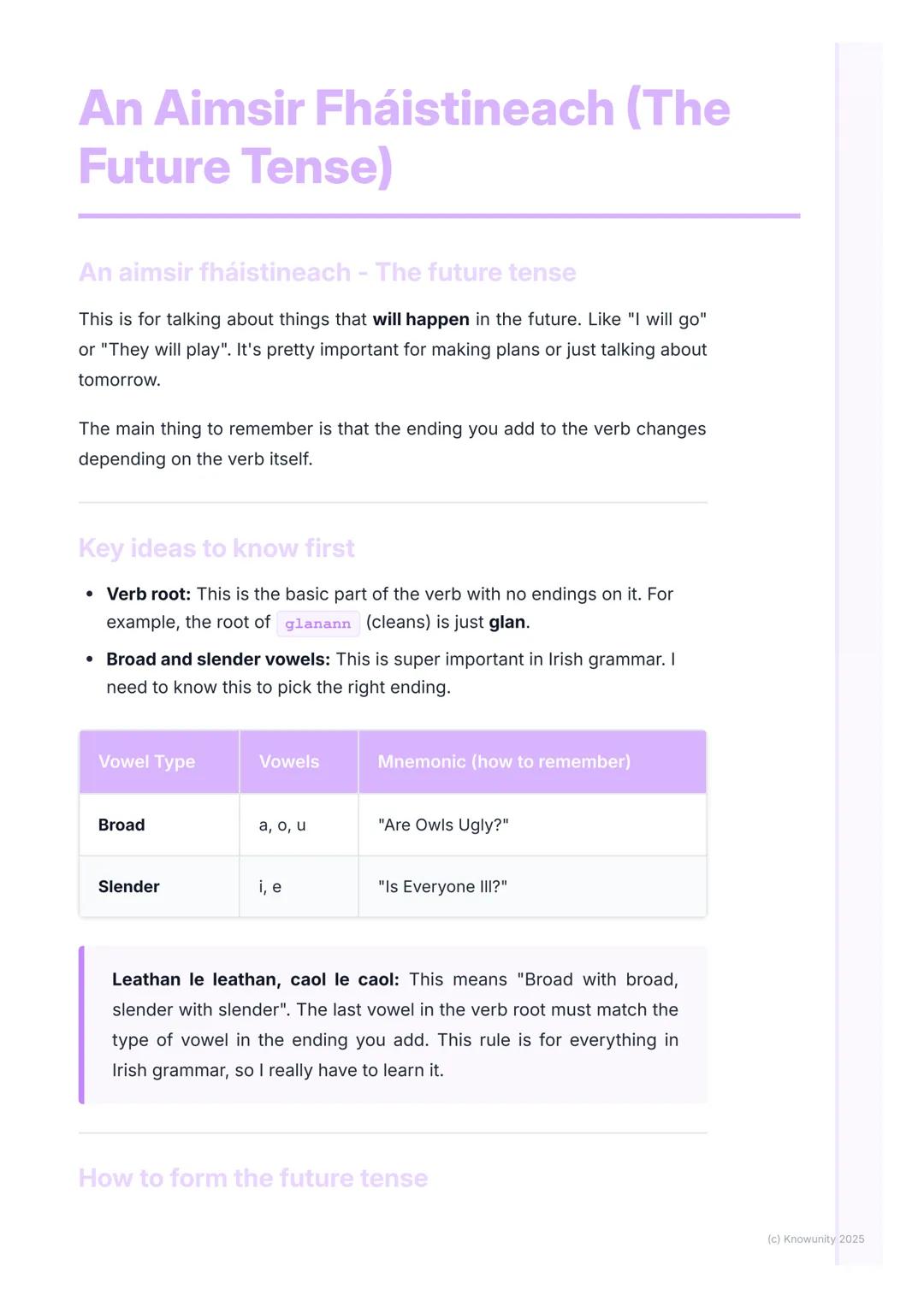
An Aimsir Fháistineach - Getting Started
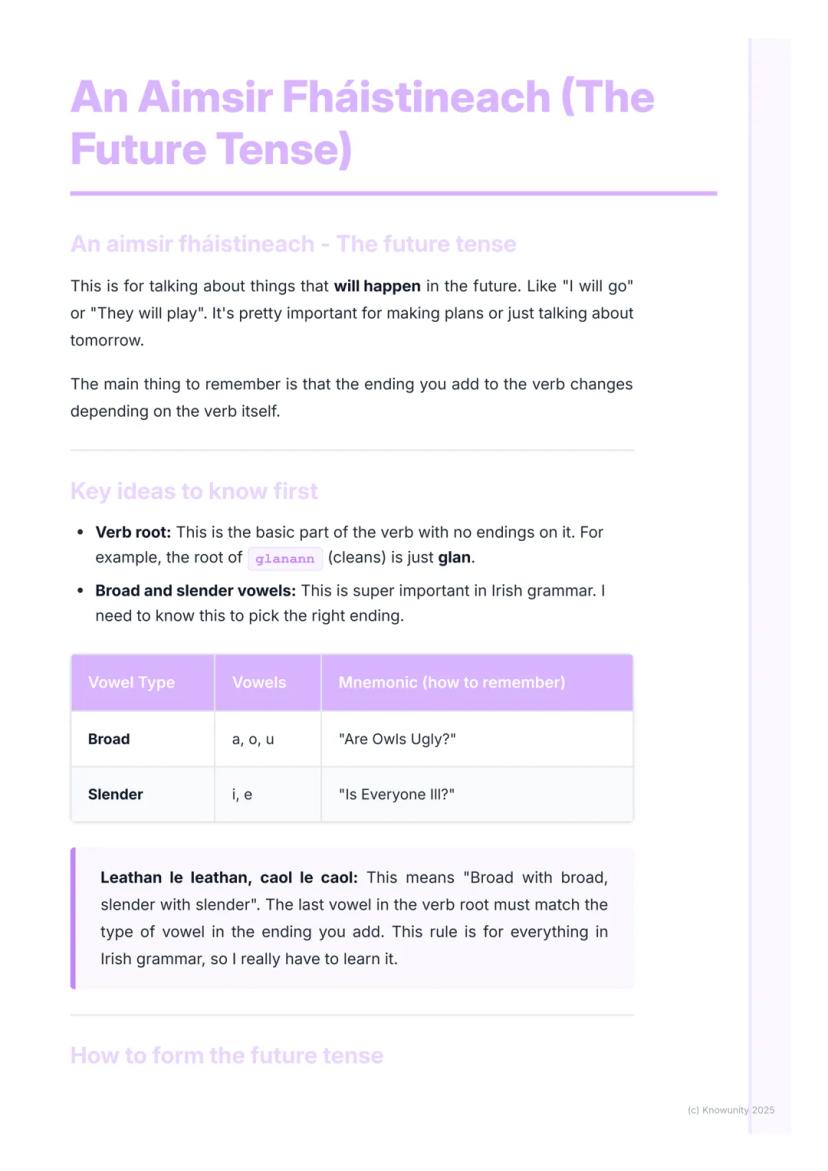
Think of the future tense as your planning language - it's how you say "I will go" or "they will play" in Irish. The trick is knowing which ending to stick on your verb, and that depends on the vowels inside it.
Before diving in, you need to master broad and slender vowels. Broad vowels are a, o, u (remember: "Are Owls Ugly?") and slender vowels are i, e ("Is Everyone Ill?"). This matters because of the golden rule: leathan le leathan, caol le caol - broad with broad, slender with slender.
The verb root is your starting point - it's the basic form without any endings. For example, glanann (cleans) has the root glan. Once you've got your root, check its last vowel to decide which ending fits.
Quick tip: Master the vowel types first - they're used throughout Irish grammar, not just the future tense!
2
of 5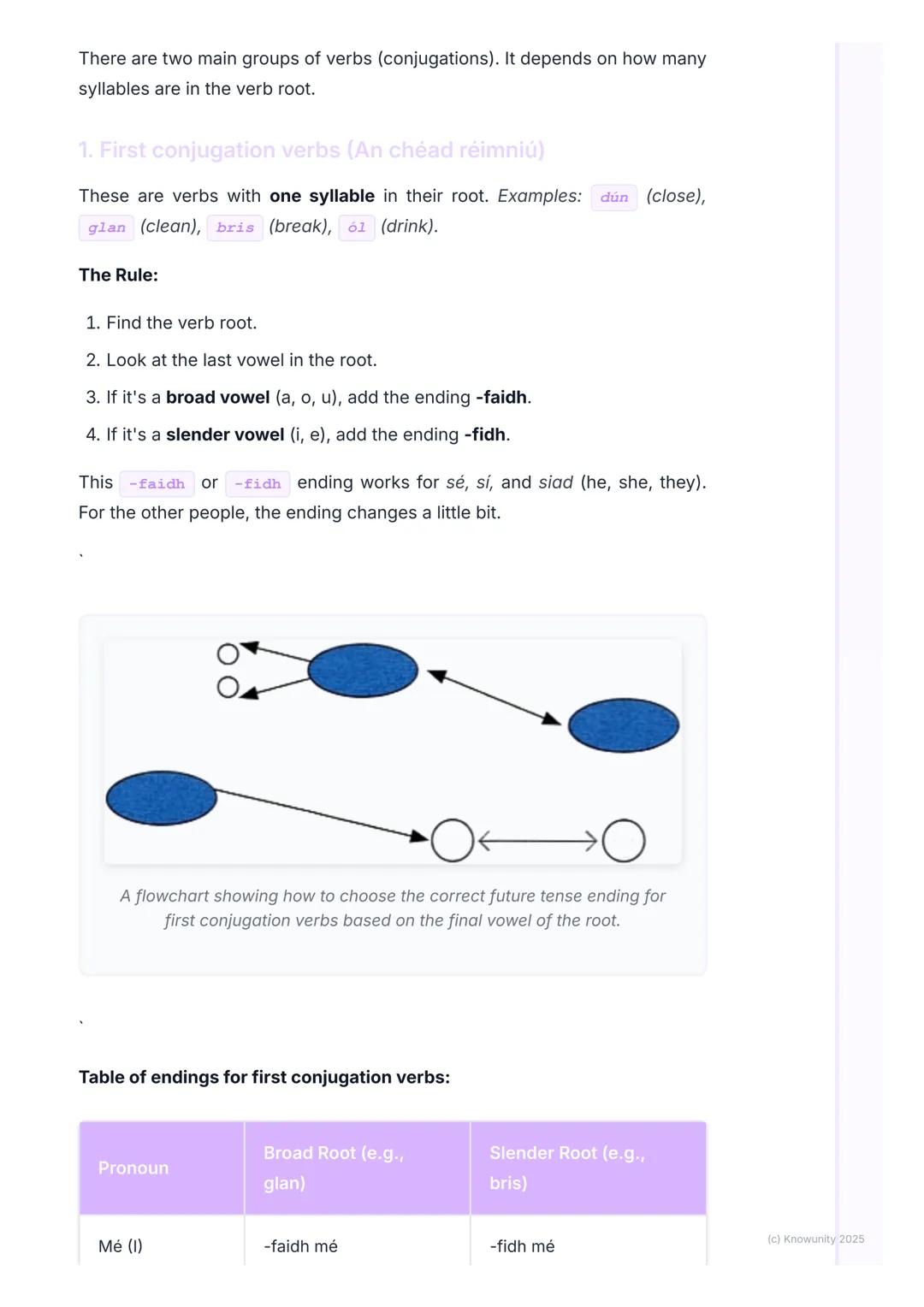
First Conjugation Verbs - The One-Syllable Gang
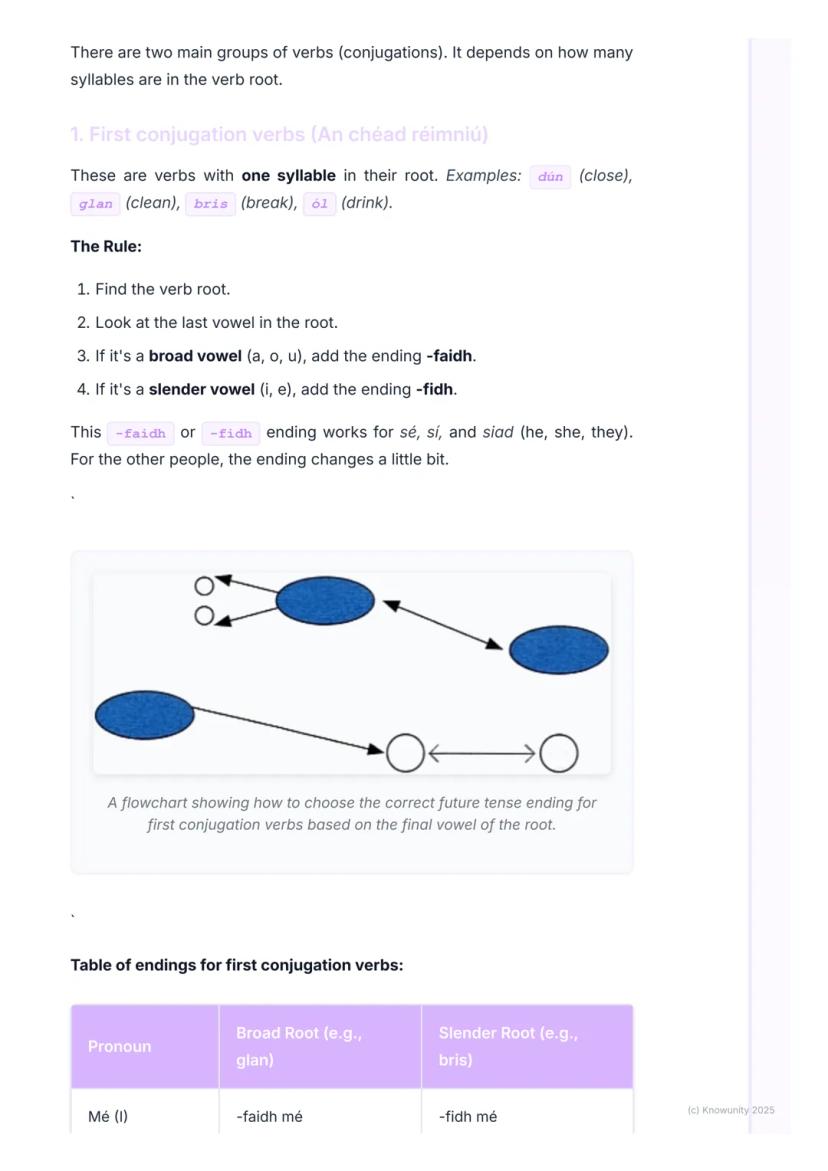
First conjugation verbs have just one syllable in their root - words like dún (close), glan (clean), bris (break), and ól (drink). These are actually the easiest once you get the pattern.
Here's the system: if your verb root ends with a broad vowel (a, o, u), you add -faidh. If it ends with a slender vowel (i, e), you add -fidh. So glan becomes glanfaidh and bris becomes brisfidh.
The endings work perfectly for sé, sí, and siad (he, she, they). For other pronouns like mé and tú, you just add the pronoun after: glanfaidh mé, glanfaidh tú. The only special case is sinn (we) - it gets its own endings: -faimid for broad roots and -fimid for slender ones.
Remember: The broad/slender rule applies to every single verb - there are no exceptions here!
3
of 5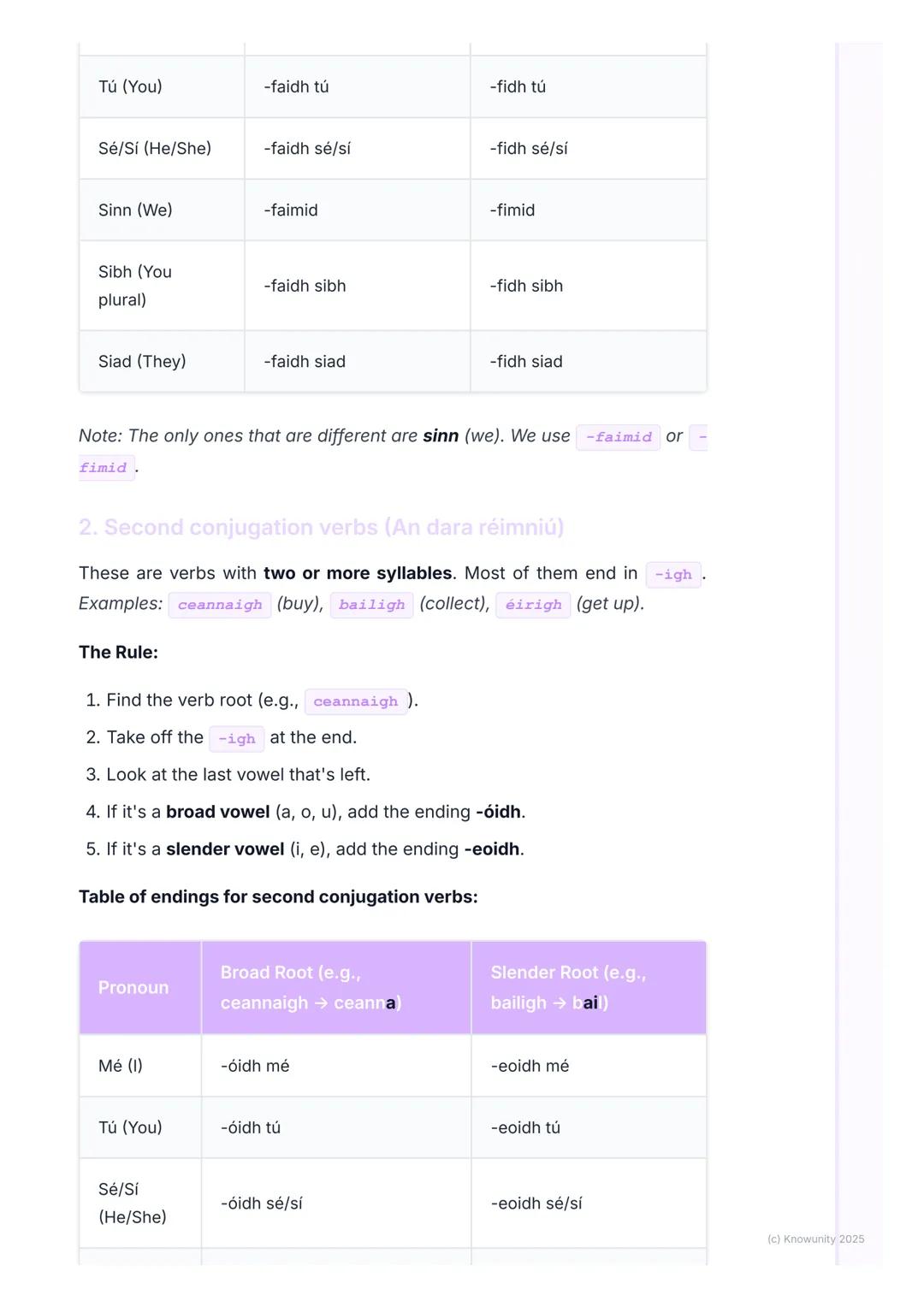
Second Conjugation Verbs - The Multi-Syllable Squad
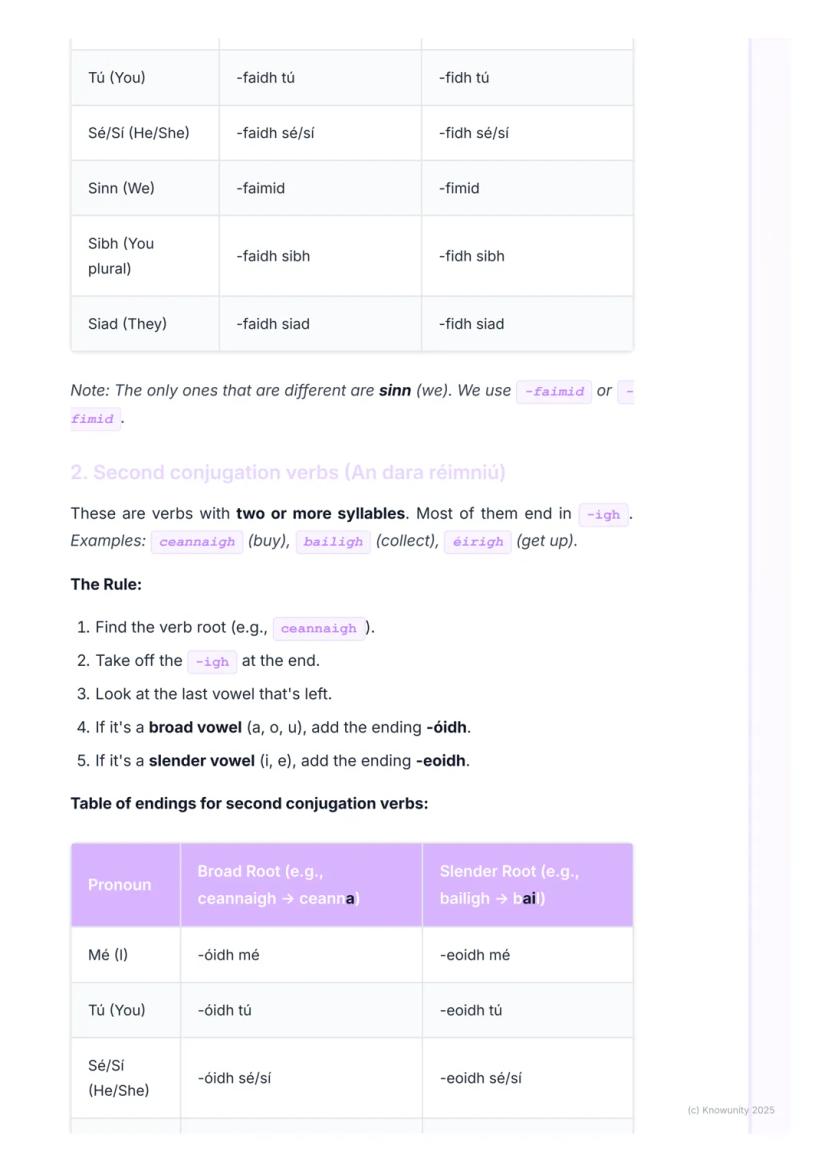
Second conjugation verbs have two or more syllables and usually end in -igh. Think ceannaigh (buy), bailigh (collect), or éirigh (get up) - they're longer words that need a different approach.
The process is straightforward: chop off the -igh ending first. Then check what vowel you're left with at the end. If it's broad (a, o, u), add -óidh. If it's slender (i, e), add -eoidh.
So ceannaigh loses its -igh to become ceanna (ending in broad 'a'), then gets -óidh to make ceannóidh. Bailigh becomes bail (ending in slender 'i'), then gets -eoidh to make baileoidh.
Just like first conjugation, sinn (we) is special again. It uses -óimid for broad roots and -eoimid for slender ones instead of the regular endings.
Pro tip: Most verbs you'll meet ending in -igh follow this pattern - it's more common than you might think!
4
of 5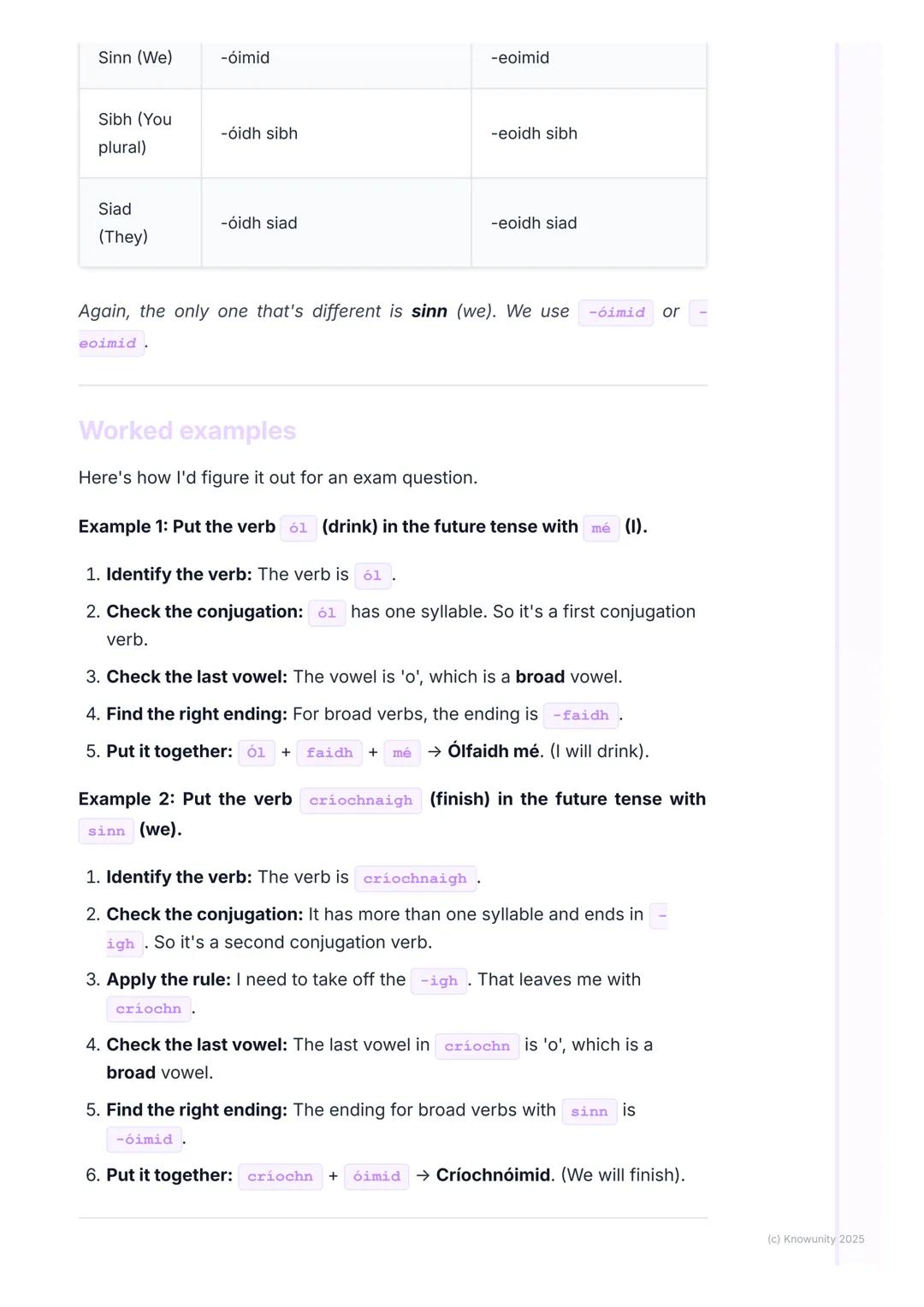
Working Through Examples
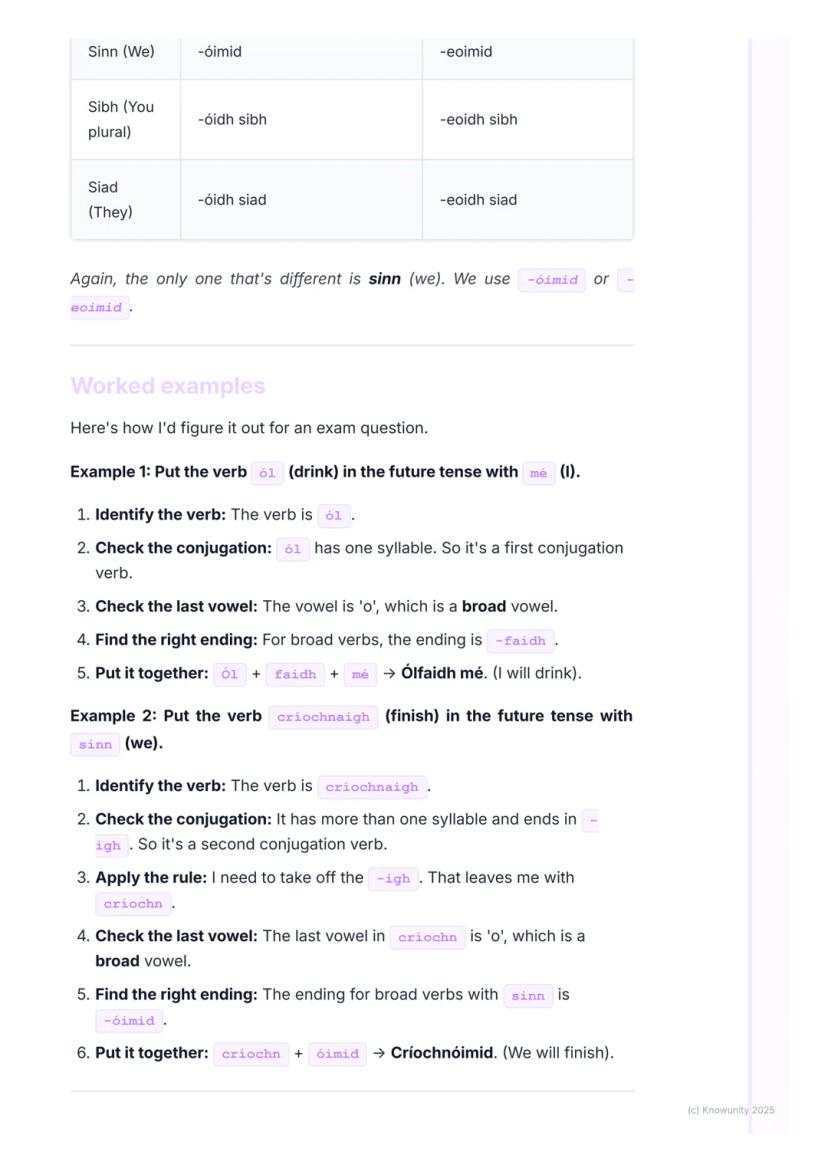
Let's tackle some exam-style questions to see how this works in practice. Take ól (drink) with mé (I) - it's one syllable, so it's first conjugation. The 'o' is broad, so we add -faidh: ólfaidh mé (I will drink).
For something trickier, try críochnaigh (finish) with sinn (we). It's multi-syllable and ends in -igh, so it's second conjugation. Drop the -igh to get críochn, which ends in broad 'o'. Since it's sinn, we use -óimid: críochnóimid (we will finish).
The key is taking it step by step: identify the conjugation type, find the root, check the vowel type, pick the right ending. Once you've done a few, the pattern becomes automatic.
Questions and negatives change things slightly - they start with An (will...?) or Ní (will not...), but the verb endings stay the same. An ólfaidh tú? (Will you drink?) and Ní ólfaidh mé (I will not drink).
Exam hack: Always identify conjugation type first - it saves you from mixing up the ending patterns!
5
of 5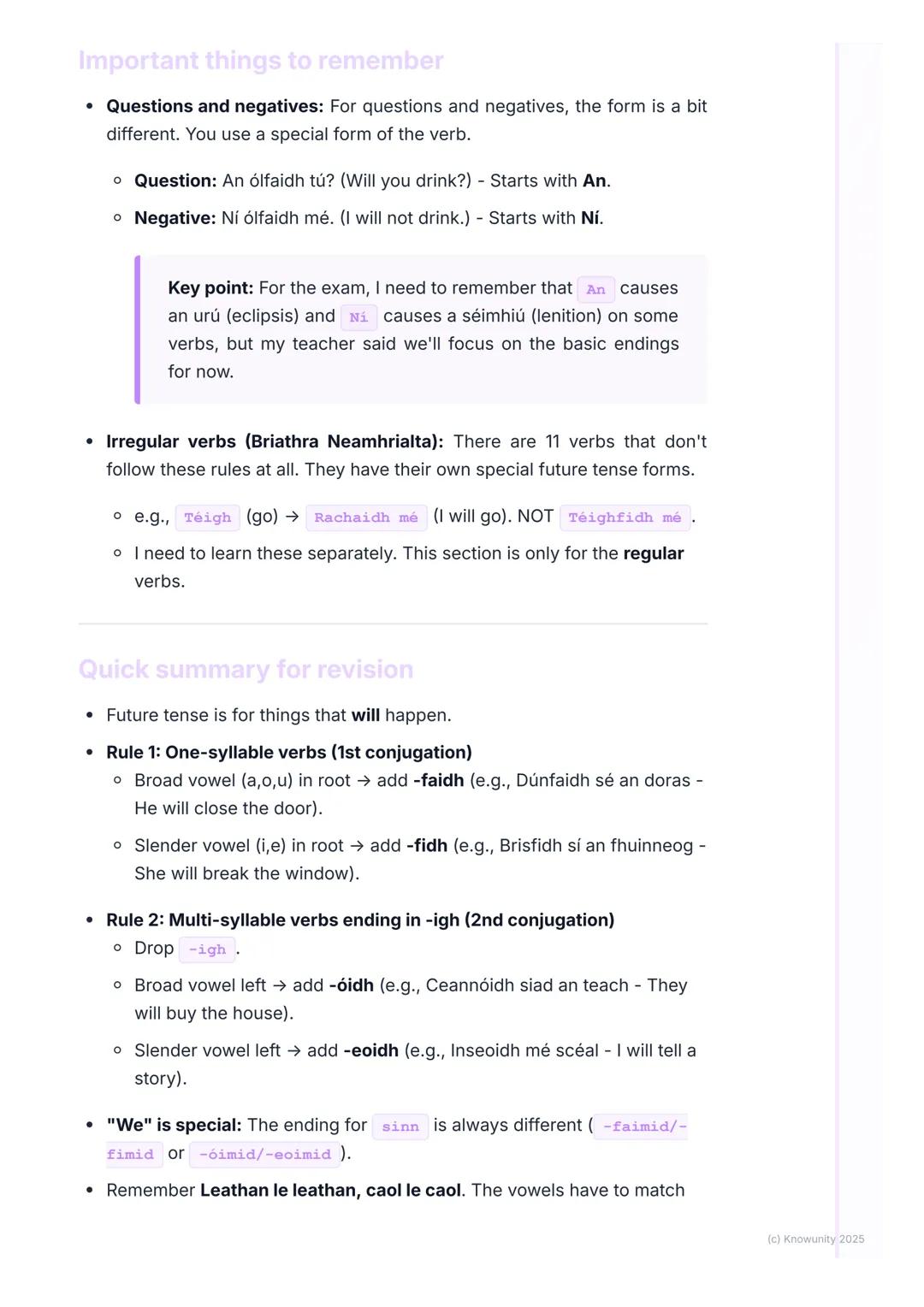
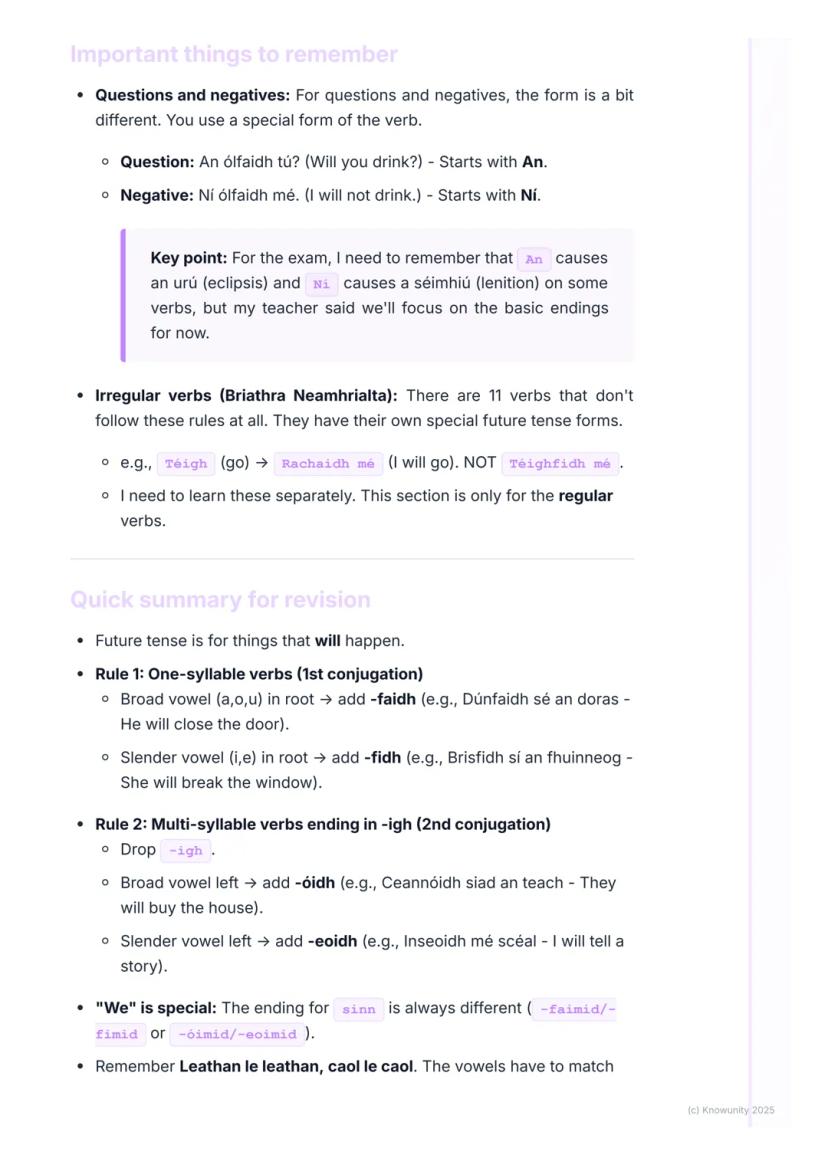
Quick Revision Summary
You've got two main patterns to remember. First conjugation : broad vowel gets -faidh, slender vowel gets -fidh. Second conjugation : drop the -igh, then broad gets -óidh, slender gets -eoidh.
The pronoun sinn (we) always gets special treatment with its own endings: -faimid/-fimid for first conjugation, -óimid/-eoimid for second conjugation. Every other pronoun just tags along after the main verb form.
Remember that irregular verbs like téigh (go) completely ignore these rules - téigh becomes rachaidh mé (I will go), not téighfidh mé. You'll need to learn those 11 irregular verbs separately.
The leathan le leathan, caol le caol rule is your safety net - if your vowels don't match up, you've made a mistake somewhere. This future tense system works for the vast majority of Irish verbs once you've mastered the basics.
Final reminder: Practice with regular verbs first - once these patterns are automatic, irregular verbs become much easier to handle!
Νομίζαμε ότι δε θα ρωτούσες ποτέ...
Τι είναι ο AI σύντροφος του Knowunity;
Ο AI σύντροφός μας είναι ειδικά σχεδιασμένος για τις ανάγκες των μαθητών. Βασισμένοι στα εκατομμύρια κομμάτια Περιεχομένων που έχουμε στην πλατφόρμα, μπορούμε να παρέχουμε πραγματικά ουσιαστικές και σχετικές απαντήσεις στους μαθητές. Αλλά δεν αφορά μόνο τις απαντήσεις, ο σύντροφος είναι ακόμη περισσότερο για την καθοδήγηση των μαθητών στις καθημερινές τους μαθησιακές προκλήσεις, με εξατομικευμένα προγράμματα μελέτης, κουίζ ή Περιεχόμενα στη Συνομιλία και 100% εξατομίκευση βασισμένη στις δεξιότητες και την ανάπτυξη των μαθητών.
Πού μπορώ να κατεβάσω την εφαρμογή Knowunity;
Μπορείτε να κατεβάσετε την εφαρμογή από το Google Play Store και το Apple App Store.
Πώς μπορώ να λάβω την πληρωμή μου; Πόσα μπορώ να κερδίσω;
Ναι, έχετε δωρεάν πρόσβαση στο περιεχόμενο της εφαρμογής και στον AI companion μας. Για να ξεκλειδώσετε ορισμένες λειτουργίες της εφαρμογής, μπορείτε να αγοράσετε το Knowunity Pro.
Πιο δημοφιλή περιεχόμενα στο Irish
9Πιο δημοφιλή περιεχόμενα
9Δε μπορείς να βρεις αυτό που ψάχνεις; Εξερεύνησε άλλα μαθήματα.
Κριτικές από τους χρήστες μας. Έχουν όλα τα καλά — και το ίδιο θα είχες κι εσύ.
4.6/5App Store
4.7/5Google Play
Η εφαρμογή είναι πολύ εύκολη στη χρήση και καλά σχεδιασμένη. Έχω βρει ό,τι έψαχνα μέχρι τώρα και έχω μάθει πολλά από τις παρουσιάσεις! Σίγουρα θα χρησιμοποιήσω την εφαρμογή για μια εργασία του μαθήματος! Και φυσικά βοηθάει πολύ και ως έμπνευση.
Στέφαν Σχρήστης iOS
Αυτή η εφαρμογή είναι πραγματικά τέλεια. Υπάρχουν τόσες πολλές σημειώσεις μελέτης και βοήθεια [...]. Το μάθημα που με δυσκολεύει είναι τα Γαλλικά, για παράδειγμα, και η εφαρμογή έχει τόσες επιλογές για βοήθεια. Χάρη σε αυτή την εφαρμογή, έχω βελτιώσει τα Γαλλικά μου. Θα την πρότεινα σε οποιονδήποτε.
Σαμάνθα Κλιχχρήστης Android
Ουάου, είμαι πραγματικά εντυπωσιασμένος. Δοκίμασα την εφαρμογή επειδή την είδα διαφημισμένη πολλές φορές και έμεινα άφωνος. Αυτή η εφαρμογή είναι Η ΒΟΗΘΕΙΑ που χρειάζεσαι για το σχολείο και πάνω απ' όλα, προσφέρει τόσα πράγματα, όπως ασκήσεις και φύλλα γεγονότων, που ήταν ΠΟΛΥ χρήσιμα για μένα προσωπικά.
Άνναχρήστης iOS
Irish5 προβολές·Ενημερώθηκε Jun 4, 2026·5 σελίδεςLearn About An Aimsir Fháistineach: Forming Future Tense in Irish
The Irish future tense (an aimsir fháistineach) is your tool for talking about things that will happen - from tomorrow's plans to next year's goals. It's built on a simple system of adding specific endings to verb roots, but you...
1
of 5
Κάνε εγγραφή για να δεις το ΠΕΡΙΕΧΟΜΕΝΟ. Είναι δωρεάν!
- Πρόσβαση σε όλα τα έγγραφα
- Βελτίωσε τους βαθμούς σου
- Γίνε μέλος με εκατομμύρια μαθητές
An Aimsir Fháistineach - Getting Started
Think of the future tense as your planning language - it's how you say "I will go" or "they will play" in Irish. The trick is knowing which ending to stick on your verb, and that depends on the vowels inside it.
Before diving in, you need to master broad and slender vowels. Broad vowels are a, o, u (remember: "Are Owls Ugly?") and slender vowels are i, e ("Is Everyone Ill?"). This matters because of the golden rule: leathan le leathan, caol le caol - broad with broad, slender with slender.
The verb root is your starting point - it's the basic form without any endings. For example, glanann (cleans) has the root glan. Once you've got your root, check its last vowel to decide which ending fits.
Quick tip: Master the vowel types first - they're used throughout Irish grammar, not just the future tense!
2
of 5Κάνε εγγραφή για να δεις το ΠΕΡΙΕΧΟΜΕΝΟ. Είναι δωρεάν!
- Πρόσβαση σε όλα τα έγγραφα
- Βελτίωσε τους βαθμούς σου
- Γίνε μέλος με εκατομμύρια μαθητές
First Conjugation Verbs - The One-Syllable Gang
First conjugation verbs have just one syllable in their root - words like dún (close), glan (clean), bris (break), and ól (drink). These are actually the easiest once you get the pattern.
Here's the system: if your verb root ends with a broad vowel (a, o, u), you add -faidh. If it ends with a slender vowel (i, e), you add -fidh. So glan becomes glanfaidh and bris becomes brisfidh.
The endings work perfectly for sé, sí, and siad (he, she, they). For other pronouns like mé and tú, you just add the pronoun after: glanfaidh mé, glanfaidh tú. The only special case is sinn (we) - it gets its own endings: -faimid for broad roots and -fimid for slender ones.
Remember: The broad/slender rule applies to every single verb - there are no exceptions here!
3
of 5Κάνε εγγραφή για να δεις το ΠΕΡΙΕΧΟΜΕΝΟ. Είναι δωρεάν!
- Πρόσβαση σε όλα τα έγγραφα
- Βελτίωσε τους βαθμούς σου
- Γίνε μέλος με εκατομμύρια μαθητές
Second Conjugation Verbs - The Multi-Syllable Squad
Second conjugation verbs have two or more syllables and usually end in -igh. Think ceannaigh (buy), bailigh (collect), or éirigh (get up) - they're longer words that need a different approach.
The process is straightforward: chop off the -igh ending first. Then check what vowel you're left with at the end. If it's broad (a, o, u), add -óidh. If it's slender (i, e), add -eoidh.
So ceannaigh loses its -igh to become ceanna (ending in broad 'a'), then gets -óidh to make ceannóidh. Bailigh becomes bail (ending in slender 'i'), then gets -eoidh to make baileoidh.
Just like first conjugation, sinn (we) is special again. It uses -óimid for broad roots and -eoimid for slender ones instead of the regular endings.
Pro tip: Most verbs you'll meet ending in -igh follow this pattern - it's more common than you might think!
4
of 5Κάνε εγγραφή για να δεις το ΠΕΡΙΕΧΟΜΕΝΟ. Είναι δωρεάν!
- Πρόσβαση σε όλα τα έγγραφα
- Βελτίωσε τους βαθμούς σου
- Γίνε μέλος με εκατομμύρια μαθητές
Working Through Examples
Let's tackle some exam-style questions to see how this works in practice. Take ól (drink) with mé (I) - it's one syllable, so it's first conjugation. The 'o' is broad, so we add -faidh: ólfaidh mé (I will drink).
For something trickier, try críochnaigh (finish) with sinn (we). It's multi-syllable and ends in -igh, so it's second conjugation. Drop the -igh to get críochn, which ends in broad 'o'. Since it's sinn, we use -óimid: críochnóimid (we will finish).
The key is taking it step by step: identify the conjugation type, find the root, check the vowel type, pick the right ending. Once you've done a few, the pattern becomes automatic.
Questions and negatives change things slightly - they start with An (will...?) or Ní (will not...), but the verb endings stay the same. An ólfaidh tú? (Will you drink?) and Ní ólfaidh mé (I will not drink).
Exam hack: Always identify conjugation type first - it saves you from mixing up the ending patterns!
5
of 5Κάνε εγγραφή για να δεις το ΠΕΡΙΕΧΟΜΕΝΟ. Είναι δωρεάν!
- Πρόσβαση σε όλα τα έγγραφα
- Βελτίωσε τους βαθμούς σου
- Γίνε μέλος με εκατομμύρια μαθητές
Quick Revision Summary
You've got two main patterns to remember. First conjugation : broad vowel gets -faidh, slender vowel gets -fidh. Second conjugation : drop the -igh, then broad gets -óidh, slender gets -eoidh.
The pronoun sinn (we) always gets special treatment with its own endings: -faimid/-fimid for first conjugation, -óimid/-eoimid for second conjugation. Every other pronoun just tags along after the main verb form.
Remember that irregular verbs like téigh (go) completely ignore these rules - téigh becomes rachaidh mé (I will go), not téighfidh mé. You'll need to learn those 11 irregular verbs separately.
The leathan le leathan, caol le caol rule is your safety net - if your vowels don't match up, you've made a mistake somewhere. This future tense system works for the vast majority of Irish verbs once you've mastered the basics.
Final reminder: Practice with regular verbs first - once these patterns are automatic, irregular verbs become much easier to handle!
Νομίζαμε ότι δε θα ρωτούσες ποτέ...
Τι είναι ο AI σύντροφος του Knowunity;
Ο AI σύντροφός μας είναι ειδικά σχεδιασμένος για τις ανάγκες των μαθητών. Βασισμένοι στα εκατομμύρια κομμάτια Περιεχομένων που έχουμε στην πλατφόρμα, μπορούμε να παρέχουμε πραγματικά ουσιαστικές και σχετικές απαντήσεις στους μαθητές. Αλλά δεν αφορά μόνο τις απαντήσεις, ο σύντροφος είναι ακόμη περισσότερο για την καθοδήγηση των μαθητών στις καθημερινές τους μαθησιακές προκλήσεις, με εξατομικευμένα προγράμματα μελέτης, κουίζ ή Περιεχόμενα στη Συνομιλία και 100% εξατομίκευση βασισμένη στις δεξιότητες και την ανάπτυξη των μαθητών.
Πού μπορώ να κατεβάσω την εφαρμογή Knowunity;
Μπορείτε να κατεβάσετε την εφαρμογή από το Google Play Store και το Apple App Store.
Πώς μπορώ να λάβω την πληρωμή μου; Πόσα μπορώ να κερδίσω;
Ναι, έχετε δωρεάν πρόσβαση στο περιεχόμενο της εφαρμογής και στον AI companion μας. Για να ξεκλειδώσετε ορισμένες λειτουργίες της εφαρμογής, μπορείτε να αγοράσετε το Knowunity Pro.
Πιο δημοφιλή περιεχόμενα στο Irish
9Πιο δημοφιλή περιεχόμενα
9Δε μπορείς να βρεις αυτό που ψάχνεις; Εξερεύνησε άλλα μαθήματα.
Κριτικές από τους χρήστες μας. Έχουν όλα τα καλά — και το ίδιο θα είχες κι εσύ.
4.6/5App Store
4.7/5Google Play
Η εφαρμογή είναι πολύ εύκολη στη χρήση και καλά σχεδιασμένη. Έχω βρει ό,τι έψαχνα μέχρι τώρα και έχω μάθει πολλά από τις παρουσιάσεις! Σίγουρα θα χρησιμοποιήσω την εφαρμογή για μια εργασία του μαθήματος! Και φυσικά βοηθάει πολύ και ως έμπνευση.
Στέφαν Σχρήστης iOS
Αυτή η εφαρμογή είναι πραγματικά τέλεια. Υπάρχουν τόσες πολλές σημειώσεις μελέτης και βοήθεια [...]. Το μάθημα που με δυσκολεύει είναι τα Γαλλικά, για παράδειγμα, και η εφαρμογή έχει τόσες επιλογές για βοήθεια. Χάρη σε αυτή την εφαρμογή, έχω βελτιώσει τα Γαλλικά μου. Θα την πρότεινα σε οποιονδήποτε.
Σαμάνθα Κλιχχρήστης Android
Ουάου, είμαι πραγματικά εντυπωσιασμένος. Δοκίμασα την εφαρμογή επειδή την είδα διαφημισμένη πολλές φορές και έμεινα άφωνος. Αυτή η εφαρμογή είναι Η ΒΟΗΘΕΙΑ που χρειάζεσαι για το σχολείο και πάνω απ' όλα, προσφέρει τόσα πράγματα, όπως ασκήσεις και φύλλα γεγονότων, που ήταν ΠΟΛΥ χρήσιμα για μένα προσωπικά.
Άνναχρήστης iOS