
Your nervous system is basically your body's lightning-fast communication network... Δες περισσότερα
 Biology3 προβολές·Ενημερώθηκε Jun 2, 2026·7 σελίδες
Understanding the Nervous System
1 / 7
1
of 7
Introduction to the Nervous System
Ever wonder how you can pull your hand away from something hot before you even realise it's burning? That's your nervous system in action - your body's incredibly fast control and communication network.
The nervous system has one main job: detect changes (called stimuli) inside and outside your body, process that information, and coordinate a response. It works much faster than your hormone system, sending electrical signals at lightning speed from your brain to your toes.
Here are the key players you need to know. A receptor is like a specialised detector that picks up specific stimuli (think light hitting your eye or sound waves reaching your ear). When something needs to happen, an effector (a muscle or gland) carries out the response.
Quick Tip: Remember that neurons are the building blocks - specialised nerve cells that transmit electrical impulses. A nerve is just a bundle of these neurons working together, and they communicate across tiny gaps called synapses using chemical messengers called neurotransmitters.
2
of 7
The Two Main Parts: CNS vs PNS
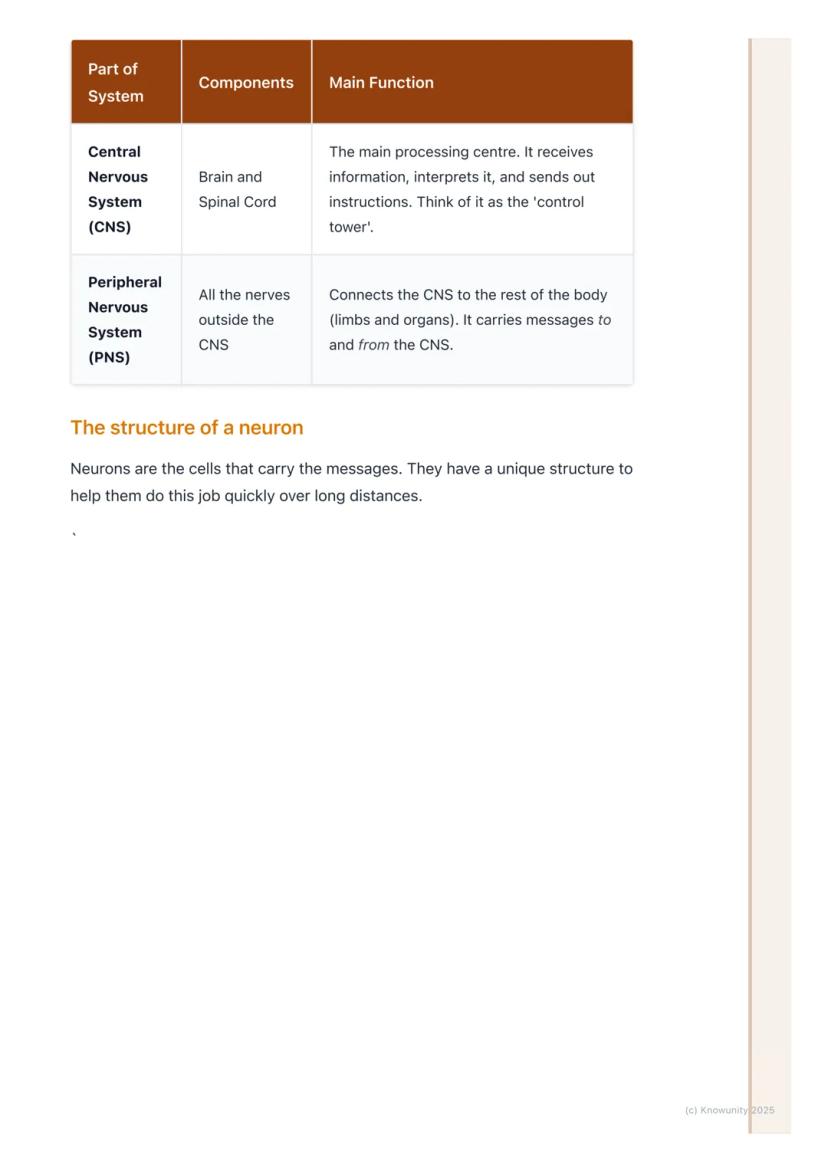
Your nervous system is split into two teams that work together perfectly. The Central Nervous System (CNS) includes your brain and spinal cord - think of it as mission control where all the major decisions get made.
The Peripheral Nervous System (PNS) is everything else - all the nerves outside your CNS that connect your control centre to your limbs and organs. It's like the messenger service carrying information to and from headquarters.
Understanding this split is crucial for exams. The CNS processes information and sends out instructions, whilst the PNS acts as the communication network linking your CNS to the rest of your body.
Exam Alert: A common question asks you to distinguish between CNS and PNS - just remember CNS = brain + spinal cord, PNS = everything else!
3
of 7
Neuron Structure: Built for Speed
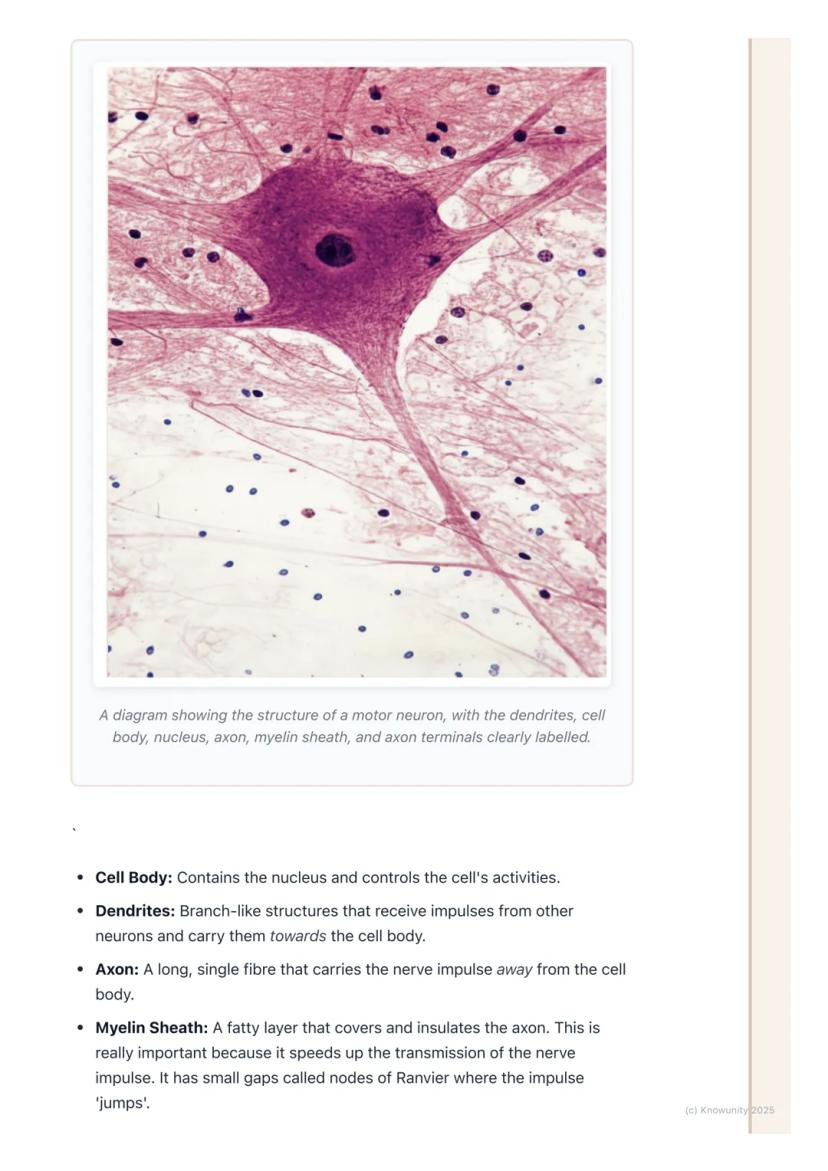
Neurons have a unique structure that's perfectly designed for carrying messages quickly over long distances. Picture a neuron like a one-way motorway for electrical signals.
Dendrites are the branched receivers that collect impulses from other neurons and carry them toward the cell body (which contains the nucleus and controls the cell). The axon is the long highway that carries the nerve impulse away from the cell body.
The myelin sheath is absolutely crucial - it's a fatty layer that wraps around the axon like insulation on an electrical wire. This speeds up transmission dramatically and has small gaps called nodes of Ranvier where the impulse 'jumps' along.
Memory Trick: Remember the direction - Dendrite → Cell Body → Axon. Think "DCA" like a flight code for the journey of a nerve impulse!
4
of 7
Brain Parts: Your Control Centre
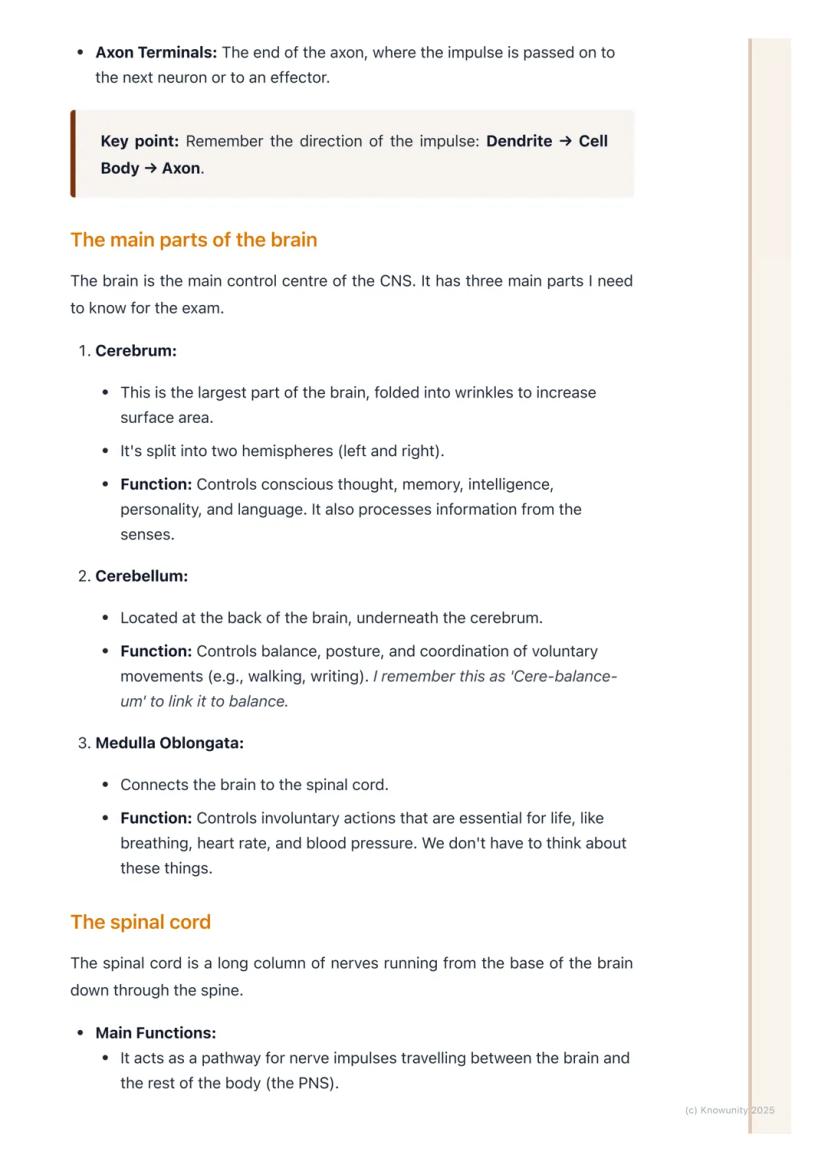
Your brain has three main sections, each with specific jobs you need to know for exams. The cerebrum is the largest part with all those wrinkles (to increase surface area) and handles conscious thought, memory, intelligence, and processing sensory information.
The cerebellum sits at the back underneath the cerebrum and controls balance, posture, and coordination. Think "cere-balance-um" to remember its main job - it's why you can walk without constantly falling over!
The medulla oblongata connects your brain to your spinal cord and runs all the vital involuntary actions like breathing and heart rate. These are the things that keep you alive without you having to think about them.
Exam Strategy: Learn one clear function for each brain part. Cerebrum = thinking, Cerebellum = balance, Medulla = vital involuntary actions like breathing.
5
of 7
Reflex Arc: Your Body's Emergency Response
Reflexes are your body's built-in safety system - automatic responses that happen faster than conscious thought. When you touch something hot, you pull away before your brain even processes "ouch!"
Here's how the reflex arc works: receptors in your skin detect heat and send an impulse along a sensory neuron to your spinal cord. Inside the spinal cord, a relay neuron (the shortcut maker) connects directly to a motor neuron without involving your brain.
The motor neuron triggers your muscle (the effector) to contract and pull your hand away. Meanwhile, a separate message goes to your brain, which is why you feel pain after you've already moved - the action happens before the awareness.
Key Point: The reflex arc bypasses the brain for the initial response - that's what makes it so fast and protective. Your spinal cord handles the emergency whilst your brain gets updated later.
6
of 7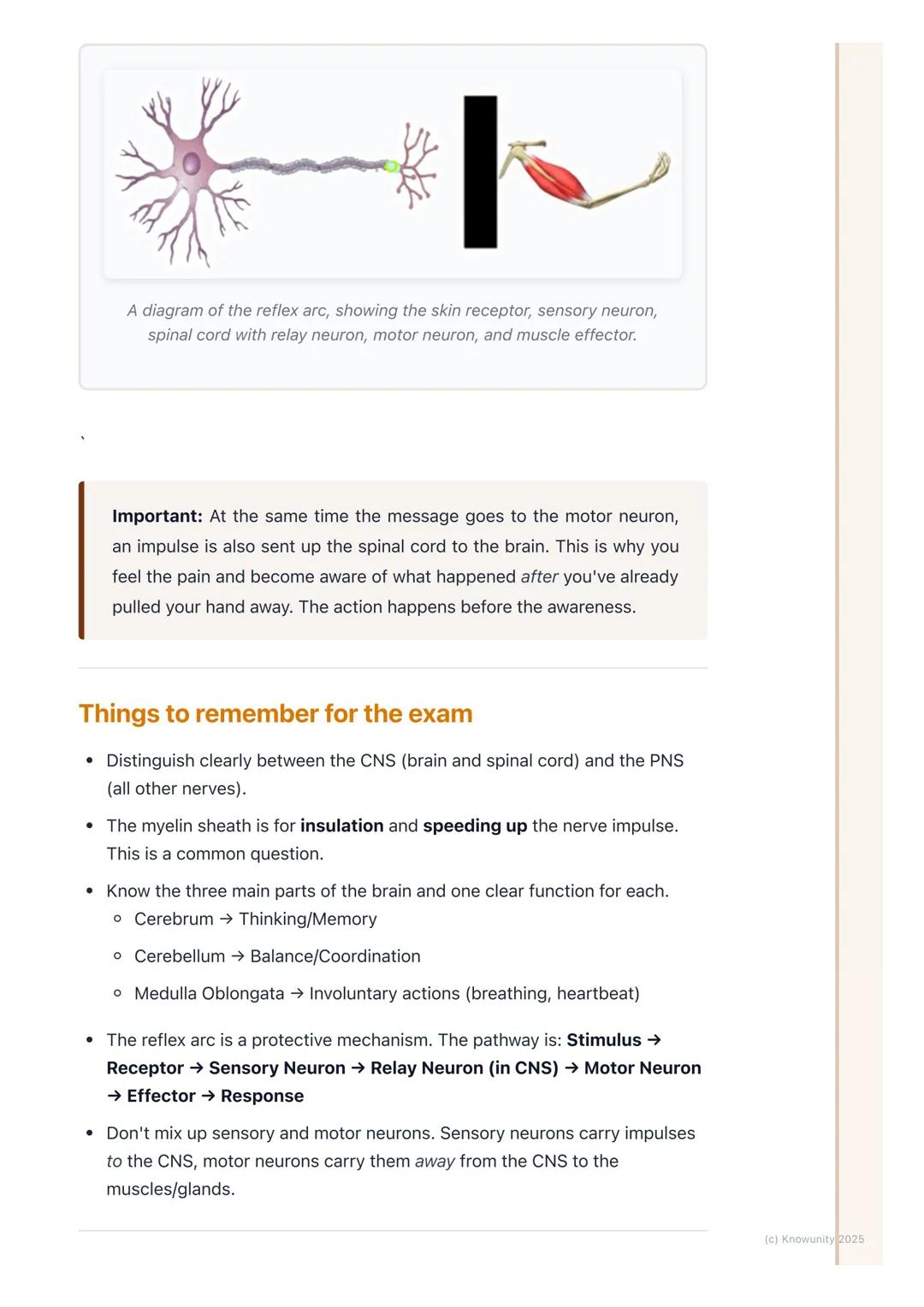
Exam Essentials: What You Must Remember
The pathway for any reflex follows this exact sequence: Stimulus → Receptor → Sensory Neuron → Relay Neuron → Motor Neuron → Effector → Response. Learn this sequence - it's exam gold.
Don't confuse sensory and motor neurons. Sensory neurons carry messages TO the CNS , whilst motor neurons carry instructions AWAY from the CNS to muscles and glands.
The myelin sheath question appears frequently - remember it insulates the axon and speeds up nerve impulses. Without it, your nervous system would be painfully slow.
Final Tip: Reflexes are protective mechanisms. They're fast because they don't waste time asking your brain for permission - your spinal cord makes the call in emergencies.
7
of 7
Quick Summary: Everything You Need
Your nervous system splits into CNS and PNS (all other nerves). Neurons are the basic building blocks with dendrites receiving signals, cell bodies processing them, and axons sending them onwards.
Your brain's three key parts handle different jobs: cerebrum for conscious thought and memory, cerebellum for balance and coordination, and medulla oblongata for vital involuntary functions like breathing and heart rate.
Reflex arcs protect you by creating automatic responses that bypass your brain for speed. The complete pathway - Stimulus → Receptor → Sensory Neuron → Relay Neuron → Motor Neuron → Effector → Response - is your ticket to exam success.
Confidence Boost: Master these basics and you'll handle any nervous system question. Focus on understanding the flow of information rather than memorising every detail - that's what separates good students from great ones.
Νομίζαμε ότι δε θα ρωτούσες ποτέ...
Τι είναι ο AI σύντροφος του Knowunity;
Ο AI σύντροφός μας είναι ειδικά σχεδιασμένος για τις ανάγκες των μαθητών. Βασισμένοι στα εκατομμύρια κομμάτια Περιεχομένων που έχουμε στην πλατφόρμα, μπορούμε να παρέχουμε πραγματικά ουσιαστικές και σχετικές απαντήσεις στους μαθητές. Αλλά δεν αφορά μόνο τις απαντήσεις, ο σύντροφος είναι ακόμη περισσότερο για την καθοδήγηση των μαθητών στις καθημερινές τους μαθησιακές προκλήσεις, με εξατομικευμένα προγράμματα μελέτης, κουίζ ή Περιεχόμενα στη Συνομιλία και 100% εξατομίκευση βασισμένη στις δεξιότητες και την ανάπτυξη των μαθητών.
Πού μπορώ να κατεβάσω την εφαρμογή Knowunity;
Μπορείτε να κατεβάσετε την εφαρμογή από το Google Play Store και το Apple App Store.
Πώς μπορώ να λάβω την πληρωμή μου; Πόσα μπορώ να κερδίσω;
Ναι, έχετε δωρεάν πρόσβαση στο περιεχόμενο της εφαρμογής και στον AI companion μας. Για να ξεκλειδώσετε ορισμένες λειτουργίες της εφαρμογής, μπορείτε να αγοράσετε το Knowunity Pro.
Πιο δημοφιλή περιεχόμενα στο Biology
8BiologyEcology introduction notes!
Start of the leaving cert ecology chapter
6th Year131
BiologyDNA & RNA
All notes on DNA & RNA including protein synthesis which is a HL topic
5th Year250
BiologyVertebrates and Invertebrates
Students will distinguish between animals that have a backbone (vertebrates) and those that do not (invertebrates), identifying examples of each.
2nd Year240
BiologyBiomolecules: chapter 8
Summary and easily understandable notes to revise chapter 8 biomolecules. Includes good labelled diagrams for visual learners
5th Year210
BiologyCirculatory System
Students will learn about the heart, blood, and blood vessels, and how this system transports oxygen, nutrients, and waste products around the body.
3rd Year140
BiologyRespiration
All respiration notes including simple diagrams and glycolysis and the Krebs cycle
5th Year120
BiologyPhotosynthesis : Biology
Photosynthesis
6th Year371
BiologyPlant Cells
Learning about the unique structures found in plant cells, such as the cell wall, chloroplasts, and large vacuole, and how they differ from animal cells.
1st Year80
Πιο δημοφιλή περιεχόμενα
9 Irish
IrishIrish oral questions and answers
Questions and answers for the leaving cert oral
5th Year4264
 English
Key Quotes : Sive
Key Quotes and explanations: Sive
6th Year2842
IrishIrish oral questions
Outline of oral questions
5th Year2055
IrishIníon- le hÁine Durkin
Aine Durkin’s poem, Iníon: Themes & summary
5th Year850
IrishIrish poetry 2027
Iníon + Dínit an Bhróin
5th Year1133
IrishLC HL notes- Iníon (poem)
Includes poem in English and Irish, theme, key words & phrases
5th Year2284
EnglishCultural Context : Shawshank Redemption : Sive : Small Things Like These
Comparative Study : Cultural Context : Shawshank Redemption, Sive and Small Things Like These
6th Year1430
IrishMo Ghrá-sa (Idir Lúibíní)
Notes on mo ghrá-sa
5th Year380
IrishAn Gaeilge Aiste
Irish Language essay
6th Year1320
Δε μπορείς να βρεις αυτό που ψάχνεις; Εξερεύνησε άλλα μαθήματα.
Κριτικές από τους χρήστες μας. Έχουν όλα τα καλά — και το ίδιο θα είχες κι εσύ.
4.6/5App Store
4.7/5Google Play
Η εφαρμογή είναι πολύ εύκολη στη χρήση και καλά σχεδιασμένη. Έχω βρει ό,τι έψαχνα μέχρι τώρα και έχω μάθει πολλά από τις παρουσιάσεις! Σίγουρα θα χρησιμοποιήσω την εφαρμογή για μια εργασία του μαθήματος! Και φυσικά βοηθάει πολύ και ως έμπνευση.
Στέφαν Σχρήστης iOS
Αυτή η εφαρμογή είναι πραγματικά τέλεια. Υπάρχουν τόσες πολλές σημειώσεις μελέτης και βοήθεια [...]. Το μάθημα που με δυσκολεύει είναι τα Γαλλικά, για παράδειγμα, και η εφαρμογή έχει τόσες επιλογές για βοήθεια. Χάρη σε αυτή την εφαρμογή, έχω βελτιώσει τα Γαλλικά μου. Θα την πρότεινα σε οποιονδήποτε.
Σαμάνθα Κλιχχρήστης Android
Ουάου, είμαι πραγματικά εντυπωσιασμένος. Δοκίμασα την εφαρμογή επειδή την είδα διαφημισμένη πολλές φορές και έμεινα άφωνος. Αυτή η εφαρμογή είναι Η ΒΟΗΘΕΙΑ που χρειάζεσαι για το σχολείο και πάνω απ' όλα, προσφέρει τόσα πράγματα, όπως ασκήσεις και φύλλα γεγονότων, που ήταν ΠΟΛΥ χρήσιμα για μένα προσωπικά.
Άνναχρήστης iOS
Biology3 προβολές·Ενημερώθηκε Jun 2, 2026·7 σελίδεςUnderstanding the Nervous System
Your nervous system is basically your body's lightning-fast communication network that keeps you alive and responding to everything around you. Think of it as your internal internet - constantly sending messages between your brain and every part of your body... Δες περισσότερα
1
of 7Κάνε εγγραφή για να δεις το ΠΕΡΙΕΧΟΜΕΝΟ. Είναι δωρεάν!
- Πρόσβαση σε όλα τα έγγραφα
- Βελτίωσε τους βαθμούς σου
- Γίνε μέλος με εκατομμύρια μαθητές
Introduction to the Nervous System
Ever wonder how you can pull your hand away from something hot before you even realise it's burning? That's your nervous system in action - your body's incredibly fast control and communication network.
The nervous system has one main job: detect changes (called stimuli) inside and outside your body, process that information, and coordinate a response. It works much faster than your hormone system, sending electrical signals at lightning speed from your brain to your toes.
Here are the key players you need to know. A receptor is like a specialised detector that picks up specific stimuli (think light hitting your eye or sound waves reaching your ear). When something needs to happen, an effector (a muscle or gland) carries out the response.
Quick Tip: Remember that neurons are the building blocks - specialised nerve cells that transmit electrical impulses. A nerve is just a bundle of these neurons working together, and they communicate across tiny gaps called synapses using chemical messengers called neurotransmitters.
2
of 7Κάνε εγγραφή για να δεις το ΠΕΡΙΕΧΟΜΕΝΟ. Είναι δωρεάν!
- Πρόσβαση σε όλα τα έγγραφα
- Βελτίωσε τους βαθμούς σου
- Γίνε μέλος με εκατομμύρια μαθητές
The Two Main Parts: CNS vs PNS
Your nervous system is split into two teams that work together perfectly. The Central Nervous System (CNS) includes your brain and spinal cord - think of it as mission control where all the major decisions get made.
The Peripheral Nervous System (PNS) is everything else - all the nerves outside your CNS that connect your control centre to your limbs and organs. It's like the messenger service carrying information to and from headquarters.
Understanding this split is crucial for exams. The CNS processes information and sends out instructions, whilst the PNS acts as the communication network linking your CNS to the rest of your body.
Exam Alert: A common question asks you to distinguish between CNS and PNS - just remember CNS = brain + spinal cord, PNS = everything else!
3
of 7Κάνε εγγραφή για να δεις το ΠΕΡΙΕΧΟΜΕΝΟ. Είναι δωρεάν!
- Πρόσβαση σε όλα τα έγγραφα
- Βελτίωσε τους βαθμούς σου
- Γίνε μέλος με εκατομμύρια μαθητές
Neuron Structure: Built for Speed
Neurons have a unique structure that's perfectly designed for carrying messages quickly over long distances. Picture a neuron like a one-way motorway for electrical signals.
Dendrites are the branched receivers that collect impulses from other neurons and carry them toward the cell body (which contains the nucleus and controls the cell). The axon is the long highway that carries the nerve impulse away from the cell body.
The myelin sheath is absolutely crucial - it's a fatty layer that wraps around the axon like insulation on an electrical wire. This speeds up transmission dramatically and has small gaps called nodes of Ranvier where the impulse 'jumps' along.
Memory Trick: Remember the direction - Dendrite → Cell Body → Axon. Think "DCA" like a flight code for the journey of a nerve impulse!
4
of 7Κάνε εγγραφή για να δεις το ΠΕΡΙΕΧΟΜΕΝΟ. Είναι δωρεάν!
- Πρόσβαση σε όλα τα έγγραφα
- Βελτίωσε τους βαθμούς σου
- Γίνε μέλος με εκατομμύρια μαθητές
Brain Parts: Your Control Centre
Your brain has three main sections, each with specific jobs you need to know for exams. The cerebrum is the largest part with all those wrinkles (to increase surface area) and handles conscious thought, memory, intelligence, and processing sensory information.
The cerebellum sits at the back underneath the cerebrum and controls balance, posture, and coordination. Think "cere-balance-um" to remember its main job - it's why you can walk without constantly falling over!
The medulla oblongata connects your brain to your spinal cord and runs all the vital involuntary actions like breathing and heart rate. These are the things that keep you alive without you having to think about them.
Exam Strategy: Learn one clear function for each brain part. Cerebrum = thinking, Cerebellum = balance, Medulla = vital involuntary actions like breathing.
5
of 7Κάνε εγγραφή για να δεις το ΠΕΡΙΕΧΟΜΕΝΟ. Είναι δωρεάν!
- Πρόσβαση σε όλα τα έγγραφα
- Βελτίωσε τους βαθμούς σου
- Γίνε μέλος με εκατομμύρια μαθητές
Reflex Arc: Your Body's Emergency Response
Reflexes are your body's built-in safety system - automatic responses that happen faster than conscious thought. When you touch something hot, you pull away before your brain even processes "ouch!"
Here's how the reflex arc works: receptors in your skin detect heat and send an impulse along a sensory neuron to your spinal cord. Inside the spinal cord, a relay neuron (the shortcut maker) connects directly to a motor neuron without involving your brain.
The motor neuron triggers your muscle (the effector) to contract and pull your hand away. Meanwhile, a separate message goes to your brain, which is why you feel pain after you've already moved - the action happens before the awareness.
Key Point: The reflex arc bypasses the brain for the initial response - that's what makes it so fast and protective. Your spinal cord handles the emergency whilst your brain gets updated later.
6
of 7Κάνε εγγραφή για να δεις το ΠΕΡΙΕΧΟΜΕΝΟ. Είναι δωρεάν!
- Πρόσβαση σε όλα τα έγγραφα
- Βελτίωσε τους βαθμούς σου
- Γίνε μέλος με εκατομμύρια μαθητές
Exam Essentials: What You Must Remember
The pathway for any reflex follows this exact sequence: Stimulus → Receptor → Sensory Neuron → Relay Neuron → Motor Neuron → Effector → Response. Learn this sequence - it's exam gold.
Don't confuse sensory and motor neurons. Sensory neurons carry messages TO the CNS , whilst motor neurons carry instructions AWAY from the CNS to muscles and glands.
The myelin sheath question appears frequently - remember it insulates the axon and speeds up nerve impulses. Without it, your nervous system would be painfully slow.
Final Tip: Reflexes are protective mechanisms. They're fast because they don't waste time asking your brain for permission - your spinal cord makes the call in emergencies.
7
of 7Κάνε εγγραφή για να δεις το ΠΕΡΙΕΧΟΜΕΝΟ. Είναι δωρεάν!
- Πρόσβαση σε όλα τα έγγραφα
- Βελτίωσε τους βαθμούς σου
- Γίνε μέλος με εκατομμύρια μαθητές
Quick Summary: Everything You Need
Your nervous system splits into CNS and PNS (all other nerves). Neurons are the basic building blocks with dendrites receiving signals, cell bodies processing them, and axons sending them onwards.
Your brain's three key parts handle different jobs: cerebrum for conscious thought and memory, cerebellum for balance and coordination, and medulla oblongata for vital involuntary functions like breathing and heart rate.
Reflex arcs protect you by creating automatic responses that bypass your brain for speed. The complete pathway - Stimulus → Receptor → Sensory Neuron → Relay Neuron → Motor Neuron → Effector → Response - is your ticket to exam success.
Confidence Boost: Master these basics and you'll handle any nervous system question. Focus on understanding the flow of information rather than memorising every detail - that's what separates good students from great ones.
Νομίζαμε ότι δε θα ρωτούσες ποτέ...
Τι είναι ο AI σύντροφος του Knowunity;
Ο AI σύντροφός μας είναι ειδικά σχεδιασμένος για τις ανάγκες των μαθητών. Βασισμένοι στα εκατομμύρια κομμάτια Περιεχομένων που έχουμε στην πλατφόρμα, μπορούμε να παρέχουμε πραγματικά ουσιαστικές και σχετικές απαντήσεις στους μαθητές. Αλλά δεν αφορά μόνο τις απαντήσεις, ο σύντροφος είναι ακόμη περισσότερο για την καθοδήγηση των μαθητών στις καθημερινές τους μαθησιακές προκλήσεις, με εξατομικευμένα προγράμματα μελέτης, κουίζ ή Περιεχόμενα στη Συνομιλία και 100% εξατομίκευση βασισμένη στις δεξιότητες και την ανάπτυξη των μαθητών.
Πού μπορώ να κατεβάσω την εφαρμογή Knowunity;
Μπορείτε να κατεβάσετε την εφαρμογή από το Google Play Store και το Apple App Store.
Πώς μπορώ να λάβω την πληρωμή μου; Πόσα μπορώ να κερδίσω;
Ναι, έχετε δωρεάν πρόσβαση στο περιεχόμενο της εφαρμογής και στον AI companion μας. Για να ξεκλειδώσετε ορισμένες λειτουργίες της εφαρμογής, μπορείτε να αγοράσετε το Knowunity Pro.
Πιο δημοφιλή περιεχόμενα στο Biology
8BiologyEcology introduction notes!
Start of the leaving cert ecology chapter
6th Year131
BiologyDNA & RNA
All notes on DNA & RNA including protein synthesis which is a HL topic
5th Year250
BiologyVertebrates and Invertebrates
Students will distinguish between animals that have a backbone (vertebrates) and those that do not (invertebrates), identifying examples of each.
2nd Year240
BiologyBiomolecules: chapter 8
Summary and easily understandable notes to revise chapter 8 biomolecules. Includes good labelled diagrams for visual learners
5th Year210
BiologyCirculatory System
Students will learn about the heart, blood, and blood vessels, and how this system transports oxygen, nutrients, and waste products around the body.
3rd Year140
BiologyRespiration
All respiration notes including simple diagrams and glycolysis and the Krebs cycle
5th Year120
BiologyPhotosynthesis : Biology
Photosynthesis
6th Year371
BiologyPlant Cells
Learning about the unique structures found in plant cells, such as the cell wall, chloroplasts, and large vacuole, and how they differ from animal cells.
1st Year80
Πιο δημοφιλή περιεχόμενα
9IrishIrish oral questions and answers
Questions and answers for the leaving cert oral
5th Year4264
EnglishKey Quotes : Sive
Key Quotes and explanations: Sive
6th Year2842
IrishIrish oral questions
Outline of oral questions
5th Year2055
IrishIníon- le hÁine Durkin
Aine Durkin’s poem, Iníon: Themes & summary
5th Year850
IrishIrish poetry 2027
Iníon + Dínit an Bhróin
5th Year1133
IrishLC HL notes- Iníon (poem)
Includes poem in English and Irish, theme, key words & phrases
5th Year2284
EnglishCultural Context : Shawshank Redemption : Sive : Small Things Like These
Comparative Study : Cultural Context : Shawshank Redemption, Sive and Small Things Like These
6th Year1430
IrishMo Ghrá-sa (Idir Lúibíní)
Notes on mo ghrá-sa
5th Year380
IrishAn Gaeilge Aiste
Irish Language essay
6th Year1320
Δε μπορείς να βρεις αυτό που ψάχνεις; Εξερεύνησε άλλα μαθήματα.
Κριτικές από τους χρήστες μας. Έχουν όλα τα καλά — και το ίδιο θα είχες κι εσύ.
4.6/5App Store
4.7/5Google Play
Η εφαρμογή είναι πολύ εύκολη στη χρήση και καλά σχεδιασμένη. Έχω βρει ό,τι έψαχνα μέχρι τώρα και έχω μάθει πολλά από τις παρουσιάσεις! Σίγουρα θα χρησιμοποιήσω την εφαρμογή για μια εργασία του μαθήματος! Και φυσικά βοηθάει πολύ και ως έμπνευση.
Στέφαν Σχρήστης iOS
Αυτή η εφαρμογή είναι πραγματικά τέλεια. Υπάρχουν τόσες πολλές σημειώσεις μελέτης και βοήθεια [...]. Το μάθημα που με δυσκολεύει είναι τα Γαλλικά, για παράδειγμα, και η εφαρμογή έχει τόσες επιλογές για βοήθεια. Χάρη σε αυτή την εφαρμογή, έχω βελτιώσει τα Γαλλικά μου. Θα την πρότεινα σε οποιονδήποτε.
Σαμάνθα Κλιχχρήστης Android
Ουάου, είμαι πραγματικά εντυπωσιασμένος. Δοκίμασα την εφαρμογή επειδή την είδα διαφημισμένη πολλές φορές και έμεινα άφωνος. Αυτή η εφαρμογή είναι Η ΒΟΗΘΕΙΑ που χρειάζεσαι για το σχολείο και πάνω απ' όλα, προσφέρει τόσα πράγματα, όπως ασκήσεις και φύλλα γεγονότων, που ήταν ΠΟΛΥ χρήσιμα για μένα προσωπικά.
Άνναχρήστης iOS