
Ever wondered how plants are organised to survive and thrive?...
 Biology6 προβολές·Ενημερώθηκε Jun 19, 2026·7 σελίδες
Understanding Plant Structures and Functions
1 / 7
1
of 7
Plant Organisation Basics
Think of plants as multicellular organisms with a smart three-part structure. The roots anchor and absorb, stems support and transport, whilst leaves make food through photosynthesis.
Every plant organ contains three main tissue systems working together. Dermal tissue acts like the plant's skin - it's the protective outer layer that prevents water loss and, in roots, absorbs water through root hairs. Ground tissue fills the middle spaces and handles photosynthesis in leaves or storage in stems and roots (think potato starch). Vascular tissue is the plant's transport system, bundled into veins that carry substances around.
The vascular system has two parts you need to master. Xylem transports water and minerals upward from roots - these are dead, hollow cells strengthened with lignin for support. Phloem moves food (sugars) both up and down the plant through living cells called sieve tubes and companion cells.
Memory trick: "Xylem to the sky, phloem to the floor" - though remember phloem can actually go both ways!
2
of 7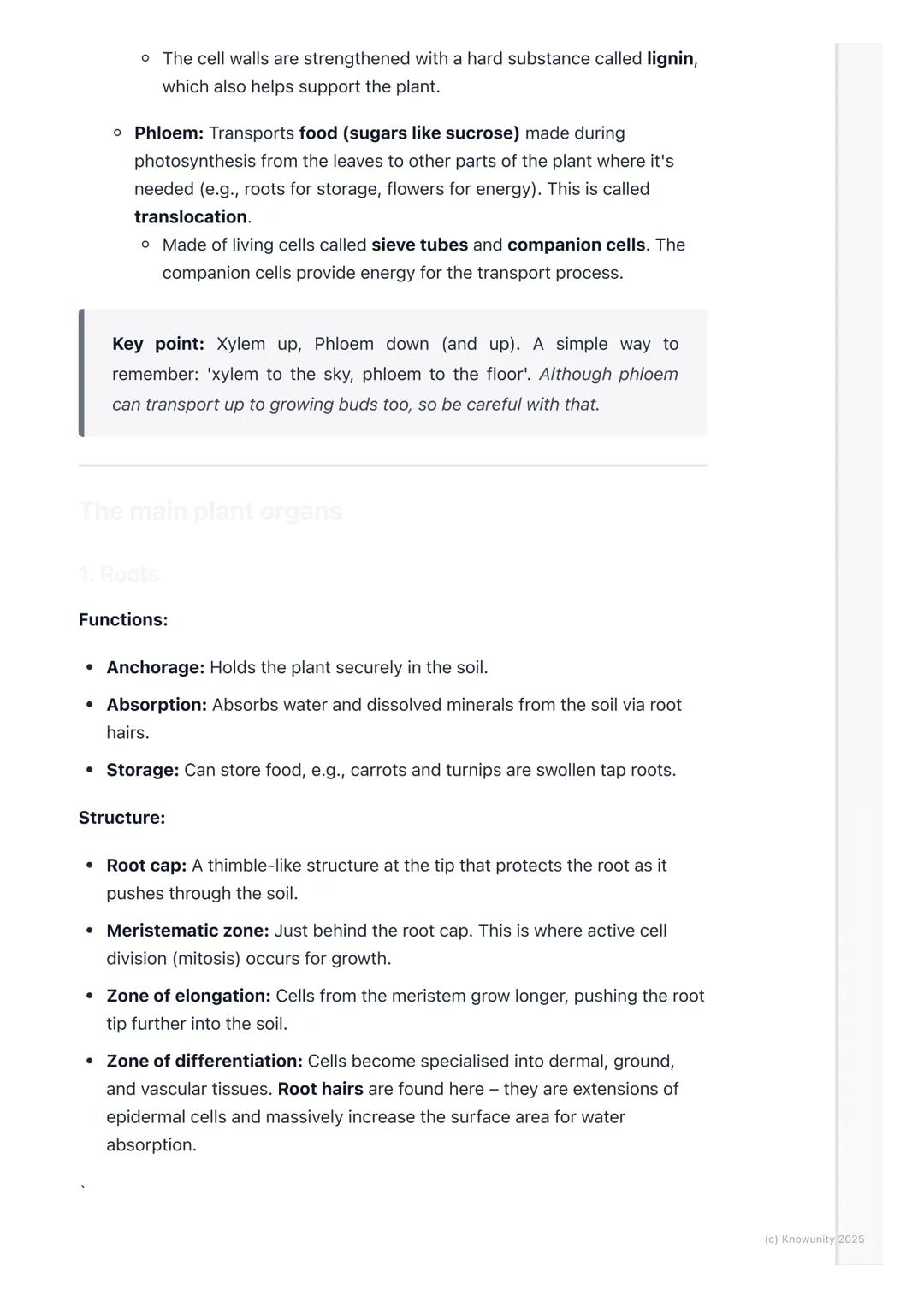
Roots: The Foundation System
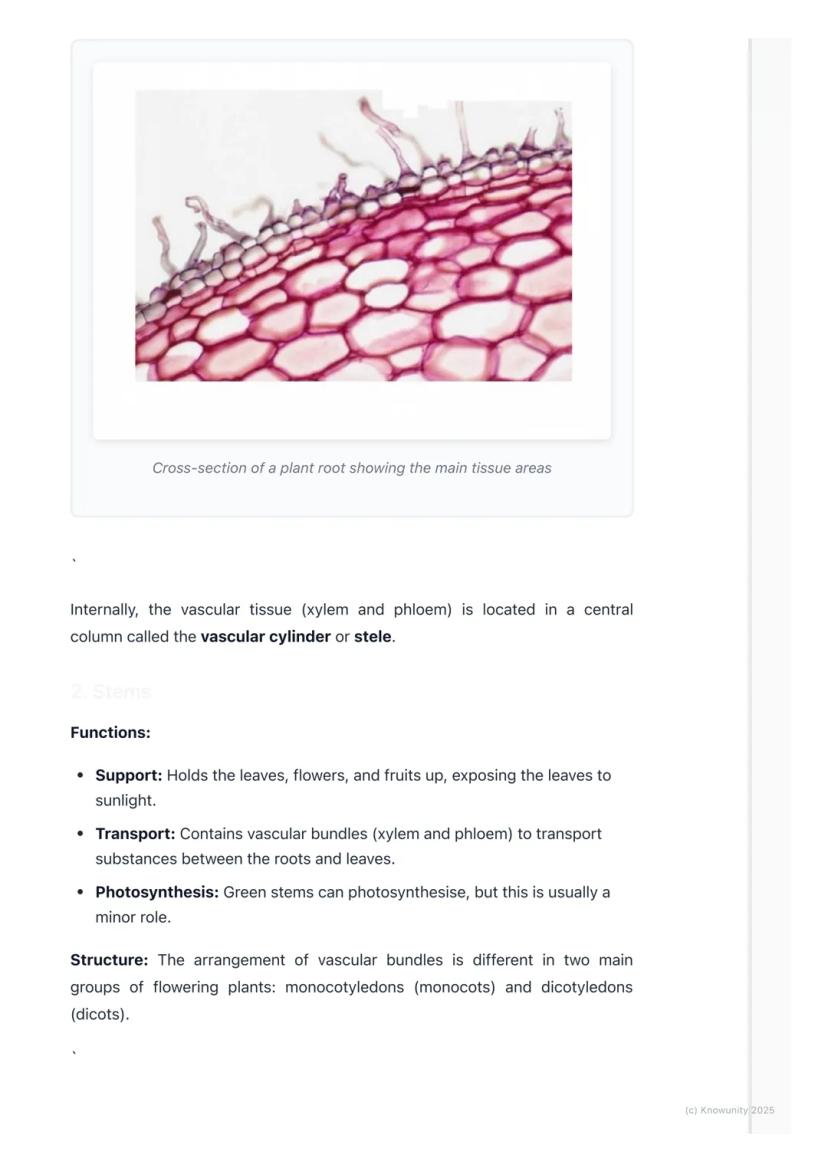
Root structure is all about getting water and staying put. The root cap protects the growing tip as it pushes through soil, whilst the meristematic zone just behind it is where active cell division happens for growth.
The clever bit is the zone of differentiation where cells specialise into different tissues. This is where you'll find root hairs - tiny extensions of skin cells that massively increase surface area for water absorption. Don't get confused - these aren't mini roots, they're single elongated cells!
Inside the root, the vascular cylinder (or stele) contains all the transport tissues in a central column. This arrangement makes perfect sense - water absorbed by root hairs can quickly reach the xylem for transport upward.
Roots have three main jobs that'll definitely appear on your exam: anchorage (holding the plant steady), absorption (taking in water and minerals), and storage (like carrots storing food in swollen tap roots).
Exam tip: Root hairs are single cells, not tiny roots - this distinction often catches students out!
3
of 7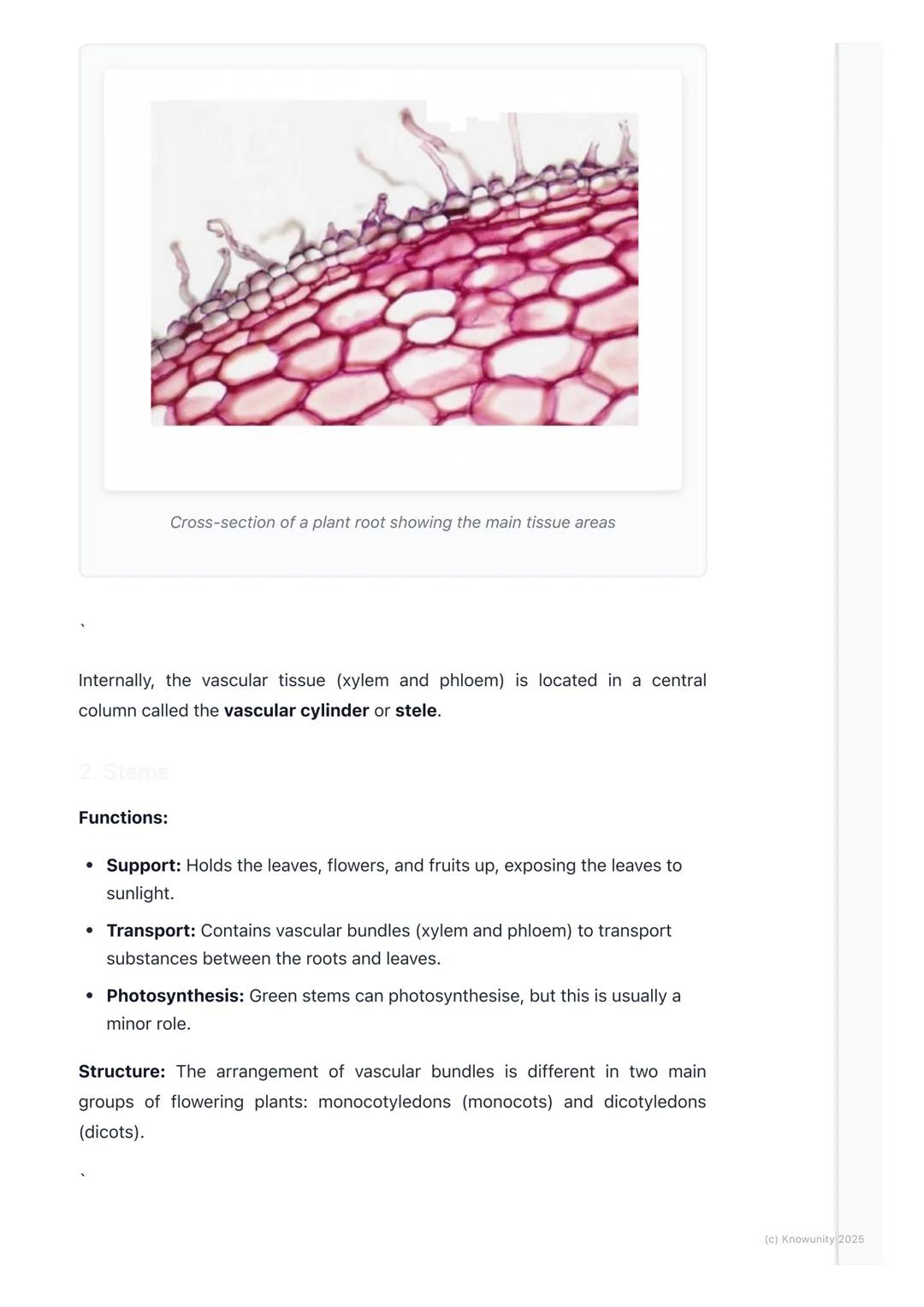
Stems: Support and Transport Central
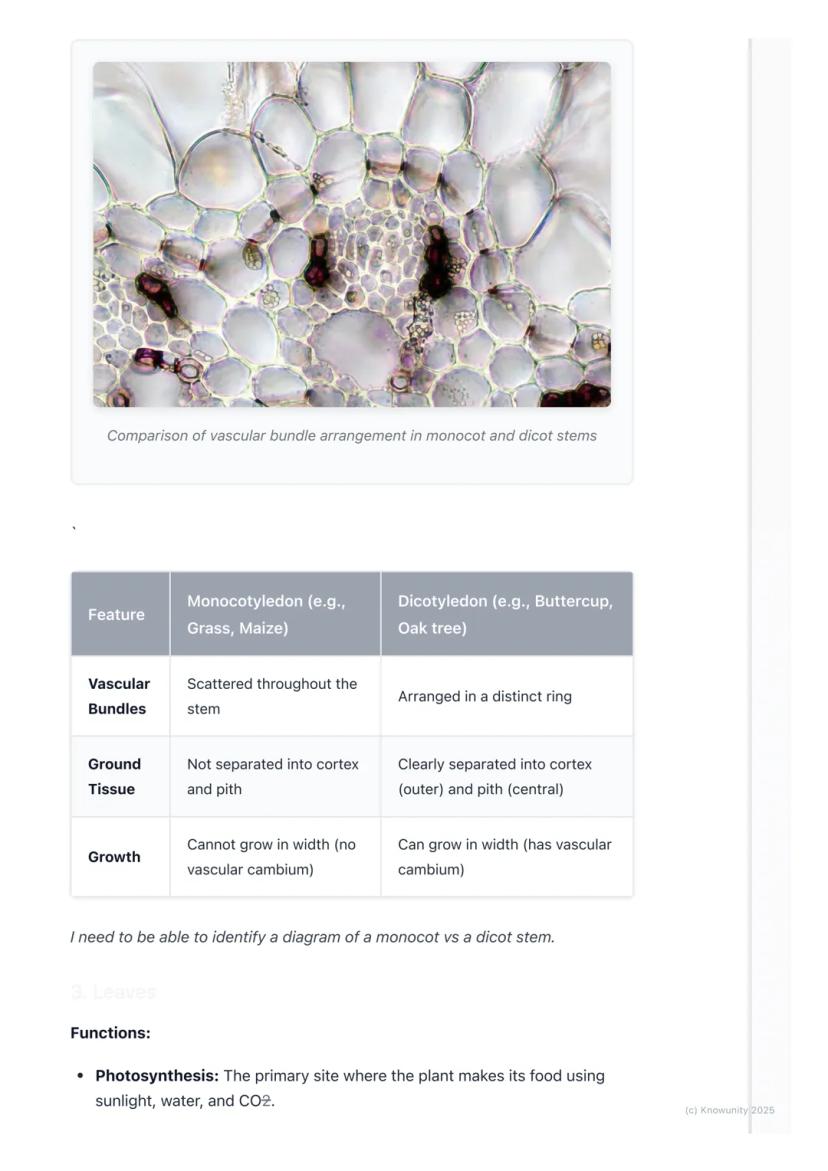
Stem structure varies dramatically between plant types, and you need to spot the difference. Monocotyledons (like grass and maize) scatter their vascular bundles randomly throughout the stem. Dicotyledons (like buttercups and oak trees) arrange them in a neat ring.
This arrangement affects how plants grow. Monocots can't grow wider because they lack vascular cambium - the growth tissue that adds thickness. Dicots can bulk up over time, which is why trees get thicker each year.
The ground tissue organisation also differs between these plant types. Dicots clearly separate their ground tissue into cortex (outer region) and pith (central region), whilst monocots don't make this distinction.
Stems handle three key functions: support (holding leaves up to catch sunlight), transport (moving substances between roots and leaves), and sometimes minor photosynthesis in green stems.
Quick ID: Scattered bundles = monocot, ring arrangement = dicot - learn to recognise these patterns in diagrams!
4
of 7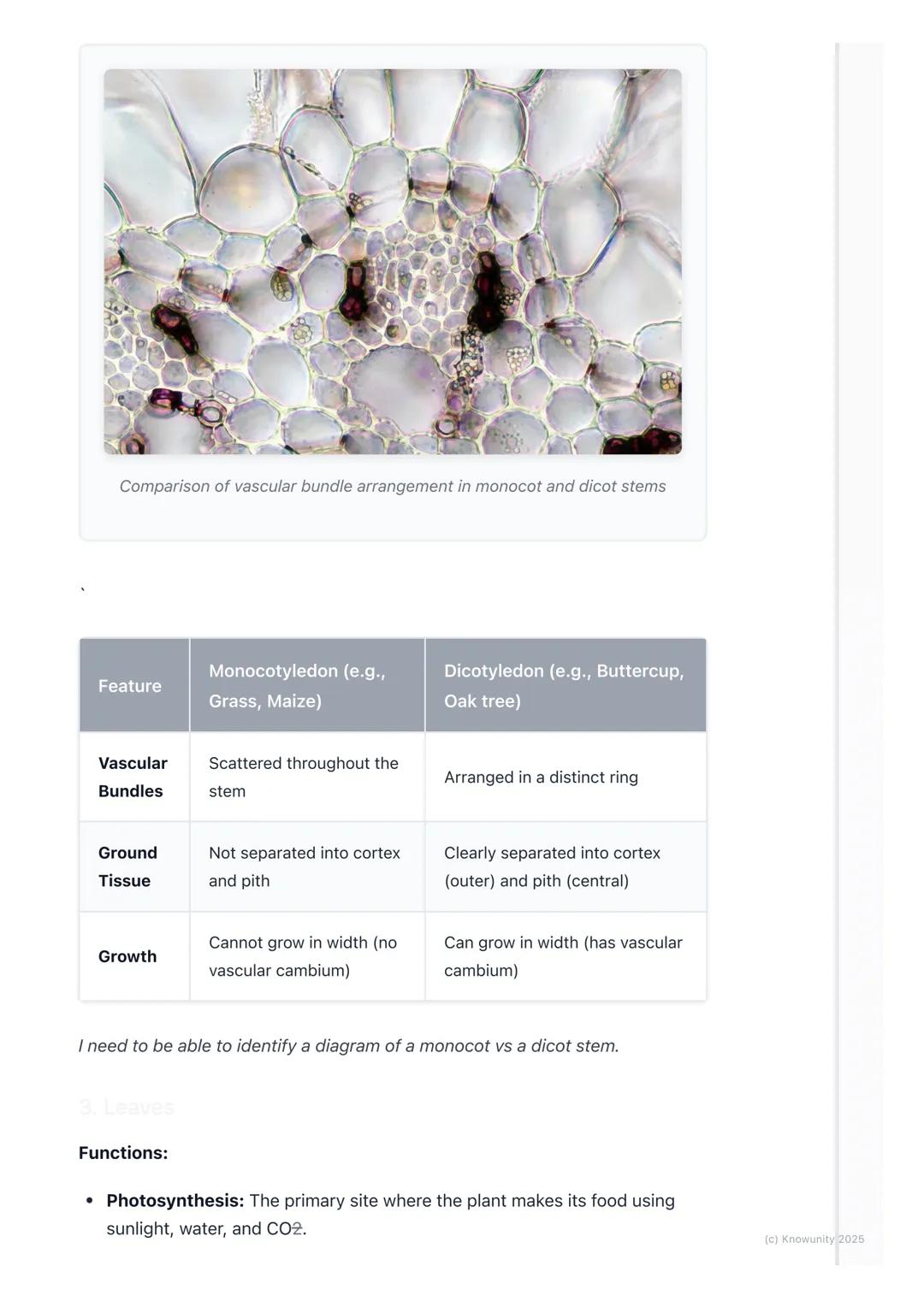
Leaves: The Food Factories
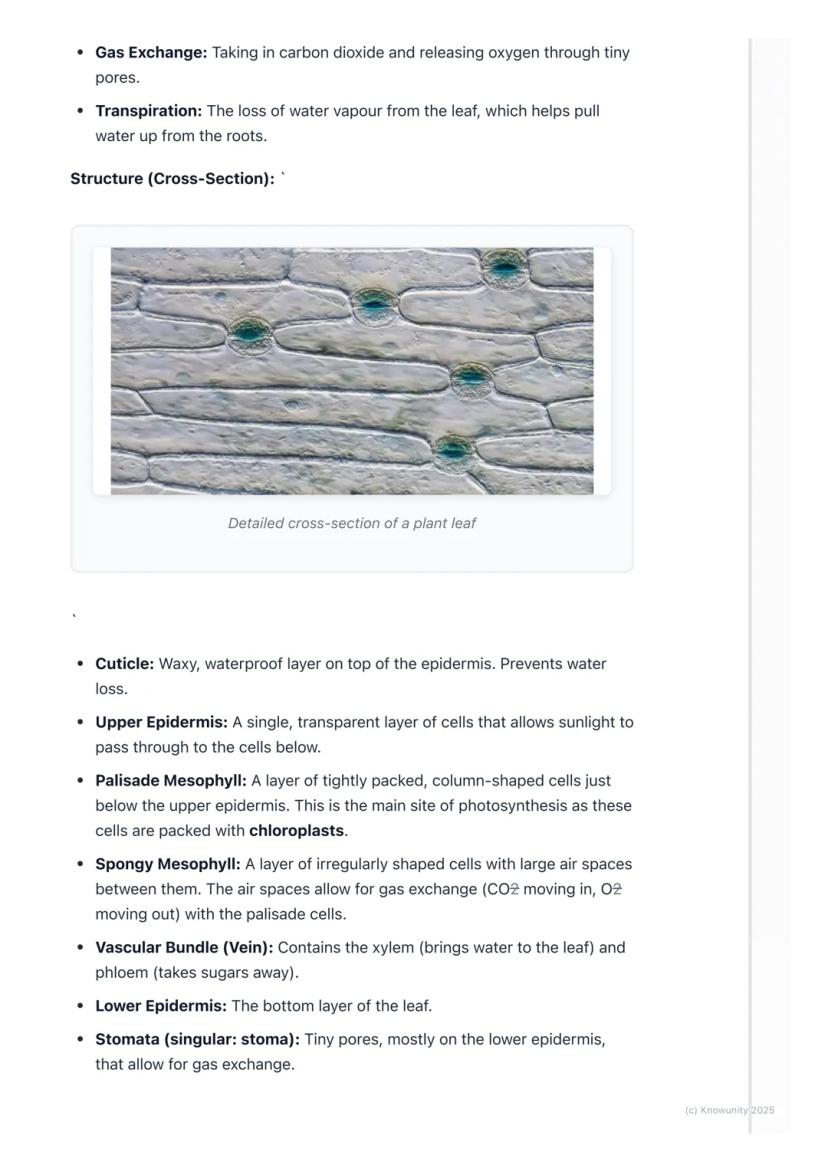
Leaf structure is perfectly designed for photosynthesis, and understanding this will help you nail those "explain the adaptation" questions. The cuticle and upper epidermis let light through whilst preventing water loss.
Palisade mesophyll cells are the photosynthesis superstars - packed with chloroplasts and arranged in tight columns just below the surface to capture maximum sunlight. Below them, spongy mesophyll has a completely different job with its loose arrangement and large air spaces.
Stomata (controlled by guard cells) are tiny pores mainly on the leaf's underside that regulate gas exchange. Carbon dioxide enters here, oxygen exits, and water vapour escapes during transpiration. The vascular bundles (veins) bring water via xylem and remove sugars via phloem.
This whole system works together brilliantly - veins supply raw materials, palisade cells capture light energy, air spaces allow gas movement, and stomata control the whole process.
Exam success: Be able to draw and label a leaf cross-section - this diagram appears frequently and is easy marks if you know it!
5
of 7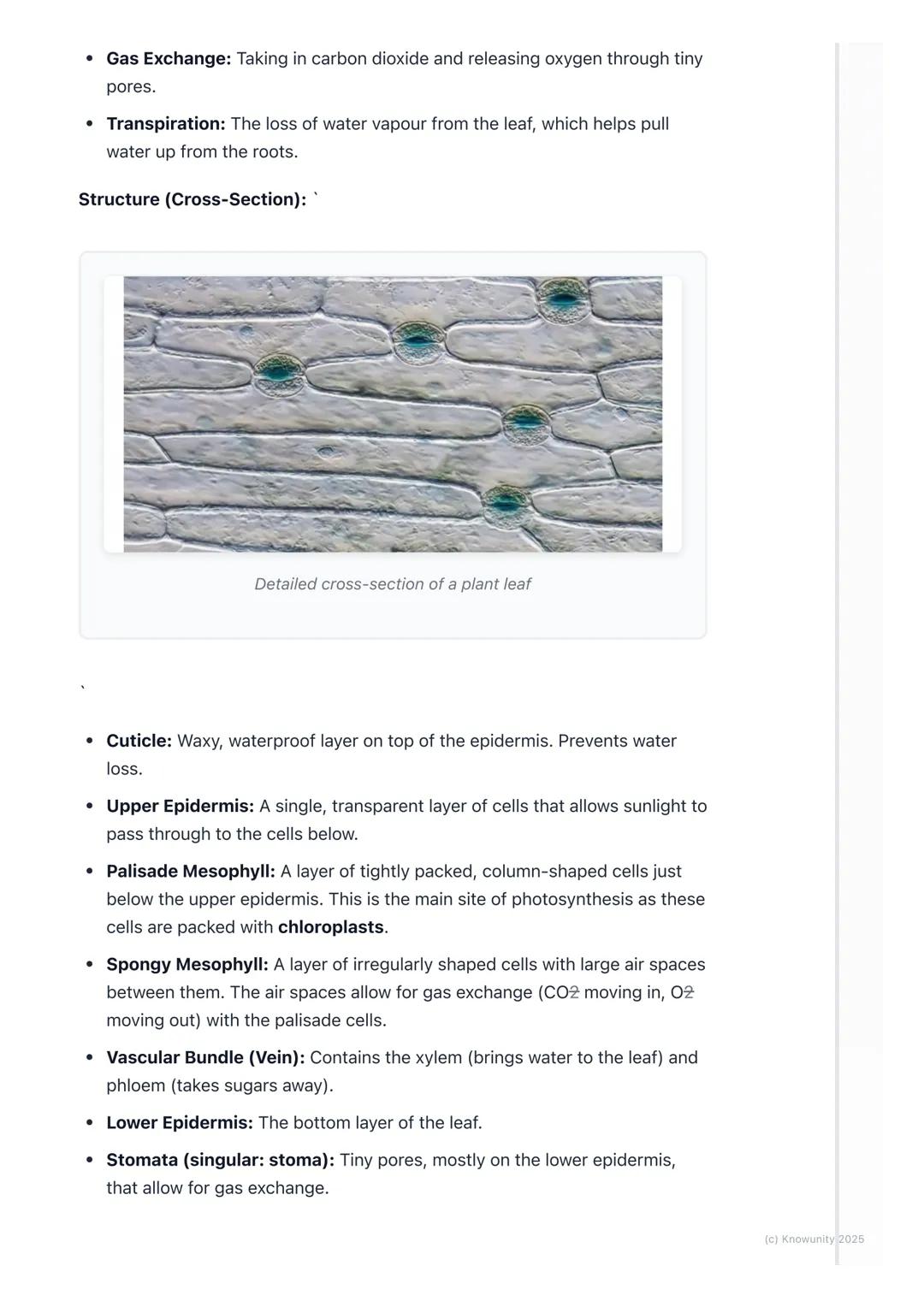
Leaf Adaptations for Photosynthesis
When exam questions ask how leaf structure supports photosynthesis, focus on three key adaptations. Palisade mesophyll structure maximises light capture - these column-shaped cells packed with chloroplasts sit at the top where light is strongest.
The spongy mesophyll and stomata system ensures efficient gas exchange. Those interconnected air spaces create a massive internal surface area, allowing carbon dioxide to diffuse rapidly from stomata to photosynthesising cells.
Vascular bundles spread throughout the leaf maintain the supply chain. Xylem delivers water (a raw material), whilst phloem removes sugars (the products), preventing build-up that could slow the process.
Remember the two transport processes that sound similar but are completely different: transpiration is water loss from leaves, whilst translocation is sugar movement in phloem. Don't mix these up!
Warning: Transpiration ≠ translocation - these sound similar but mean totally different things. Keep them straight!
6
of 7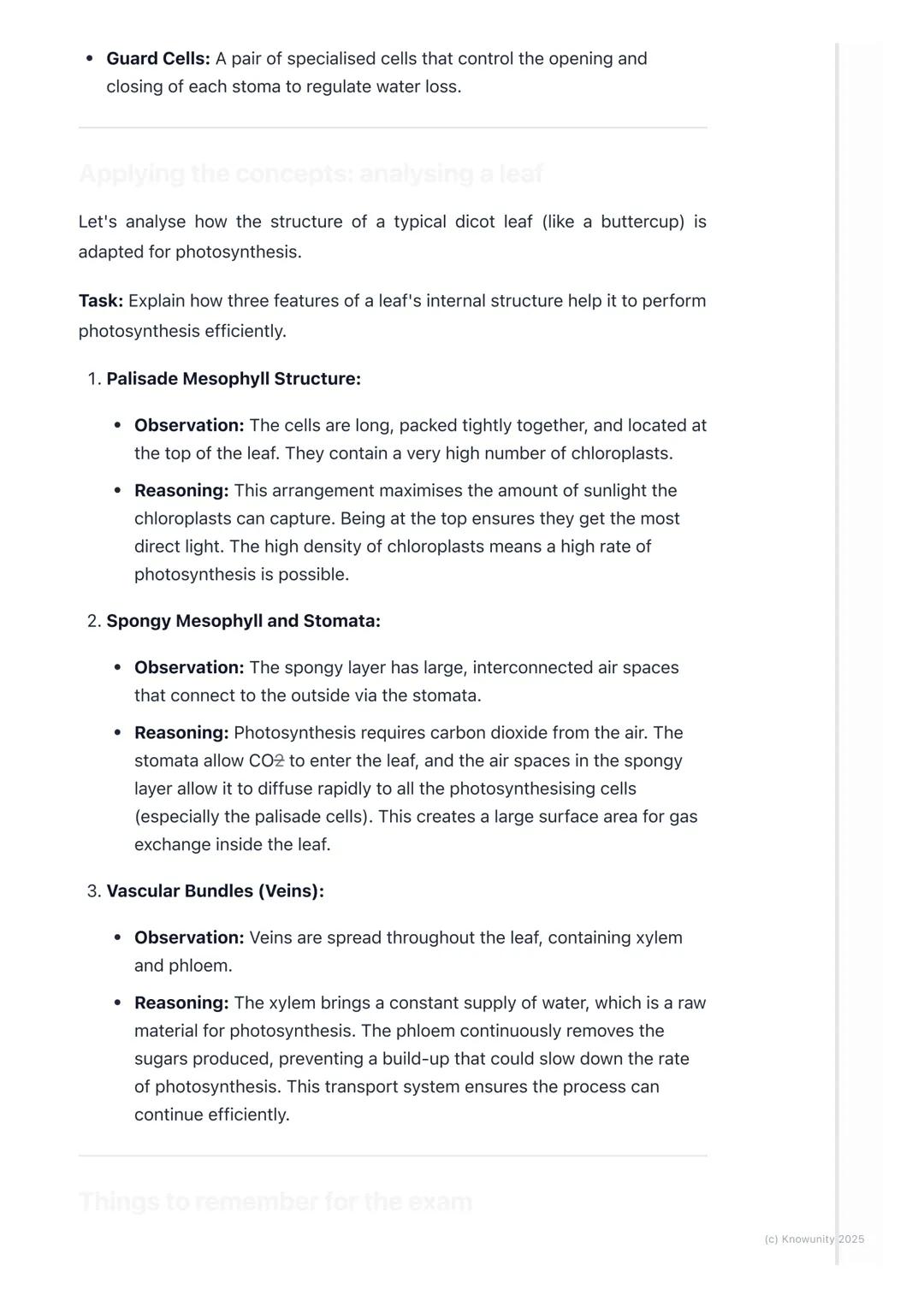
Monocots vs Dicots: Key Differences
Understanding monocot and dicot stem differences is crucial for plant identification. Monocotyledons scatter their vascular bundles randomly throughout the stem cross-section, like dots on a dice.
Dicotyledons arrange their vascular bundles in a clear ring pattern, creating distinct regions. Their ground tissue separates into cortex (outer) and pith (inner), whilst monocots don't make this separation.
The growth implications are significant. Dicots possess vascular cambium tissue that allows width increase over time - this is why trees can grow thicker. Monocots lack this cambium, so they can only grow taller, not wider.
This knowledge helps you identify plant types from stem diagrams and explains why bamboo (a monocot) grows so differently from oak trees (dicots). The structural differences reflect different evolutionary strategies.
Pattern recognition: In diagrams, if you see bundles in a ring, it's a dicot; if they're scattered randomly, it's a monocot!
7
of 7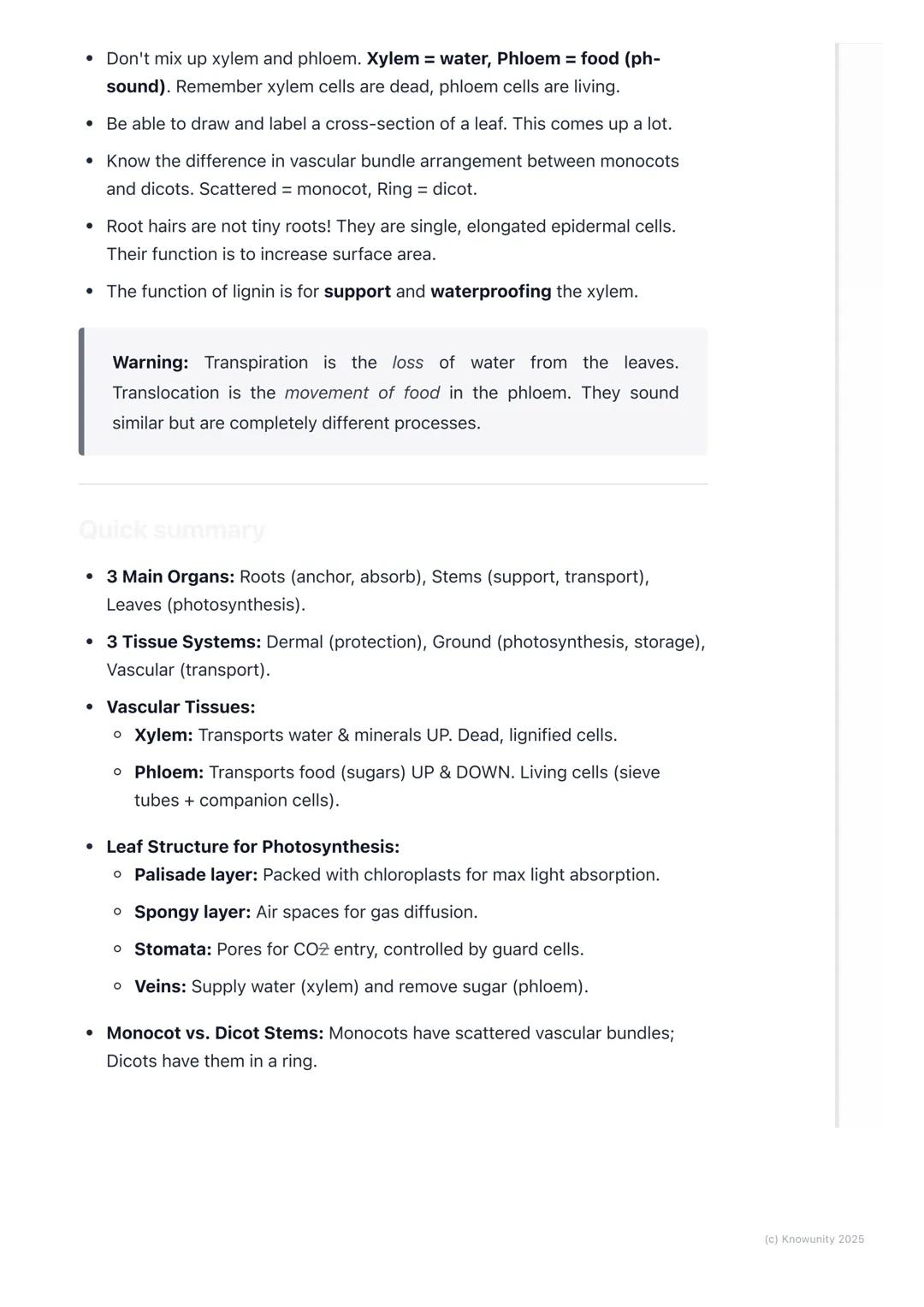
Exam Success Guide
Master these key distinctions to avoid common mistakes. Xylem transports water upward through dead, lignin-strengthened cells, whilst phloem moves sugars through living sieve tubes and companion cells in both directions.
Root hairs are single elongated cells, not tiny roots - they increase surface area for absorption. Lignin strengthens xylem walls and provides structural support to the whole plant.
For leaf diagrams, remember the layers from top to bottom: cuticle, upper epidermis, palisade mesophyll, spongy mesophyll, lower epidermis with stomata and guard cells. The vascular bundles (veins) run through the middle layers.
Plant organisation follows a logical pattern: three main organs (roots, stems, leaves), three tissue systems (dermal, ground, vascular), and two transport tissues (xylem up, phloem both ways). Understanding this hierarchy will help you tackle any plant structure question confidently.
Final tip: Practice drawing leaf cross-sections until you can do them from memory - it's guaranteed easy marks on your exam!
Νομίζαμε ότι δε θα ρωτούσες ποτέ...
Τι είναι ο AI σύντροφος του Knowunity;
Ο AI σύντροφός μας είναι ειδικά σχεδιασμένος για τις ανάγκες των μαθητών. Βασισμένοι στα εκατομμύρια κομμάτια Περιεχομένων που έχουμε στην πλατφόρμα, μπορούμε να παρέχουμε πραγματικά ουσιαστικές και σχετικές απαντήσεις στους μαθητές. Αλλά δεν αφορά μόνο τις απαντήσεις, ο σύντροφος είναι ακόμη περισσότερο για την καθοδήγηση των μαθητών στις καθημερινές τους μαθησιακές προκλήσεις, με εξατομικευμένα προγράμματα μελέτης, κουίζ ή Περιεχόμενα στη Συνομιλία και 100% εξατομίκευση βασισμένη στις δεξιότητες και την ανάπτυξη των μαθητών.
Πού μπορώ να κατεβάσω την εφαρμογή Knowunity;
Μπορείτε να κατεβάσετε την εφαρμογή από το Google Play Store και το Apple App Store.
Πώς μπορώ να λάβω την πληρωμή μου; Πόσα μπορώ να κερδίσω;
Ναι, έχετε δωρεάν πρόσβαση στο περιεχόμενο της εφαρμογής και στον AI companion μας. Για να ξεκλειδώσετε ορισμένες λειτουργίες της εφαρμογής, μπορείτε να αγοράσετε το Knowunity Pro.
Πιο δημοφιλή περιεχόμενα στο Biology
8BiologyEcology introduction notes!
Start of the leaving cert ecology chapter
6th Year131
BiologyDNA & RNA
All notes on DNA & RNA including protein synthesis which is a HL topic
5th Year250
BiologyVertebrates and Invertebrates
Students will distinguish between animals that have a backbone (vertebrates) and those that do not (invertebrates), identifying examples of each.
2nd Year240
BiologyBiomolecules: chapter 8
Summary and easily understandable notes to revise chapter 8 biomolecules. Includes good labelled diagrams for visual learners
5th Year210
BiologyCirculatory System
Students will learn about the heart, blood, and blood vessels, and how this system transports oxygen, nutrients, and waste products around the body.
3rd Year140
BiologyRespiration
All respiration notes including simple diagrams and glycolysis and the Krebs cycle
5th Year120
BiologyPhotosynthesis : Biology
Photosynthesis
6th Year371
BiologyPlant Cells
Learning about the unique structures found in plant cells, such as the cell wall, chloroplasts, and large vacuole, and how they differ from animal cells.
1st Year80
Πιο δημοφιλή περιεχόμενα
9 Irish
IrishIrish oral questions and answers
Questions and answers for the leaving cert oral
5th Year4264
 English
Key Quotes : Sive
Key Quotes and explanations: Sive
6th Year2842
IrishIrish oral questions
Outline of oral questions
5th Year2055
IrishIníon- le hÁine Durkin
Aine Durkin’s poem, Iníon: Themes & summary
5th Year890
IrishIrish poetry 2027
Iníon + Dínit an Bhróin
5th Year1153
IrishLC HL notes- Iníon (poem)
Includes poem in English and Irish, theme, key words & phrases
5th Year2304
EnglishCultural Context : Shawshank Redemption : Sive : Small Things Like These
Comparative Study : Cultural Context : Shawshank Redemption, Sive and Small Things Like These
6th Year1430
IrishMo Ghrá-sa (Idir Lúibíní)
Notes on mo ghrá-sa
5th Year380
IrishAn Gaeilge Aiste
Irish Language essay
6th Year1320
Δε μπορείς να βρεις αυτό που ψάχνεις; Εξερεύνησε άλλα μαθήματα.
Κριτικές από τους χρήστες μας. Έχουν όλα τα καλά — και το ίδιο θα είχες κι εσύ.
4.6/5App Store
4.7/5Google Play
Η εφαρμογή είναι πολύ εύκολη στη χρήση και καλά σχεδιασμένη. Έχω βρει ό,τι έψαχνα μέχρι τώρα και έχω μάθει πολλά από τις παρουσιάσεις! Σίγουρα θα χρησιμοποιήσω την εφαρμογή για μια εργασία του μαθήματος! Και φυσικά βοηθάει πολύ και ως έμπνευση.
Στέφαν Σχρήστης iOS
Αυτή η εφαρμογή είναι πραγματικά τέλεια. Υπάρχουν τόσες πολλές σημειώσεις μελέτης και βοήθεια [...]. Το μάθημα που με δυσκολεύει είναι τα Γαλλικά, για παράδειγμα, και η εφαρμογή έχει τόσες επιλογές για βοήθεια. Χάρη σε αυτή την εφαρμογή, έχω βελτιώσει τα Γαλλικά μου. Θα την πρότεινα σε οποιονδήποτε.
Σαμάνθα Κλιχχρήστης Android
Ουάου, είμαι πραγματικά εντυπωσιασμένος. Δοκίμασα την εφαρμογή επειδή την είδα διαφημισμένη πολλές φορές και έμεινα άφωνος. Αυτή η εφαρμογή είναι Η ΒΟΗΘΕΙΑ που χρειάζεσαι για το σχολείο και πάνω απ' όλα, προσφέρει τόσα πράγματα, όπως ασκήσεις και φύλλα γεγονότων, που ήταν ΠΟΛΥ χρήσιμα για μένα προσωπικά.
Άνναχρήστης iOS
Biology6 προβολές·Ενημερώθηκε Jun 19, 2026·7 σελίδεςUnderstanding Plant Structures and Functions
Ever wondered how plants are organised to survive and thrive? Just like humans have organs that do specific jobs, plants have three main organs - roots, stems, and leaves - that work together brilliantly. Understanding how these are structured will...
1
of 7
Κάνε εγγραφή για να δεις το ΠΕΡΙΕΧΟΜΕΝΟ. Είναι δωρεάν!
- Πρόσβαση σε όλα τα έγγραφα
- Βελτίωσε τους βαθμούς σου
- Γίνε μέλος με εκατομμύρια μαθητές
Plant Organisation Basics
Think of plants as multicellular organisms with a smart three-part structure. The roots anchor and absorb, stems support and transport, whilst leaves make food through photosynthesis.
Every plant organ contains three main tissue systems working together. Dermal tissue acts like the plant's skin - it's the protective outer layer that prevents water loss and, in roots, absorbs water through root hairs. Ground tissue fills the middle spaces and handles photosynthesis in leaves or storage in stems and roots (think potato starch). Vascular tissue is the plant's transport system, bundled into veins that carry substances around.
The vascular system has two parts you need to master. Xylem transports water and minerals upward from roots - these are dead, hollow cells strengthened with lignin for support. Phloem moves food (sugars) both up and down the plant through living cells called sieve tubes and companion cells.
Memory trick: "Xylem to the sky, phloem to the floor" - though remember phloem can actually go both ways!
2
of 7Κάνε εγγραφή για να δεις το ΠΕΡΙΕΧΟΜΕΝΟ. Είναι δωρεάν!
- Πρόσβαση σε όλα τα έγγραφα
- Βελτίωσε τους βαθμούς σου
- Γίνε μέλος με εκατομμύρια μαθητές
Roots: The Foundation System
Root structure is all about getting water and staying put. The root cap protects the growing tip as it pushes through soil, whilst the meristematic zone just behind it is where active cell division happens for growth.
The clever bit is the zone of differentiation where cells specialise into different tissues. This is where you'll find root hairs - tiny extensions of skin cells that massively increase surface area for water absorption. Don't get confused - these aren't mini roots, they're single elongated cells!
Inside the root, the vascular cylinder (or stele) contains all the transport tissues in a central column. This arrangement makes perfect sense - water absorbed by root hairs can quickly reach the xylem for transport upward.
Roots have three main jobs that'll definitely appear on your exam: anchorage (holding the plant steady), absorption (taking in water and minerals), and storage (like carrots storing food in swollen tap roots).
Exam tip: Root hairs are single cells, not tiny roots - this distinction often catches students out!
3
of 7Κάνε εγγραφή για να δεις το ΠΕΡΙΕΧΟΜΕΝΟ. Είναι δωρεάν!
- Πρόσβαση σε όλα τα έγγραφα
- Βελτίωσε τους βαθμούς σου
- Γίνε μέλος με εκατομμύρια μαθητές
Stems: Support and Transport Central
Stem structure varies dramatically between plant types, and you need to spot the difference. Monocotyledons (like grass and maize) scatter their vascular bundles randomly throughout the stem. Dicotyledons (like buttercups and oak trees) arrange them in a neat ring.
This arrangement affects how plants grow. Monocots can't grow wider because they lack vascular cambium - the growth tissue that adds thickness. Dicots can bulk up over time, which is why trees get thicker each year.
The ground tissue organisation also differs between these plant types. Dicots clearly separate their ground tissue into cortex (outer region) and pith (central region), whilst monocots don't make this distinction.
Stems handle three key functions: support (holding leaves up to catch sunlight), transport (moving substances between roots and leaves), and sometimes minor photosynthesis in green stems.
Quick ID: Scattered bundles = monocot, ring arrangement = dicot - learn to recognise these patterns in diagrams!
4
of 7Κάνε εγγραφή για να δεις το ΠΕΡΙΕΧΟΜΕΝΟ. Είναι δωρεάν!
- Πρόσβαση σε όλα τα έγγραφα
- Βελτίωσε τους βαθμούς σου
- Γίνε μέλος με εκατομμύρια μαθητές
Leaves: The Food Factories
Leaf structure is perfectly designed for photosynthesis, and understanding this will help you nail those "explain the adaptation" questions. The cuticle and upper epidermis let light through whilst preventing water loss.
Palisade mesophyll cells are the photosynthesis superstars - packed with chloroplasts and arranged in tight columns just below the surface to capture maximum sunlight. Below them, spongy mesophyll has a completely different job with its loose arrangement and large air spaces.
Stomata (controlled by guard cells) are tiny pores mainly on the leaf's underside that regulate gas exchange. Carbon dioxide enters here, oxygen exits, and water vapour escapes during transpiration. The vascular bundles (veins) bring water via xylem and remove sugars via phloem.
This whole system works together brilliantly - veins supply raw materials, palisade cells capture light energy, air spaces allow gas movement, and stomata control the whole process.
Exam success: Be able to draw and label a leaf cross-section - this diagram appears frequently and is easy marks if you know it!
5
of 7Κάνε εγγραφή για να δεις το ΠΕΡΙΕΧΟΜΕΝΟ. Είναι δωρεάν!
- Πρόσβαση σε όλα τα έγγραφα
- Βελτίωσε τους βαθμούς σου
- Γίνε μέλος με εκατομμύρια μαθητές
Leaf Adaptations for Photosynthesis
When exam questions ask how leaf structure supports photosynthesis, focus on three key adaptations. Palisade mesophyll structure maximises light capture - these column-shaped cells packed with chloroplasts sit at the top where light is strongest.
The spongy mesophyll and stomata system ensures efficient gas exchange. Those interconnected air spaces create a massive internal surface area, allowing carbon dioxide to diffuse rapidly from stomata to photosynthesising cells.
Vascular bundles spread throughout the leaf maintain the supply chain. Xylem delivers water (a raw material), whilst phloem removes sugars (the products), preventing build-up that could slow the process.
Remember the two transport processes that sound similar but are completely different: transpiration is water loss from leaves, whilst translocation is sugar movement in phloem. Don't mix these up!
Warning: Transpiration ≠ translocation - these sound similar but mean totally different things. Keep them straight!
6
of 7Κάνε εγγραφή για να δεις το ΠΕΡΙΕΧΟΜΕΝΟ. Είναι δωρεάν!
- Πρόσβαση σε όλα τα έγγραφα
- Βελτίωσε τους βαθμούς σου
- Γίνε μέλος με εκατομμύρια μαθητές
Monocots vs Dicots: Key Differences
Understanding monocot and dicot stem differences is crucial for plant identification. Monocotyledons scatter their vascular bundles randomly throughout the stem cross-section, like dots on a dice.
Dicotyledons arrange their vascular bundles in a clear ring pattern, creating distinct regions. Their ground tissue separates into cortex (outer) and pith (inner), whilst monocots don't make this separation.
The growth implications are significant. Dicots possess vascular cambium tissue that allows width increase over time - this is why trees can grow thicker. Monocots lack this cambium, so they can only grow taller, not wider.
This knowledge helps you identify plant types from stem diagrams and explains why bamboo (a monocot) grows so differently from oak trees (dicots). The structural differences reflect different evolutionary strategies.
Pattern recognition: In diagrams, if you see bundles in a ring, it's a dicot; if they're scattered randomly, it's a monocot!
7
of 7Κάνε εγγραφή για να δεις το ΠΕΡΙΕΧΟΜΕΝΟ. Είναι δωρεάν!
- Πρόσβαση σε όλα τα έγγραφα
- Βελτίωσε τους βαθμούς σου
- Γίνε μέλος με εκατομμύρια μαθητές
Exam Success Guide
Master these key distinctions to avoid common mistakes. Xylem transports water upward through dead, lignin-strengthened cells, whilst phloem moves sugars through living sieve tubes and companion cells in both directions.
Root hairs are single elongated cells, not tiny roots - they increase surface area for absorption. Lignin strengthens xylem walls and provides structural support to the whole plant.
For leaf diagrams, remember the layers from top to bottom: cuticle, upper epidermis, palisade mesophyll, spongy mesophyll, lower epidermis with stomata and guard cells. The vascular bundles (veins) run through the middle layers.
Plant organisation follows a logical pattern: three main organs (roots, stems, leaves), three tissue systems (dermal, ground, vascular), and two transport tissues (xylem up, phloem both ways). Understanding this hierarchy will help you tackle any plant structure question confidently.
Final tip: Practice drawing leaf cross-sections until you can do them from memory - it's guaranteed easy marks on your exam!
Νομίζαμε ότι δε θα ρωτούσες ποτέ...
Τι είναι ο AI σύντροφος του Knowunity;
Ο AI σύντροφός μας είναι ειδικά σχεδιασμένος για τις ανάγκες των μαθητών. Βασισμένοι στα εκατομμύρια κομμάτια Περιεχομένων που έχουμε στην πλατφόρμα, μπορούμε να παρέχουμε πραγματικά ουσιαστικές και σχετικές απαντήσεις στους μαθητές. Αλλά δεν αφορά μόνο τις απαντήσεις, ο σύντροφος είναι ακόμη περισσότερο για την καθοδήγηση των μαθητών στις καθημερινές τους μαθησιακές προκλήσεις, με εξατομικευμένα προγράμματα μελέτης, κουίζ ή Περιεχόμενα στη Συνομιλία και 100% εξατομίκευση βασισμένη στις δεξιότητες και την ανάπτυξη των μαθητών.
Πού μπορώ να κατεβάσω την εφαρμογή Knowunity;
Μπορείτε να κατεβάσετε την εφαρμογή από το Google Play Store και το Apple App Store.
Πώς μπορώ να λάβω την πληρωμή μου; Πόσα μπορώ να κερδίσω;
Ναι, έχετε δωρεάν πρόσβαση στο περιεχόμενο της εφαρμογής και στον AI companion μας. Για να ξεκλειδώσετε ορισμένες λειτουργίες της εφαρμογής, μπορείτε να αγοράσετε το Knowunity Pro.
Πιο δημοφιλή περιεχόμενα στο Biology
8BiologyEcology introduction notes!
Start of the leaving cert ecology chapter
6th Year131
BiologyDNA & RNA
All notes on DNA & RNA including protein synthesis which is a HL topic
5th Year250
BiologyVertebrates and Invertebrates
Students will distinguish between animals that have a backbone (vertebrates) and those that do not (invertebrates), identifying examples of each.
2nd Year240
BiologyBiomolecules: chapter 8
Summary and easily understandable notes to revise chapter 8 biomolecules. Includes good labelled diagrams for visual learners
5th Year210
BiologyCirculatory System
Students will learn about the heart, blood, and blood vessels, and how this system transports oxygen, nutrients, and waste products around the body.
3rd Year140
BiologyRespiration
All respiration notes including simple diagrams and glycolysis and the Krebs cycle
5th Year120
BiologyPhotosynthesis : Biology
Photosynthesis
6th Year371
BiologyPlant Cells
Learning about the unique structures found in plant cells, such as the cell wall, chloroplasts, and large vacuole, and how they differ from animal cells.
1st Year80
Πιο δημοφιλή περιεχόμενα
9IrishIrish oral questions and answers
Questions and answers for the leaving cert oral
5th Year4264
EnglishKey Quotes : Sive
Key Quotes and explanations: Sive
6th Year2842
IrishIrish oral questions
Outline of oral questions
5th Year2055
IrishIníon- le hÁine Durkin
Aine Durkin’s poem, Iníon: Themes & summary
5th Year890
IrishIrish poetry 2027
Iníon + Dínit an Bhróin
5th Year1153
IrishLC HL notes- Iníon (poem)
Includes poem in English and Irish, theme, key words & phrases
5th Year2304
EnglishCultural Context : Shawshank Redemption : Sive : Small Things Like These
Comparative Study : Cultural Context : Shawshank Redemption, Sive and Small Things Like These
6th Year1430
IrishMo Ghrá-sa (Idir Lúibíní)
Notes on mo ghrá-sa
5th Year380
IrishAn Gaeilge Aiste
Irish Language essay
6th Year1320
Δε μπορείς να βρεις αυτό που ψάχνεις; Εξερεύνησε άλλα μαθήματα.
Κριτικές από τους χρήστες μας. Έχουν όλα τα καλά — και το ίδιο θα είχες κι εσύ.
4.6/5App Store
4.7/5Google Play
Η εφαρμογή είναι πολύ εύκολη στη χρήση και καλά σχεδιασμένη. Έχω βρει ό,τι έψαχνα μέχρι τώρα και έχω μάθει πολλά από τις παρουσιάσεις! Σίγουρα θα χρησιμοποιήσω την εφαρμογή για μια εργασία του μαθήματος! Και φυσικά βοηθάει πολύ και ως έμπνευση.
Στέφαν Σχρήστης iOS
Αυτή η εφαρμογή είναι πραγματικά τέλεια. Υπάρχουν τόσες πολλές σημειώσεις μελέτης και βοήθεια [...]. Το μάθημα που με δυσκολεύει είναι τα Γαλλικά, για παράδειγμα, και η εφαρμογή έχει τόσες επιλογές για βοήθεια. Χάρη σε αυτή την εφαρμογή, έχω βελτιώσει τα Γαλλικά μου. Θα την πρότεινα σε οποιονδήποτε.
Σαμάνθα Κλιχχρήστης Android
Ουάου, είμαι πραγματικά εντυπωσιασμένος. Δοκίμασα την εφαρμογή επειδή την είδα διαφημισμένη πολλές φορές και έμεινα άφωνος. Αυτή η εφαρμογή είναι Η ΒΟΗΘΕΙΑ που χρειάζεσαι για το σχολείο και πάνω απ' όλα, προσφέρει τόσα πράγματα, όπως ασκήσεις και φύλλα γεγονότων, που ήταν ΠΟΛΥ χρήσιμα για μένα προσωπικά.
Άνναχρήστης iOS